


Skip to content

4 steps to make your own didgeridoo beeswax mouthpiece

beeswax

At a time when wooden mouthpieces are becoming the norm, it is still good to know how to redo your beeswax mouthpiece!
Because this one will have to be renewed regularly. Fortunately, shaping your mouthpiece with beeswax is quite simple.

There are several reasons to change its mouthpiece, and of all, hygiene is certainly the first. Indeed, when you buy an instrument, the mouthpiece has certainly welcomed dozens of players before you… Not very gusty isn’t it?!? As for those who bought their didgeridoo long ago, there are many risks that it is eventually getting old and dirty.

First step: get beeswax for your didgeridoo!

In a beekeeper’s market, in a drugstore, beeswax is everywhere. If you are in a big city, you should be able to find a honey shop. Of solid consistency, it is sold in block or honeycomb sheet, its price is cheap. With a few euros, you can make dozens of mouthpieces. Be careful not to confuse it with pasty beeswax which is intended to maintain your furniture. I remember that at the beginning I had this error… After having a lot of difficulty to make my mouthpiece (because the wax had no outfit), I had been surprised by noticing that it had still not dried after 24 hours! I could have waited months if a friend hadn’t put me on track! Aaahh the joy of the beginning. ?
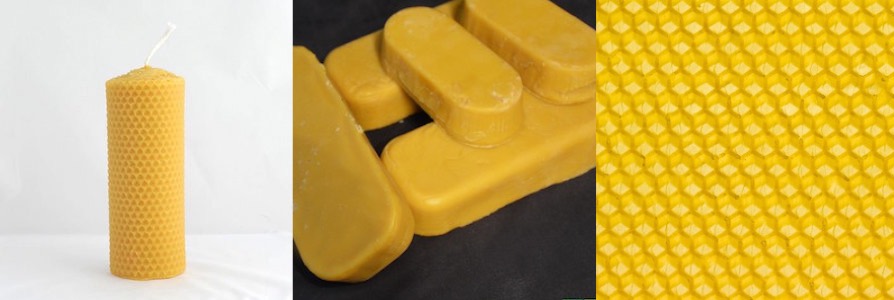
Bread wax 500 grams. / Rolled honeycomb wax to make a candle / Alveolate wax plate

Second step: softening beeswax

Soften a piece of wax (about a 4cm x 4cm x 1cm rectangle) and let it become soft and malleable. You have several solutions to achieve this result:

  • in the sun … if it’s summer or you’re in Australia!
  • In the oven at a very, very soft temperature …
  • in the microwave,
  • with a hair dryer,
  • or any other heat source.

Step Three: Shape a Ring from your didgeridoo size
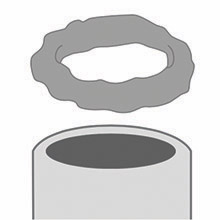
Pattern of beeswax coming on the didgeridoo
Once the wax is softened, model it into a coil, then a ring the diameter of your didgeridoo. Once the diameter is adapted, melt slightly the part that will be in contact with your didgeridoo in order to stick it well to the didgeridoo. Place it quickly on the instrument with sufficient pressure to seal it securely.

Fourth step: adapt the shape to your didgeridoo
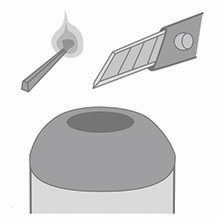
diagram of the match and the cutter to shape beeswax
For finishes, heat a blade (knife or cuter that fears nothing) and remove excess wax. The purpose of this is to remove the wax that would interfere with your nose and make it flat to put your lips as tightly as possible. A mouth full of curls is a real air leak nest!

And here’s your mouthpiece which is now finished! It’s no more complicated than that. ?

I hope these few steps will help you to redo your mouthpiece! If you have any questions or comments, please feel free to post them at the bottom of this page. Good breath with a brand new mouthpiece!

And if you want to go further, I wrote a didgeridoo method that gives all the basics (read more: How to play your first rhythms on the didgeridoo ).

A big thank you to Stephane Bouillet for the illustrations.

Buying guide

Choose your didgeridoo

Being enthusiastic is one thing, but you still need to know what to start on! Follow the guide, I’ve cleared the path for you.

  • To get started: budget, note, pitfalls to avoid
  • To move up a level: my selection
Read the guide

5/5225 Google reviews

9952members

Read next

8 responses to “4 steps to make your own didgeridoo beeswax mouthpiece”

  1. karin.molho Avatar
    karin.molho

    Hello, do I need to put beeswax on a travel didgeridoo? Thank you

    Automatically translated from French · See the original

    Bonjour faut-il mettre de la cire sur didgeridoo de voyage ? Merci

    1. Gauthier Aubé Avatar
      Gauthier Aubé

      Hi Karin, if you’re talking about the Travel Didgeridoo (this one), then no, there’s no need to make a beeswax mouthpiece. The Travel Didge already has a rubber mouthpiece with a 30mm opening, which is perfect for playing.

      Automatically translated from French · See the original

      Bonjour Karin,
      si tu parles (je me permets le tutoiement) du Travel Didgeridoo (celui-ci), alors non, ça n’est pas la peine de faire une embouchure en cire. Le Travel Didge a déjà une embouchure en caoutchouc avec une ouverture de 30mm, ce qui est parfait pour souffler.

  2. So for the shape, it really depends on what you’re looking for, but generally speaking the wider your didgeridoo is, the higher your mouthpiece will be. 50 mm is already a good diameter, so I’d say your mouthpiece should be about 3 cm tall. That’s just to free up your nose when you play (so it doesn’t hit your didge).

    As for the rounded or protruding side, I like when the flat of the mouthpiece is nice and regular and not too protruding. But that’s really something you need to test to see what works for you. That said, don’t make too thin a mouthpiece, because the issue won’t be its fragility but rather that it might melt and not hold up when you play for long periods.

    And don’t take too long to change the beeswax either because it’s said that regular contact with it is carcinogenic… Some people got pimples around their mouth from playing with this type of mouthpiece… It’s a hydrocarbon derivative, really really not good for your health…

    Automatically translated from French · See the original

    Alors pour la forme, tout dépend de ce que tu recherches, mais globalement plus ton didgeridoo sera large plus l’embouchure sera haute. 50 mm ça commence à faire un bon diamètre, donc comme ça je dirais que ton embouchure devra faire environ 3 cm de hauteur. C’est juste pour libérer le nez quand tu joues (pour qu’il ne tape pas dans ton didg).

    Pour le côté arrondi ou saillant, moi j’aime quand le plat de l’embouchure est bien régulier et pas trop saillant. Mais ça c’est vraiment toi qui doit tester ce qui te convient. Ceci étant ne fait pas une embouchure trop fine, car le soucis ne sera pas sa fragilité mais plutôt qu’elle risque de fondre et ne pas tenir quand tu joueras longtemps.

    Et ne tarde pas quand même à changer la paraffine car il est dit que le contact régulier avec celle-ci est cancérigène… Certains ont eu des boutons autour de la bouche en jouant sur ce type d’embouchure… C’est un dérivé d’hydrocarbure, vraiment vraiment pas top pour la santé…

  3. amaury Avatar
    amaury

    Hello Gauthier

    Can you make a mouthpiece with another type of wax? Why does everyone only talk about beeswax and nothing else?
    I’m in a pretty remote area and I can’t find beeswax, so I’m going to try melting candles…

    Automatically translated from French · See the original

    Hello Gauthier

    Peut-on réaliser une embouchure avec un autre type de cire ? Pourquoi tout le monde ne parle que de la cire d’abeille et rien d’autre?
    Je suis dans un coin un peu paumé et je ne trouve pas de cire d’abeille, je vais essayer de faire fondre des bougies…

    1. Hey Amaury,
      If you’re in the middle of nowhere, you should have a beekeeper somewhere nearby!
      That said, your question is a good one and I hope I’m not a bit late to answer it. Beeswax is natural, candle wax is made with paraffin which is far from being a very healthy thing! So it’s for a health aspect that beeswax should be preferred, having your lips constantly in contact with paraffin really isn’t good in the long run…
      Plus, beeswax smells good. 🙂

      Automatically translated from French · See the original

      Salut Amaury,
      Si tu es dans un coin paumé, tu dois avoir un apiculteur vers chez toi !
      Ceci dit ta question est bonne et j’espère que je n’arrive pas un peu tard pour y répondre. La cire d’abeille est naturelle, la cire de bougie est faite avec de la paraffine qui est loin d’être un truc très sain ! C’est donc pour un aspect santé que la cire d’abeille est à privilégier, à voir ses lèvres toujours en contact avec la paraffine n’est vraiment pas bon à long terme…
      En plus, la cire d’abeille sent bon. 🙂

      1. Amaury Avatar
        Amaury

        Hi,
        so I made two PVC didgeridoos + candle wax mouthpiece: it works well but I think I can still improve the shape of the mouthpiece.
        It’s just a temporary fix since I’m traveling in Africa and couldn’t bring mine, so I’ll make do with the wax for a few weeks 😉
        Regarding the mouthpiece shape: any tips? I thought I had read a page on your site but I can’t find it?
        If I remember correctly a good mouthpiece is around 30mm: what about the shape? Thin and precise (but breakable) or more rounded?
        I’m playing on 50mm tubes so the mouthpiece is necessary, and its shape makes a big difference in how easy it is to play.
        Where’s the sweet spot?
        Thanks Gauthier,
        Amaury

        Automatically translated from French · See the original

        Salut,
        voilà j’ai fabriqué deux didg en PVC + embouchure en bougie : ça marche bien mais je pense pouvoir encore améliorer la forme de l’embouchure.
        C’est pour dépanner car je suis en déplacement en Afrique et j’ai pas pu emmener le mien, donc je vais faire avec la bougie pour quelques semaines 😉
        Concernant la forme de l’embouchure : des conseils ? Il me semblait avoir lu une page sur ton site mais je ne l’ai pas retrouvé?
        Si je me souviens bien une bonne embouchure fait autour de 30mm : quid de la forme? Fine et précise (mais cassante) ou plutot arrondie ?
        Je joue sur des tube de 50mm donc l’embouchure est nécessaire, et sa forme modifie beaucoup la facilité de jeu.
        Où est l’optimal ?
        Merci Gauthier,
        Amaury

  4. Saskia Velasquez-Verschuur Avatar
    Saskia Velasquez-Verschuur

    Hey Gauthier! Thanks for the tips and for this blog!

    Question: when you play with a beeswax mouthpiece do you end up with it all over your lips? I tested it on an old didge, the mouthpiece is fine but after 5 minutes of playing I’ve got it everywhere (and boy is it a pain to get off!)

    Thanks in advance for your answer 🙂

    Automatically translated from French · See the original

    Salut Gauthier! Merci pour les conseils et pour ce blog!

    Question: quand on joue avec une embouchure en cire on s’en met pas plein les babines? J’ai testé sur un vieux didg, l’embouchure est bien mais à partir de 5 minutes de jeu j’en ai de partout (et c’est que c’est coriace pour partir ce truc!)

    Merci d’avance pour ta réponse 🙂

    1. Hi Saskia,
      Full lips is a bit of an exaggeration… ! 🙂
      It’s normal for it to stick a bit, but not to the point of having beeswax all over your lips, no. Beeswax is just sticky.
      On the other hand, your mouthpiece might be getting old? I think, but I’m not entirely sure, that some beeswax softens more than others. A comment on Facebook mentioned something I forgot to talk about: Aboriginal people sometimes put pigments in the beeswax to harden it. Maybe you could try this method and let us know how it goes?

      Automatically translated from French · See the original

      Salut Saskia,
      Plein les babines c’est beaucoup dire… ! 🙂
      C’est normal que ça colle un peu, mais pas de là à avoir plein de cire sur les lèvres, là non. La cire est juste collante.
      En revanche ton embouchure a peut-être vieillie ? Je crois, mais je n’en suis pas certain, que des cires ramollissent plus que d’autres. Un commentaire sur Facebook à mentionner un chose dont j’ai oublié de parler : ils arrive que les Aborigènes mettent des pigments dans la cire pour la durcir. Peut-être que tu pourrais essayer cette méthode et nous dire ce qu’il en est ?

Leave a Reply