



In this lesson, I show you everything you need to make your very first sound on the didgeridoo: the drone, the basic sound. You need this sound before you start circular breathing. And you will see, it is much easier than you think.
Step 1: practise without the didgeridoo
Start without the didgeridoo, with your lips only.
- Start very relaxed. That is my first piece of advice: be really relaxed.
- Then, quite quickly, firm up the corners of your lips.
- It is a bit like a small smile, but not really a smile. If you smile too much, the sound stops at once. It is more like closing your mouth.
Practise this a little. Then you can try it on your didgeridoo.
Step 2: play from the front
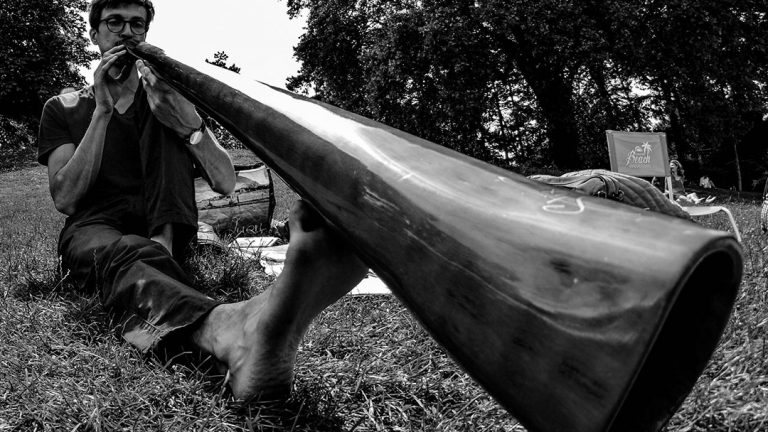
You can play from the front or from the side. Some players play on the side, others play from the front.
I have one big piece of advice for you: play from the front, and forget the side. I explain why it matters so much in lesson 5.
Step 3: put your lips on the mouthpiece
Take your didgeridoo and simply place your mouth on the mouthpiece. All the air you blow should go into the didgeridoo, not out at the sides.
Step 4: find the right tension in your lips
If your lips are too tight
Your sound can start like this, and it is not very beautiful: your lips are too tight. It is not a trumpet. On the didgeridoo, it is much more relaxed. So if you are too tight, relax your lips, and the sound will start again.
If your lips are too relaxed
The opposite is being too relaxed. The sound is very low and the air escapes very quickly, so it is very difficult to hold the sound for long. In this case, push a little more to make your lips tighter.
Step 5: hold a long sound
The goal of this exercise is to hold your sound for quite a long time. No circular breathing yet, just the sound. First, it is very important to control your lips.
Step 6: start your sound with “to”
One last thing: use a small “to” to start your sound. It is a French syllable, but you will get the idea: your tongue gives the start of the sound.
Listen in the video: can you hear the small “to” at the start? It is very simple, but it helps a lot to start your sound the right way. Then listen to the same sound without it.
What to practise now
So practise two things: a very clean start, and a very long sound. After that, you can prepare yourself for circular breathing in lesson 3.
For the whole path, from your first sound to your first rhythms, see my step-by-step guide to playing the didgeridoo.



Leave a Reply
You must be logged in to post a comment.