



You probably already know that the didgeridoo has only one note. Indeed, unlike “classical” instruments such as the piano, violin, or guitar that use multiple notes, all the work of a didgeridoo player consists of breaking down the single note available to extract the maximum sound possible from it. That’s why today, I’d like to take a closer look at the physical composition of this note. And this involves studying the frequencies that compose it. In physics, this is called the spectrum of a sound. Beyond the pure theory we’re going to cover, you’ll be surprised to hear how this can help you develop your listening skills and your playing.
So, are you ready to get frequencies in your ears (and eyes)?
Let’s dive into didgeridoo physics!
Each note corresponds to a frequency
It’s important to understand that each note vibrates at a “main” frequency. This is called the fundamental and it determines the name of the note. For the didgeridoo, the fundamental is therefore the note of the instrument. This is why we talk about a didgeridoo in C, in D, in E… etc.
That said, you have every right to say: “Okay, but what’s this story about frequencies?! I mean, concretely, how does it work?!”
Good point, dear reader, your insight delights me! Well, we can define frequency as follows:
Frequency is the number of vibrations (of air) per second. Frequencies are expressed in Hertz (Hz). This name finds its origins in the name of Mr. Hertz who discovered these frequencies.
Here’s a diagram that shows you the principle:
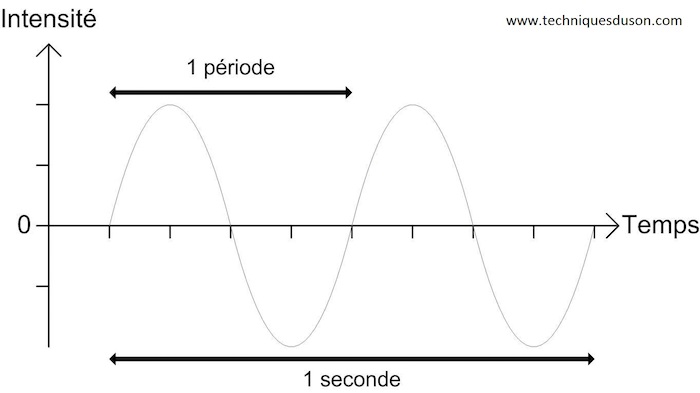
Remember that the higher a sound, the higher its frequency will be. And conversely, the lower a sound, the lower its frequency will be.
Thus the frequency corresponding to a didgeridoo in D is 74.43Hz, which means that such an instrument makes the air vibrate 74.43 times per second. Do you understand? Great! So, let’s continue!
Here’s a table that groups the correspondence between notes and frequencies.
For information, the range of didgeridoos is located very, very (I could even add a third one!) predominantly in the space framed in red on the table.
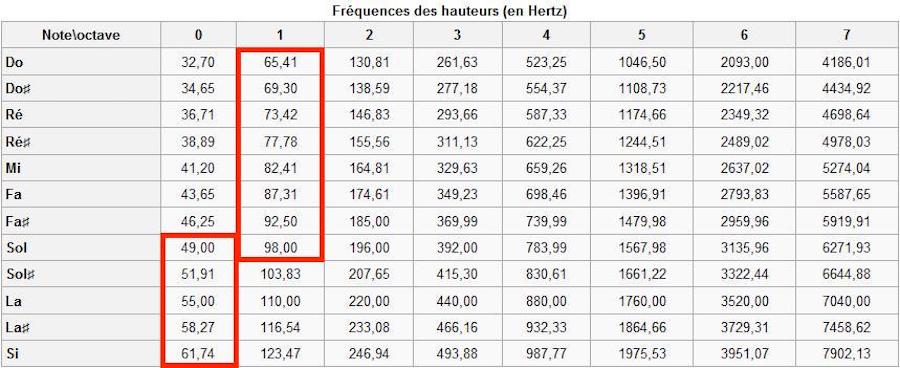
Table source: http://colmard.com/Arduino-lecon7.html
To make a small digression, where it starts to get interesting is that these frequencies don’t stop at just musical notes. We hear it quite often these days: everything is vibration. Thus, the sound world is only a tiny part of the frequencies that make up our universe. Here’s a diagram that shows that ultimately light, colors, radio waves, infrared are just frequencies that vibrate much faster or conversely much slower than sounds. Isn’t that crazy?! The first time I discovered this, it blew my mind. I said to myself: “But actually, when we make music, we’re painting, it’s sound painting. Amazing…!”
After that, you can do what you want with it… I found it quite amusing.
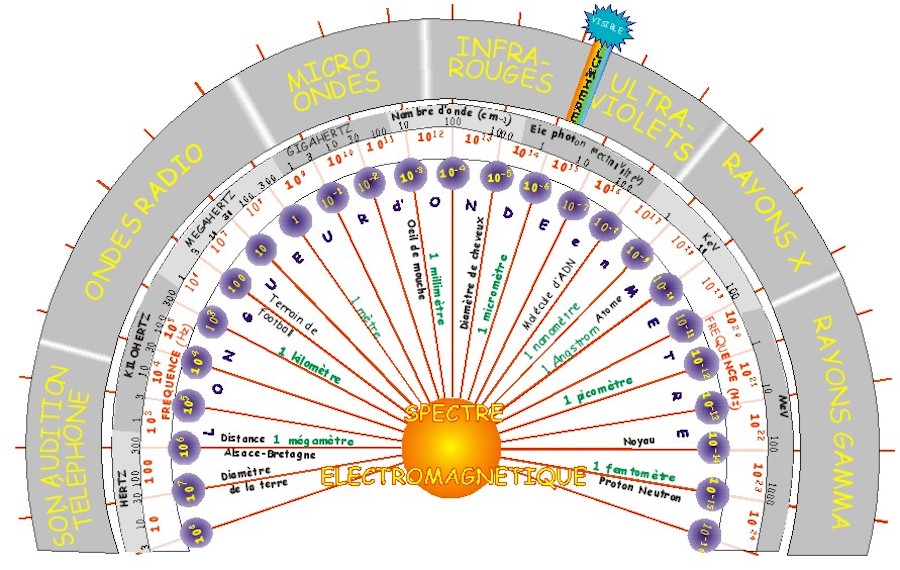
Source: http://catherine2205.free.fr/physique/spectre_electromag.html
The law of harmonics in music
After this poetic-metaphysical moment, let’s return to our beloved subject.
Let’s summarize what we now know. We’ve seen that each didgeridoo has its note and that each note corresponds to a precise frequency. Good!
Now, we’re going to complicate things a bit. You might suspect it, but it’s not just the fundamental that vibrates when you blow into the didgeridoo. Otherwise, we would just hear a linear sound that we couldn’t vary (or very little).
Thus there are other frequencies that overlap with the didgeridoo’s note. These frequencies are called harmonics and their combination gives the timbre of each instrument. Thanks to them, we can easily differentiate the sound produced by a singer from that produced by a trumpet, for example.
These harmonics don’t come randomly, they correspond to a series very well known to musicians, because we find it everywhere. To discover them, you just need to take the fundamental and multiply it by one, then two, then three… etc.
Here’s what it gives for a didgeridoo in D:
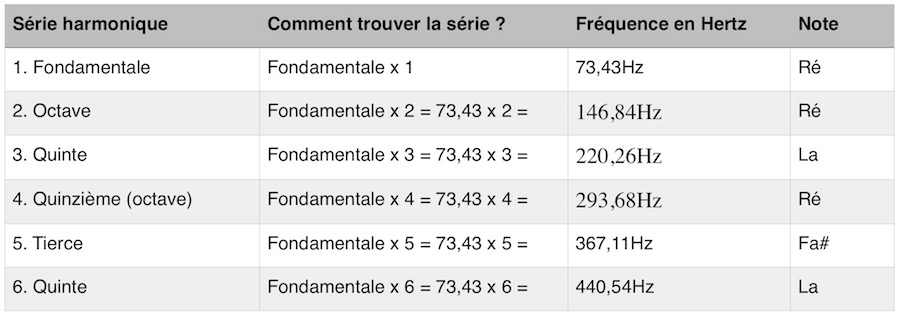
As we saw previously, a didgeridoo in D vibrates at 74.43Hz, this frequency represents the first harmonic, it is our starting point.
The second harmonic is at the octave, so it will be a D, but higher, vibrating at 146.84Hz. Then, we go up to the fifth then to the fifteenth…etc… Ouch, am I losing you?…
Well, it’s true that that’s a lot of information, especially if you’re discovering all these terms at once.
To tell the truth, the octave, the fifth and all that jazz, we don’t really care about it.
What’s important is to understand that there are a multitude of frequencies that are produced when you play your didgeridoo. And that these respect an order that will always be the same on each instrument. This order corresponding to a very simple law which is the fundamental multiplied by 1, 2, 3…
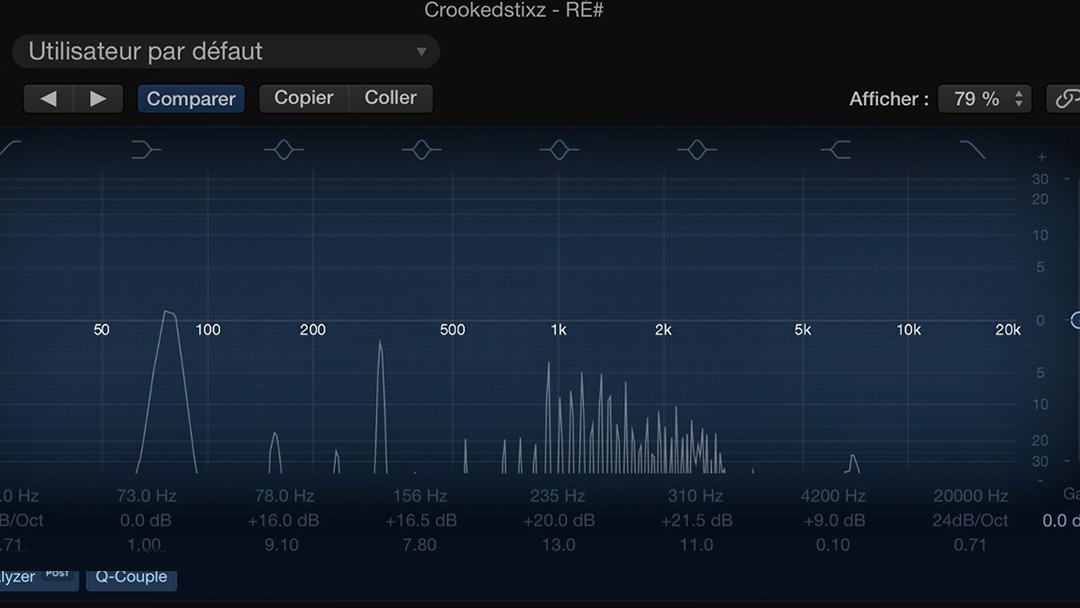
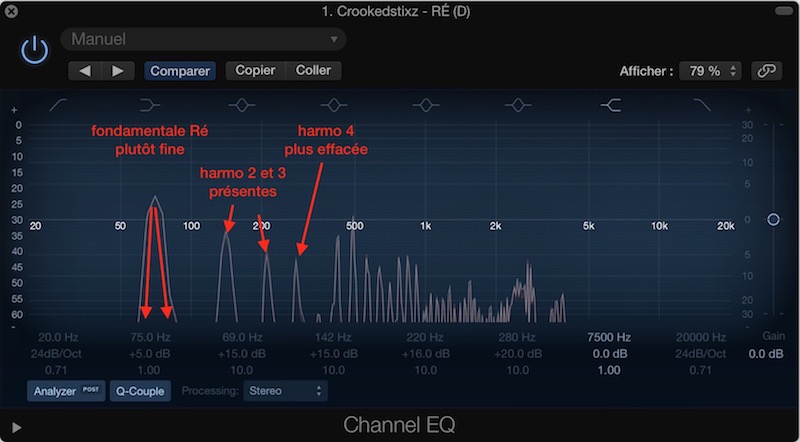
I suspected that this theory could be tedious. So I prepared something to stretch your brain. Here, for example, is what the frequency spectrum of a D didgeridoo from Crookedstixz looks like.
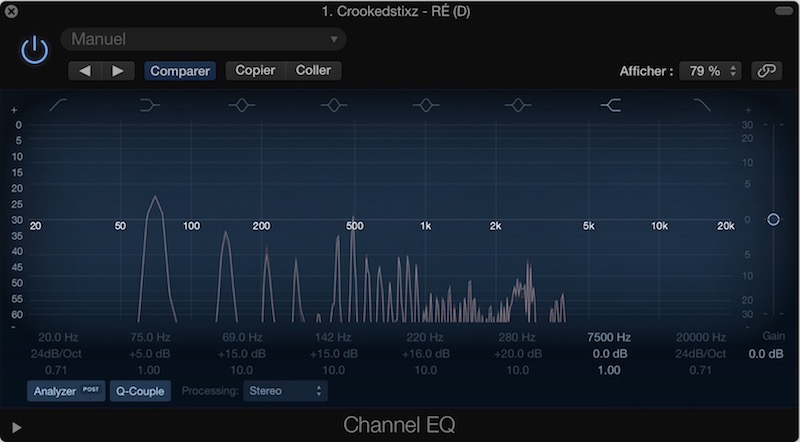
We can see very clearly, four first peaks starting from the left.
We just studied these first four harmonics. We have the fundamental, which I remind you, is the note of the didgeridoo (in D here) then the harmonics that follow.
Here’s the same diagram that shows you what these frequency peaks correspond to.
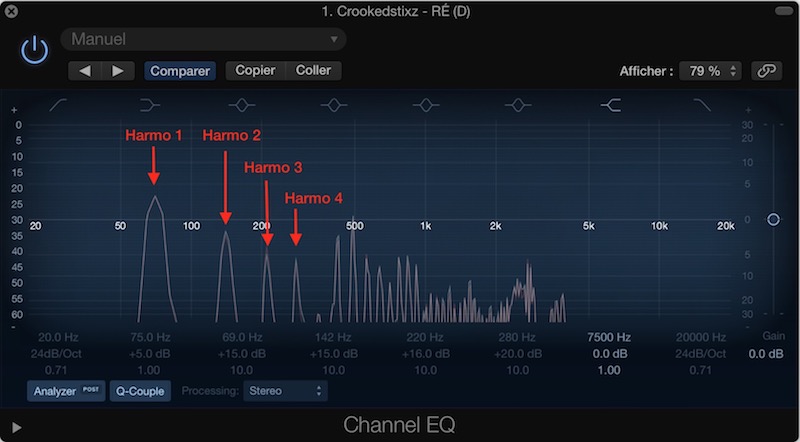
Harmonic 1 = about 73.42Hz = D, referring to the table above, we see that this is indeed the note of our didgeridoo.
Harmonic 2 = 73.42Hz x 2 = about 146.84Hz = octave = D
Harmonic 3 = 73.42Hz x 3 = about 220.26Hz = Fifth = A
Harmonic 4 = 73.42Hz x 4 = about 293.68Hz = Fourteenth = D
Beware of confusion around didgeridoo harmonics!
Harmonics are often subject to some confusion. In the didgeridoo what is commonly called harmonics, is nothing more than amplified vowels like: O, A, E, or I. In this case, the tongue will position itself in such a way that it will amplify a precise frequency of the didgeridoo corresponding to the articulated vowel. Generally, these frequencies are between 500Hz and 3500Hz.
In this article, when I talk about harmonics, these are those located in the lower frequencies. They are very close to the drone and often between 50Hz (first harmonic of a didgeridoo in A) and 500Hz.
The main difference with vowels and these “low” harmonics is that we have almost no action on the latter. They are part of the didgeridoo’s drone. That is to say that no matter what sounds we articulate with the tongue, these harmonics remain present.
To differentiate them, we could very well say that vowels are active harmonics, because they depend on our action. And that conversely, the drone harmonics are passive, because they are naturally present in the sound.
What follows is even more exciting (yes exciting, that’s a change isn’t it?). I recorded the sound of four didgeridoos to show you how the first harmonics of each instrument sound (I’m a bit tired of repeating didgeridoo all the time!).
In these recordings, I amplified the harmonics one after the other so that you can hear them well (I would have liked to do more, but the software limited me to four).
If you read my article on didgeridoo psychology, you know the two main shapes of a didgeridoo: conical and cylindrical.
For the exercise, I had fun comparing the frequencies of four instruments, classified by note and shape:
- Two didgeridoos in D: one conical (CrooKedStiXz) and the other cylindrical (Bob Druett)
- Two didgeridoos in C: the first is conical and made by Marcos Ferrazza and the second is cylindrical and comes from Alex-didg.
Let’s go for the sound, nothing beats theory in action!
Conical didgeridoo in D made by CrooKedStiXz
Cylindrical didgeridoo in D by Bob Druett.
Conical didgeridoo in C by Marcos Ferrazza.
Cylindrical didgeridoo in C from Alex-didgeridoo.
Thanks to Greg from didgeridoo-passion (also listen in French to: From the Nomadidge festival to Aboriginal Australian culture, meeting with Grégory Zwingelstein) for allowing me to record the didgeridoos from CrooKedStiXz and Marcos Ferrazza!
Effect of a didgeridoo’s shape on its sound spectrum
There, have you watched the videos? Do you understand better now what I explained above? Just remember that most of the time the first 5 frequencies define the character of a didgeridoo.
By the way, did you notice the main difference between conical and cylindrical didgeridoos?
The conical shape of the two tested didgeridoos amplifies the first four harmonics almost equally. This has the consequence of giving this cavernous and earthy effect. Nothing more normal: its first four harmonics connect it to the ground.
As for the two cylindrical didgeridoos, they only amplify the first harmonic (fundamental note) and the fourth, leaving harmonics 2 and 3 almost inaudible.
You may have also observed that the fundamental is much “thicker” in Bob Druett’s D than in CrooKedStiXz’s. When we know that Bob’s didgeridoo is much wider than the second, it’s quite amusing to see that we find this “anatomy” in the spectrum of the two instruments. However, this is not the case with Alex-didg’s C, this factor might be related to the weight of the didgeridoo.
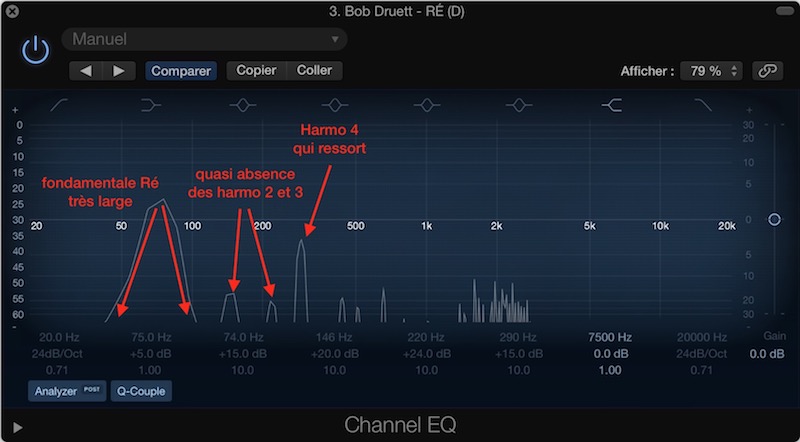
Cylindrical didgeridoo in D by Bob Druett
Conical didgeridoo in D by CrooKedStiXz
Singing Didge: a didgeridoo that sings
Last December, I started working with Adam, Australian maker of CrooKedStiXz. By the way, he does really excellent work, I highly recommend him. So I received a D# didgeridoo that he had made according to my requests. From the first second I blew into it, I fell in love with this didgeridoo. Do you know why? Because it sings! Listen instead:
Do you hear that frequency that sounds well above the others? It’s (again!) this fourth harmonic that dominates the spectrum.
I amplified it on the same recording so you can hear it well.
Cylindrical didgeridoo in D# by Crookedstixz
Didgeridoo in D#
Fundamental: D# = 77.78Hz
Octave: D# = 155.56Hz
Fifth: A# = 233.34Hz
Fifteenth: D# = 311.12Hz
Third: G = 388.9Hz
Fifth: A# = 466.68Hz
To make sure we’re talking about the same thing, I specify that it’s the amplified harmonic that is the furthest right in the video, the one that vibrates at 310Hz. It offers a warm presence to the didgeridoo.
We’re dealing with the same pattern as Alex-didg’s C didgeridoo and Bob Druett’s D (both tested above). However, the fourth harmonic is particularly present in this D#.
I always say that such a didgeridoo is an instrument that sings, and believe me, they are very rare to find. Indeed, few people pay attention to this and therefore makers don’t necessarily focus their research in this direction. Most of the time, we seek power at the expense of these fine frequencies.
Conclusion: listen (again and always) to your didgeridoo!
My hope is that you educate your ear. Because it’s in my opinion, the only way to develop your playing. Once again, we don’t give a damn about the theory developed here. It’s not important for blowing into a piece of wood! When I started playing, I had absolutely no awareness of all this, and to tell you the truth, it annoyed me quite a bit!
I just wanted to blow. However, I quickly heard these didgeridoos that sang. Very often, other players didn’t understand why I loved this didgeridoo so much rather than another more powerful and easier to play. At the time, I couldn’t say the cause of my love for such a singing didgeridoo! I was content to say: “It has a presence in the sound that is super beautiful.”
I was far from scientific rigor and I completely ignored the presence of the fourth harmonic, but I heard it and that was the main thing.
So, stay tuned to your didgeridoo, stay vigilant, and never stop developing your listening! (To watch: Are you ready to listen to your didgeridoo?)
Comment, share, like… if you think this can bring a little happiness and understanding to other players!









Leave a Reply
You must be logged in to post a comment.