

Skip to content

Why do so few women play the didgeridoo (and what does that reveal about our society)?

It never fails.

At every workshop, I get this question: “By the way Gauthier, do you know why so few women play the didgeridoo?!”

So I suggest we take a closer look at this situation that raises so many questions!

A majority of men on Wakademy

First of all, I’ll share the numbers I have. Whether it’s Wakademy members, students who attend workshops, people who follow me on Facebook, followers on Instagram or YouTube subscribers, the observation is generally the same and the numbers revolve around a common ratio:
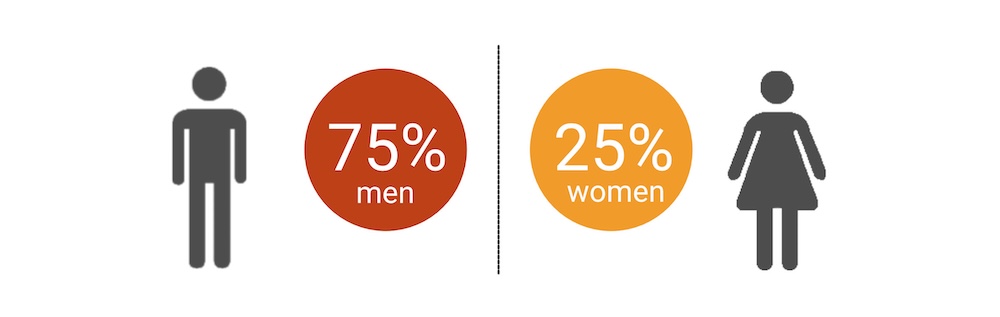
Without making the Wakademy population an absolute truth, we can easily say that the didgeridoo world is mostly composed of men.

Causes linked to the didgeridoo?

The Aboriginal tradition?

In most Australian Aboriginal communities, it is true that the didgeridoo is an instrument reserved for men.

I also recorded an interview with Adèle Blanchin, where she shares her journey as a female didgeridoo player — unfortunately, the interview is only available in French.

This factor is certainly part of the explanation.

Uluru mountain in central Australia

Uluru, like the didgeridoo, has become a symbol of Australian Aboriginal cultures

However, it probably has more influence in Australia than in Europe or in the United States (the two main centers of didgeridoo players).

Aside from the obvious fact that it’s much less comfortable to be a woman than a man in this context, I don’t think we can explain the numbers mentioned above by this single factor.

So let’s continue.

A phallic instrument?

No need to be a psychoanalyst to quickly conclude that the didgeridoo has a rather evocative shape!

Just listen to the almost universal jokes, admittedly a bit crude, that compare our good old didgeridoo to a phallus (or to a giant joint…?).

Still, I wouldn’t venture into this psychoanalytic question, as I doubt it can justify why men are more attracted to the didgeridoo than women!

For now, we must admit that we don’t have valid explanations for the phenomenon. So let’s broaden our horizon by taking a look at the broader world of music.

The place of women in the world of music

I suggest a little experiment.

Remember the last concerts you attended (okay, it’s been a while!), or the composition of your favorite band, or the last music video you watched, the last song you listened to…

Do you notice anything?

  • How many women were on stage?
  • How many of them were drummers?
  • How many were bassists? Guitarists? Singers?

And so on…

It is so common to have (almost) exclusively male bands that we no longer even notice what’s happening in front of us!

Now, if I asked you to give me three names of classical music composers?

Vivaldi, Bach, Mozart, Beethoven, Debussy, Tchaikovsky, Stravinsky… These are just a few examples among many others! And the worst part is that I wouldn’t even need to specify “men only”…

You’ll agree that the exercise becomes nearly impossible if I asked you to name even just one female composer!

I’ll still do it: Clara Schumann (yes, she’s the wife of the famous composer, and the fact that I even have to clarify that only reinforces the imbalance this article aims to highlight!).

… And we’re only talking about music here…

Yes.

It sucks.
singer Cesária Évora singing

A chance to highlight women of wonderful talent: the singer Cesária Évora

Women are underrepresented in most fields, especially in culture…

Women and contemporary music: shocking numbers

I had already noticed all this for several years, but to prepare this article, I told myself I would rely on facts.

So I did some research to support my point. And I came across, among other things, the final thesis of Mathilde Pakette, in French (“ Women and contemporary music: findings, analysis, and keys to understanding an unequal field”). Thanks to Mathilde for her work, which provided clear data on the number of women in the contemporary music world.

A quick clarification: what do we mean by contemporary music?

Rather than giving you an imprecise personal definition, I’ll copy-paste Mathilde Pakette’s definition from her thesis:

“Contemporary music” (…) includes four major musical families:

  • Jazz and improvised music
  • Traditional music and world music
  • Chanson
  • Amplified music (which uses electric amplification as a mode of creation), divided into three sub-families:
    • Rock, blues, country, pop, fusion, metal, industrial, hardcore, punk…;
    • Hip Hop, R’n’B, ska, reggae, ragga, dub, funk…;
    • Electronic music.


This represents a good portion of the music produced in our era!

And here are the numbers, also drawn from Mathilde Pakette’s work.

Warning, they’re staggering.

  • 8% of women won a Victoire de la musique between 1985 and 2015
  • In Île-de-France, across the programming of 15 contemporary music venues analyzed, only 12.96% of performers on stage are women.
  • … of which 7.4% are lead artists
  • … and 5.4% are instrumentalists
  • 10.2% of women use rehearsal studios in these same venues.
  • In professional development programs led by contemporary music networks in Île-de-France, among 127 groups and 507 artists supported, only 12% are women, including 7% instrumentalists.
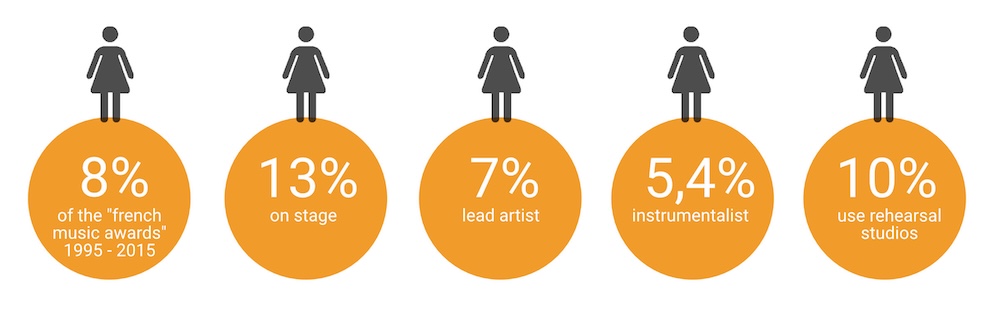
These numbers must be placed in context, but they remain highly telling!

Ouch.

Let’s continue.

In this France 24 article titled (in French) “In the music industry, inequalities between men and women are growing”, we find very similar numbers in American popular music:

  • In six years, not a single woman has been nominated in the “Producer of the Year” category at the Grammys. And when we widen to the five most prestigious categories of this iconic ceremony, women represent only 9.3% of nominated artists.
  • In 2017, among the 100 most popular songs (…) less than 17% were performed by female artists.
  • Among the 600 hit songs that defined the past six years (2012–2017), only 12.3% were written by women and 2% produced by women.

Well…

Shall we talk about it? ?

What I learned from Macron’s interview on Brut

“You might ask, what does this guy have to do with the topic?!”

Don’t panic, let me explain.

The other day, I watched the interview given by President Macron on Brut to observe political rhetoric. An exercise I find fascinating in many ways.

But what caught my attention wasn’t that, but what happened on the Brut set. Facing the president were three journalists: two men and one woman.

Well, guess what?

In 2h40, the woman spoke very (very, very) little. And to top it off, she was discreetly shut down by her male colleague when she tried to ask a question.

It’s subtle.

It’s quick.

You almost don’t notice it.

But it’s there.

Needless to say, this same journalist did NOT dare do the same to his other male colleague.

My sister, who has a PhD in social psychology (specialized in micro-discrimination and micro-aggressions), had told me: “Statistically, a woman on a TV set speaks less than the men present on that same set.”

Damn. The stats were right.

And of course, this is just a tiny part of a much larger and more insidious system…

A conditioning that runs deep

The problem with conditioning is that it is conditioning.

By definition, we don’t notice it — otherwise it wouldn’t be conditioning.

And it obviously applies to both sides: men and women.

We are all conditioned, regardless of sex or gender. Of course, there are varying degrees. But this understanding helps us see our behaviors through the lens of unconscious mechanisms.

For example, in our society, women are more inclined to be discreet and stay in the background, whereas men move forward more easily and impose themselves more…

And I’m not blaming that journalist, nor judging or lecturing either men or women on anything!

However, I would like to share my experience to highlight what I see as the biggest risk.

Division and stigmatization

I was born in a white male body, in a country called France. I was lucky enough to receive an education that opened me to culture, respect for others, and philosophical questioning.

In other words, in our society, I was born privileged.

So, I educated myself.

I listened to feminist podcasts. I tried to understand the place of women (and I still am). I question myself as a man. Year after year, I try to become aware of my own conditioning.

And yet!

I recently realized that I was carrying something heavy inside: the guilt of being a man. The dominant white male seems to have committed all possible horrors: wars, destruction of the planet, domestic violence, murders…

It’s hard, when you’re aware of your place as a man, not to feel guilty. Especially, I must admit, when listening to certain feminist speeches.

Of course, I don’t want to create further division. There is clearly still a lot to be done. The numbers speak for themselves, and I’m not denying them.

But I believe that if, on one side, many women seem angry at men, most men seem afraid of women. And I definitely include myself in that group.

What if women accepted their anger to take their place?
What if men accepted their fear to lower their weapons?

Sometimes I dream of a society where women are no longer princesses and men no longer princes, where women are no longer victims and men no longer oppressors. A society where each and every one of us tries daily to understand our own conditioning more deeply.
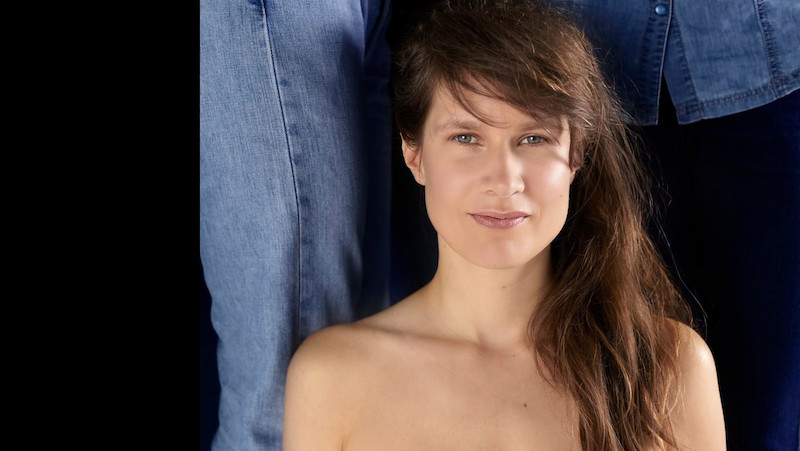
The singer Camille looking at us.

The singer Camille

We are women.
We are men.
We are human beings.

No matter our sex, gender, skin color, social class, origins… It is urgent, in the world we live in, to shape our lives in the image of who we truly are.

It’s the famous “Who am I?”. A vast question asked since the dawn of time, and as you will have understood, the didgeridoo is only a tiny part of the answer.

And you — where do you stand on these questions? What do you think about these sensitive topics shaping our era? If you want to support this cause, share and comment!

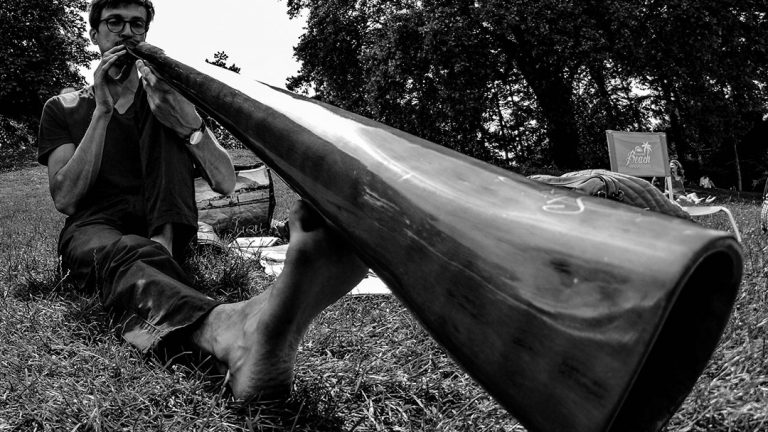
Main photo credit (player in the photo: Lies Beijerinck): La république des Pyrénées

Free

Learn the didgeridoo for free

Full courses, free. You start right away.

Beginner level course

Master circular breathing

Learn circular breathing in 4 simple, easy-to-follow steps. You’ll be surprised at how much easier it is than it looks!

7 videos

Intermediate level course

Develop your sense of rhythm

To play rhythms that sound good, you need to understand how the breath shapes the rhythm. That’s what I show you here!

Coming soon

Intermediate level course

Increase your speed

Wobbles will help you build speed like no other technique. An absolute must!

8 videos

5/5225 Google reviews

9917members

Read next

17 responses to “Why do so few women play the didgeridoo (and what does that reveal about our society)?”

  1. I don’t think this is about women being in the shadow of men. In indigenous culture, there is men’s business and there is women’s business. Didgeridoo falls under men’s business. This is not about sexism, this is division of tasks. I don’t think men’s and women’s business, and what that business is, is even discussed outside indigenous people, so it’s not really our place to question this.

    I bought my latest didgeridoo from a local indigenous man, and was given permission to play it in the ways I wanted to. But there were two conditions, no woman can play it, no woman can hold it. He made that didgeridoo, it was used in ceremonies, and his father was an Elder, so I will absolutely respect his wishes as he sold it to me under those conditions.

    If used in sound healing and sound meditation work, indigenous communities even feel very strongly about not directing the didgeridoo at woman particularly if the host walks around the room.

    Whatever your opinion, there should be respect of the instrument that’s been played for 1500yrs and its cultural background. Understandably, in Europe and the US, there aren’t the indigenous communities to go and source traditional didgeridoos or yidakis, to ask for permission or to pay respects to, so the situation is somewhat different to when you live among indigenous people.

    Just thought I’d add some thoughts from an Australian 😊

  2. ralph.runknagel Avatar
    ralph.runknagel

    Hello,

    first excuse for writing in English, but my school – days – French is quiet rusty. The more grateful I am for Gauthiers friendly translation of most of his great blog posts and videos to English. Big thumbs up for this, Gauthier!

    I was quiet shocked by those numbers you show in your article, since I thought music (especially modern music) as kind of a “soft and often psychologically sophisticated” art form (hope you get what I mean with this) is more balanced in question of gender equality.
    I know this topic quiet well from fine arts. There is only female artist one known to a wider field up until the era of Impressionism: the brilliant Artemisia Gentilleschi (what a wonderful name, isn’t it?) – an artist from late Baroque. Then there’s nothing for some hundred years. From impressionists times there are four or five (Mary Cassatt, Berthe Morisot, Camille Claudel – so abused from the “great” Rodin – and two or three more, hardly known women). Later on in the 20th century, it seems that the famous Bauhaus took an important role in giving women a space to express themselves. But there are maybe a handful amongst all the men. Take a stroll through a museum of contemporary art, look at the prize winners – women’s works are very severely underrepresented!
    So a big shoutout to the wonderful work of the Rebecca Horn, Yayoi Kusama, Cindy Sherman, Marina Abramovic, Louise Bourgeoise and all the other brave women trying to make a stand for their unique female perspective on our world!

    All the best from the Baltic Sea
    Ralph

    1. Thank you Ralph for this beautiful comment and for sharing all these names.
      As you said, glory to the women who have managed (and continue) to assert themselves in the face of a patriarchy that is still hard to dislodge.

  3. Doris Avatar
    Doris

    What a big topic!
    The role of women in the shadow of men is an ancient tradition and still present in society’s thinking. I don’t know what needs to happen for that to change.

    I recently had an experience where I saw a show by a cabaret artist, a man who critically reflects on society and politics. After the show, I was standing with a few men, and the cabaret artist came over because he knew some of them, and then he looked at me questioningly. And he didn’t ask who I was, but rather, “And you’re the wife of…?”

    And I want to add another female composer, quite the same period of Clara Schumann: Fanny Mendelssohn-Bartholdy. Pianist and composer. Her family largely forbade her pursuing a musical career and publishing her compositions. It’s evident, that Felix Mendelssohn-Bartholdy (her brother ;-)) published several of her compositions under his name. He admired her works, which were also a source of inspiration for him. Just a few months before her death, Fanny published some of her compositions against her family’s wishes.

    1. Thank you, Doris, for your comment.
      The story of Fanny Mendelssohn-Bartholdy is so revealing.
      When I think about how many women have been prevented (and much more)— and still are today — it really moves me.

      And the question that artist asked truly shows how much deconditioning we still have ahead of us (I’m not judging him, and I include myself in this too!).
      Thank you Doris

  4. Nadia Avatar
    Nadia

    Hey Gauthier,
    In my opinion, it’s not a question of physical ability that explains why there are fewer female players!
    I simply think they have other things to do?
    Woman has disturbed man since the dawn of time. According to certain writings, there was originally a Goddess venerated by all who gave life and nourished her children (all humans). Then with the arrival of religion in general we moved to a God (masculine no matter the religion). We took women for witches simply because they knew the power of Nature and were connected to It.
    Men and women are different but complementary and in each human being there is a part of masculinity and femininity.
    Man or woman, each has their importance and their role. We can see this clearly in Aboriginal culture. There is no competition or tasks inferior to others.
    Woman can indeed be frightening because she gives life through her body, she nourishes her offspring (which Nature does). She is rhythmed by cycles (just like the seasons and the moon).
    She can seem mysterious because she feels more easily than some men what surrounds her (We often talk about the 6th sense!).
    Getting back to the didgeridoo, there are women who play who remain discreet.
    but indeed as Guillaume was able to explain, when you have a family life you make choices.
    Each has their own motivation.
    In any case, the theme of “sacred feminine” is having a moment right now and allows some women to question their place and lost abilities. Perhaps one day we will achieve a real and beautiful balance between the two sexes that will allow us all to live in harmony.

    Automatically translated from French · See the original

    Coucou Gauthier,
    Pour ma part, ce n’est pas une question de capacité physique qui fait qu’il y a moins de joueuses!
    Je pense simplement qu’elles ont autre chose à faire ?
    La femme dérange l’homme depuis la nuit des temps. D’après certains écrits il y avait au départ une Déesse vénérée de tous qui donnait vie et nourrissait ses enfants (tous les humains). Puis avec l’arrivée de la religion en général on est passé à un Dieu (masculin quelque soit la religion). On a pris des femmes pour des sorcières simplement parce qu’elles connaissaient le pouvoir de la Nature et etaient connectées à Elle.
    Hommes et femmes sont différents mais complémentaires et en chaque être humain il y a une part de masculinité et de féminité.
    Homme ou femme, chacun a son importance et son rôle. On le voit bien dans la culture aborigène. Il n’y a pas de concurrence ou de tâches inférieures à d’autres.
    La femme peut faire peur en effet car elle donne la vie par le biais de son corps, elle nourrit sa progéniture (ce que fait la Nature). Elle est rythmée par des cycles (tout comme les saisons et la lune).
    Elle peut paraitre mystérieuse car elle ressent plus facilement que certains hommes ce qui l’entoure (On parle souvent du 6ème sens!).
    Pour revenir au didgeridoo, il y a des femmes qui jouent qui restes discrètes.
    mais en effet comme a pu l’expliquer Guillaume, lorsqu’on a une vie de famille on fait des choix.
    Chacun a sa propre motivation.
    Quoiqu’il en soit, le thème du “féminin sacré ” a le vent en poupe en ce moment et permet à certaines femmes de se questionner sur sa place et ses capacités perdues. Peut-être arrivera t on un jour a un véritable et bel équilibre entre les deux sexes qui nous permettra de vivre tous en harmonie.

  5. Lise Lebas Avatar
    Lise Lebas

    Hello Gauthier,

    First of all, I’m not sure if you’ll have time to read this short message in response to the article you just sent me about your concerns regarding women who play the didgeridoo, and in any case, these few lines don’t require a response… except, of course, if you happen to have time.

    I just treated myself for Christmas to the “beginner pack” with your method, sold by didgeridoo passion. I’m a woman, I’m 64 years old and I’ve decided to embark on this adventure. No doubt, moreover, that as soon as I’ve made enough progress I’ll sign up for your online courses.

    I also asked myself the question: why so few visible women in this world of men that seems to me often created by men and for men. To accept this situation, I asked myself what the world, society, would be like if it had been dominated by women. It’s likely that the excesses, the abuses of power and other misbehaviors would have been equally regrettable. Beyond the divide between men and women, there is human nature and mother nature or divine power if you prefer, which allowed the apes that we once were to develop our central nervous system beyond reason, it sometimes seems.

    Your concerns, the doubts and fears that are yours are commendable but, you are a man capable of living balanced and equitable relationships with the people around you, whether they are men or women. This is evident in your videos, in your pedagogical approach, it’s heard in your music. One last little thing, it’s only a hypothesis, but in addition to the cultural or societal aspect of the phenomenon, women have a smaller thoracic capacity than men and this may also contribute to the rarity of female didgeridoo players.

    It remains for me to thank you for the investment you make in this instrument with its quasi-metaphysical tones and to wish you a happy end of year season.

    Automatically translated from French · See the original

    Bonjour Gauthier,

    Tout d’abord, j’ignore si vous aurez le temps de lire ce petit mail en réponse à l’article que vous venez de m’envoyer sur les interrogations qui sont les vôtres à propos des femmes qui jouent du didgeridoo, et, en tout état de cause, ces quelques lignes ne demandent pas de réponse… sauf, bien sûr, si vous en avez éventuellement le temps.

    Je viens de m’offrir pour Noël le ” pack débutant “avec votre méthode, commercialisé par didgeridoo passion. Je suis une femme, j’ai 64 ans et j’ai décidé de me lancer dans cette aventure. Nul doute, au demeurant, que, dès que j’aurais suffisamment progressé je m’inscrirai à vos cours en ligne.

    Je me suis aussi posé la question; pourquoi si peu de femmes visibles dans ce monde d’hommes qui me semble souvent crée par des hommes et pour les hommes. Pour accepter cette situation, je me suis demandé ce que serait le monde, la société, si cette dernière avait été dominée par les femmes. Il est probable que les dérives, les abus de pouvoir et autres débordements auraient été tout aussi regrettables. Par-delà le clivage, hommes, femmes, il y a la nature humaine et mère nature ou la puissance divine si l’on préfère qui a permis aux singes que nous fûment jadis de développer notre système nerveux central au-delà du raisonnable, semble – t – il parfois.

    Vos interrogations, les doutes et les craintes qui sont les vôtres sont louables mais, vous êtes un garçon capable de vivre des relations équilibrées et équitables avec les personnes qui vous approchent, qu’ils s’agissent d’hommes ou de femmes. Cela se voit dans vos vidéos, dans votre approche pédagogique, cela s’entend dans votre musique. Une dernière petite chose, il s’agit seulement d’une hypothèse, mais outre l’aspect culturel ou sociétal du phénomène, les femmes ont une capacité thoracique moins grande que celle des hommes et ceci peut aussi participer de la rareté des joueuses de didgeridoo.

    Il me reste à vous remercier pour l’investissement qui est le vôtre vis à vis de cet instrument aux accents quasi métaphysiques et vous souhaiter de bonnes fêtes de fin d’année.

  6. Hi Gauthier,
    Nice topic, very timely. I do awareness-raising sessions in schools and I can confirm there’s a lot of work to be done, and it affects men and women equally. We’re all definitely conditioned and we all pay the price for it, in small or big ways. What’s beautiful is that it’s moving forward bit by bit 🙂
    Really enjoyed your article…
    And to illustrate, here’s this, sung by both masculine and feminine voices, in a very poetic way (though I couldn’t find the album version which is gorgeous…) :
    LAMOMALI DE -M- – UNE ÂME @ Vieilles Charrues 2017 – YouTube
    No didj in it but it’s beautiful if you ask me and very much to the point…
    And yes, that’s it, let’s sow plenty of seeds 😉 in music or otherwise…

    Automatically translated from French · See the original

    Coucou Gauthier,
    Joli sujet, bien à l’ordre du jour. Je fais des sensibilisations en milieu scolaire et je confirme qu’il y a du taf, et que cela touche autant les hommes que les femmes. On est bel et bien tous conditionnés et on en fait tous les frais, à petites ou grosses doses. Ce qui est beau, c’est que cela avance tout doucement 🙂
    Beaucoup aimé ton article…
    Et pour illustrer, voici ceci, chanté par du masculin et du féminin, de manière très poétique (j’ai par contre pas trouvé la version de l’album qui est superbe…) :
    LAMOMALI DE -M- – UNE ÂME @ Vieilles Charrues 2017 – YouTube
    Ya pas de didj dedans mais c’est joli comme tout je trouve et bien à propos…
    Et oui, c’est ça, semons plein de graines 😉 en musique ou autrement…

  7. Guillaume Avatar
    Guillaume

    Nice article… thank you for sharing this.
    It’s a topic I’ve always been very sensitive to. I sometimes tend to believe that sexism is the first and worst of battles, the cause of all the others… Our inability to accept, take into account, and respect the other’s difference, by fully recognizing their mystical mystery… and the horror of an absurd struggle when our natures are actually, by essence, of an ecstatic complementarity… make me shed tears when I really dwell on it…
    But I like to think that we have evolved enormously (thankfully!!!) in this area, and that it really seems to be going well: that our collective consciousness of these issues will inevitably continue to deepen and refine in the years/decades to come, that we are collectively well launched on these questions…
    But it’s certain that we really need to roll up our sleeves !!!
    What’s tricky, among other things, is that being “equal” doesn’t mean being “identical”… For example, personally I am a father and I want to fully assume my fatherhood, be present for my children and break with a tradition that would encourage me to prioritize my career and leave their education to their mother. I also want her to be able to flourish professionally.
    It happens that we are both professional musicians… And music is a jealous discipline, isn’t it? Young children can easily be powerful brakes, even career-breakers for musicians… but even more so for female musicians, and not just through conditioning in my opinion: I could never be connected to my children in the same way she is, in such a primary, visceral way because I couldn’t carry them in my womb, give birth to them and breastfeed them. I naturally have a different role, no less, no greater, simply different. If we recognized at its true value the investment and love that mothers give to their children, we would rediscover the pride of what has nourished and helped us grow, and we would do justice to Mozart’s mother instead of only talking about Leopold’s role… If we recognized at its true value the service rendered to society by parents who actually take care of their children, to give them solid foundations on which to build and become balanced adults… That would change everything in my opinion! Currently it seems to me that parents must sacrifice their parenthood if they want to build a career or even simply make ends meet, often we no longer have the space and time to take care of our children. So daycare, school, babysitters, television, video games… and those who suffer the most from it, just after the children, are the mothers in my opinion… So going on tour, writing an opera, getting freelance status with your heart broken… what’s the point?!! When we’re done with sexism this planet will surely have the sweetness of a true paradise…. so, let’s do it together!!! 🙂

    Automatically translated from French · See the original

    Bel article… merci pour ce partage.
    C’est un sujet auquel j’ai toujours été très sensible. J’ai parfois tendance à croire que le sexisme est la première et la pire des batailles, cause de toute les autres… Notre incapacité à accepter, prendre en compte, et respecter la différence de l’autre, en lui reconnaissant pleinement son mystère mystique… et l’horreur d’un combat absurde alors que nos natures sont en réalité, par essence, d’une complémentarité extatique… me font verser des larmes quand je m’y arrête vraiment…
    Mais j’aime a penser que nous avons énormément (heureusement!!!) évolué dans ce domaine, et que ça semble vraiment bien partis : que notre conscience collective de ces enjeux va forcement continuer de s’approfondir et de s’affiner dans les années/décennies à venir, qu’on est bien collectivement lancés sur ces questions…
    Mais c’est sûr qu’il faut vraiment se retrousser les manches !!!
    Ce qui est délicat, entre autre, c’est qu’être “égaux” ne signifie pas être “identiques”… Par exemple personnellement je suis père et je tiens à assumer pleinement ma paternité, être présent pour mes enfants et rompre avec une tradition qui m’inciterais à privilégier ma carrière et à laisser le soin de leur éducation à leur mère. Je tiens également a ce qu’elle puisse s’épanouir professionnellement.
    Il se trouve que nous sommes tous 2 musiciens professionnels… Et la musique est une discipline jalouse n’est-ce pas ? Les enfants en bas-âge peuvent facilement être des puissants freins, voir des brise-carrières pour des musiciens… mais encore plus pour des musiciennes, et pas seulement par conditionnement à mon avis : Je ne pourrais jamais être relié à mes enfants de la même façon qu’elle, de façon si primaire, si viscérale parce que je n’ai pas pu les porter dans mon ventre, ni les mettre au monde et les allaiter. J’ai par nature un autre rôle, non moindre, non supérieur, simplement différent. Si nous reconnaissions à sa juste valeur l’investissement et l’amour que les mères offrent à leur enfants, nous retrouverions la fierté de ce qui nous a nourri et fait grandir, et nous rendrions justice à la mère de Mozart au lieu de ne parler que du rôle de Léopold… Si nous reconnaissions à sa juste valeur le service rendu à la société par les parents qui s’occupent réellement de leurs enfants, pour leur donner des bases solides sur lesquelles se construire et devenir des adultes équilibrés… Ça changerais tout à mon avis ! Actuellement il me semble que les parents doivent sacrifier leur parentalité s’ils veulent faire carrière ou même simplement joindre les 2 bouts, bien souvent on n’a plus la place et le temps de s’occuper de nos enfants. Alors crèche, école, garderie, télévision, jeux vidéos… et celles qui en souffrent le plus, juste après les enfants, ce sont les mères à mon avis… Alors partir en tournée, écrire un opéra, décrocher l’intermittence avec le cœur à l’envers… a quoi bon ?!! Quand on en aura finit avec le sexisme cette planète aura sûrement la douceur d’un vrai paradis…. alors, allons -y ensemble !!! 🙂

  8. Calie M Avatar
    Calie M

    Hi Gauthier, this article touched me deeply. I took the time to let it settle before writing this message. Thank you for this well-documented, well-referenced article that goes beyond the question of women and the didgeridoo—something that’s been so painful lately from all sides—and brings out other injustices and misunderstandings. Thank you for broadening the perspective, and then stepping back. It’s funny (timely?) that I’m right in the middle of

    Automatically translated from French · See the original

    Bonjour Gauthier, il m’a touchée cet article, j’ai pris le temps de le laisser infuser avant d’écrire ce message, gratitude. Merci pour cet article documenté, référencé, qui dépasse la question des femmes et du didgeridoo, si blessante ces derniers temps de tous côtés, et faisant ressortir d’autres injustices et incompréhensions. Merci pour l’élargissement du regard, puis la prise de recul. C’est drôle (d’actualité ?) je suis en plein dans le “Qui suis-je ?” en ce moment. Retirer ses couches, se ressentir, prendre la responsabilité de ses émotions.. Rester alignée avec l’en-dedans, quand j’entre en relation avec le monde. Graines de rêvolution ! =)

  9. Patrick GARBOUS Avatar
    Patrick GARBOUS

    Thank you Gauthier for this very interesting and well-developed article.
    I think men and women are not equal but complementary. One is not superior to the other nor inferior.
    From a practical standpoint, it’s shameful that for the same work or the same activity (sports for example), women don’t receive the same pay as men.
    Many religions don’t seem to favor women.
    Getting back to the didgeridoo (like many leisure activities), you sometimes find more girls than boys in certain fields (horseback riding for example) but when they reach adulthood, women become rarer. It’s true that on top of work, they may have to look after children and the home (a role too rarely shared by men) and don’t have much time and energy left for a hobby.
    I completely agree with Véronique’s comments.
    The world is far from perfect and too often even less perfect for women, even though sometimes and even often they are more deserving than men.

    Automatically translated from French · See the original

    Merci Gauthier pour cet article bien intéressant et très travaillé.
    Je pense que l’homme et la femme ne sont pas égaux mais complémentaires. L’un n’est pas supérieur à l’autre ni inférieur.
    D’un point de vue pratique, il est honteux que pour un même travail ou une même activité (sportive par exemple), les femmes ne reçoivent pas les mêmes rémunérations que les hommes.
    Bon nombre de religions ne semblent pas favoriser les femmes.
    Pour en revenir au didgeridoo (comme à de nombreuses activités de loisir), on trouve parfois plus de filles que de garçons dans certains domaines (équitation par exemple) mais arrivées à l’âge adulte, les femmes se font plus rare. Il est vrai qu’un plus d’un travail, elles doivent éventuellement s’occuper des enfants et de la maison (rôle trop peu partagé par l’homme) et n’ont plus beaucoup de temps et d’énergie pour un loisir.
    Je rejoins tout à fait les propos de Véronique.
    Le monde est loin d’être parfait et trop souvent encore moins parfait pour les femmes alors que parfois et même souvent elles sont plus méritantes que les hommes.

  10. Victor Avatar
    Victor

    Thank you Gauthier for this inspired and inspiring article!

    Automatically translated from French · See the original

    Merci Gauthier pour cet article inspiré et inspirant !

  11. Véronique Avatar
    Véronique

    Thank you Gauthier for this magnificent article on the relationship between men and women. Women have to fight harder to achieve equal pay with men, for example. Relationships between women in companies are often horrible. The sense of hierarchy is more present than elsewhere.

    A woman will make you feel that you are inferior because you didn’t attend a certain school, or because you’ve only been there for a few months and so your voice has no weight. Ambitious women are terrible witches like in 101 Dalmatians or in the film ‘The Devil Wears Prada’.

    I’ve noticed that these are often women who haven’t found the man of their life and who, to give themselves composure, criticize those who are satisfied with their family life. These women play a really interesting game with all the men by showing off in front of them. It’s funny to observe them.

    I don’t believe for a second that one day we can achieve equality between men and women. Physically speaking it’s not possible: we simply have less strength. We necessarily assume motherhood and the education of our children. It’s been logical for millennia because it’s we women who bring them into the world. We can never reverse this reality.

    Often, we add cooking and housekeeping to that. We can no longer find time to do something else like playing the didgeridoo for example. Life increasingly offers us beautiful things to try, music but all the other arts in general.

    Personally I draw whenever I can but those moments are too rare but so precious.

    In conclusion. Is it because men have fewer constraints, more time, that they take the time to play an instrument.
    That’s my feeling in a nutshell.
    Have a good day.

    Automatically translated from French · See the original

    Merci Gauthier pour ce magnifique article sur le rapport homme femme. La femme doit plus se battre pour arriver à être l’égale d’un homme au niveau du salaire par exemple. Les rapports entre femmes dans les entreprises sont souvent horribles. Le sens de la hiérarchie est plus présente qu’ailleurs.

    La femme va te fait bien sentir que tu es inférieure parce que tu n’as pas fait telle ou telle école, ou que tu n’es là que depuis quelques mois et donc que ta parole n’a aucun poids. Les femmes arrivistes sont de terribles sorcières comme dans les 101 dalmatiens ou dans le film le ‘diable s’habille en Prada’.

    J’ai constaté que ce sont souvent des femmes qui n’ont pas trouvé l’homme de leur vie et qui pour se donner une contenance critiquent celles qui sont satisfaites de leur vie de famille. Ces femmes là jouent un jeu vraiment intéressant avec tous les hommes en se pavanant devant eux. C’est rigolo de les observer.

    Je ne crois pas une seconde qu’un jour on puisse atteindre l’égalité homme femme. Physiquement parlant ce n’est pas possible : nous avons tout simplement moins de force. Nous assumons forcément la maternité et l’éducation de nos enfants. C’est dans la logique depuis des millénaires puisque c’est nous les femmes qui les mettons au monde. On ne pourra jamais inverser cette réalité.

    Bien souvent, on rajoute à cela la cuisine et le ménage. On ne peut plus trouver de temps pour faire autre chose comme jouer du didgeridoo par exemple. La vie de plus en plus nous offre de belles choses à essayer, la musique mais tous les autres arts en général.

    Personnellement je dessine dès que je peux mais ces moments là sont trop rares mais tellement précieux.

    En conclusion. Est ce que c’est parce-que les hommes ont moins de contraintes, plus de temps, qu’ils prennent le temps de jouer d’un instrument.
    Voilà rapidement mon sentiment.
    Bonne journée.

  12. priscilla galvan Avatar
    priscilla galvan

    Thank you Gauthier for this magnificent article (and, by the way, thank you for your teaching, so clear and of high quality). I so much agree with you! I’m a female didgeridoo player and even more proud to be one after reading this article! Acknowledging one’s anger and fear. This speaks to me, I’ve never felt anger towards men. Actually, men’s privileges or acts/activities/professions not accessible to women by convention have always seemed ridiculous or laughable to me. Because I’ve never seen any impossibility in taking my place. So of course I’ve had outdated, sexist comments. But I’ve always had confidence in my ability to do things usually reserved for men, and I did them no matter what anyone said. I could have played the victim or been in a feminist struggle. But for me, that’s not useful because no laws (in France) forbid me from playing didgeridoo, cutting wood, doing DIY, practicing shamanism, making decisions for my household, being an actor in my own life… etc

    Automatically translated from French · See the original

    Merci Gauthier pour ce magnifique article (et, en passant,merci pour ton enseignement si clair et de qualité). Je te rejoints tant! Je suis une joueuSE de didgeridoo et encore plus fière de l’être en lisant cet article! Reconnaître sa colère et sa peur. Ca me parle, je n’ai jamais éprouvé de colère envers les hommes. en fait les privilèges des hommes ou les actes/activites/metier non accessible aux femmes par convention m’ont toujours paru ridicule ou risible. Car je n’ai jamais vu d’impossibilité a prendre ma place. Alors bien sur que j’ai eu ded remarques has been, sexiste. Mais j’ai toujours eu confiance en ma capacité a faire des trucs habituellement décerné aux hommes et je l’ai fait quoi qu’on en dise. J’aurais pu me victimiser ou être dans une lutte féministe. Mais pour moi, c’est pas utile car aucunes lois (en France) ne m’interdisent de jouer du didgeridoo, couper du bois, bricoler, faire du chamanisme, prendre des décisions pour mon foyer, etre actrice de ma vie…etc

    1. Gauthier Aubé Avatar
      Gauthier Aubé

      Thank you Priscilla, your message warmed my heart and made me smile.
      Here’s to free women and men. 🙂

      Automatically translated from French · See the original

      Merci Priscilla, ton message me fait chaud au cœur et m’a donné le sourire.
      Vive les femmes et hommes libres. 🙂

  13. … Jean FERRAT sang: “Woman is the future of man”…

    Automatically translated from French · See the original

    … Jean FERRAT chantait:
    “La femme est l’avenir de l’homme”…

    1. Gauthier Aubé Avatar
      Gauthier Aubé

      Thank goodness poetry exists! It doesn’t require philosophical rigor, nor any form of theoretical demonstration, yet it gets straight to the point. Thanks Bernard.

      Automatically translated from French · See the original

      Heureusement que la poésie existe ! Elle n’exige ni rigueur philosophique, ni toutes formes de démonstrations théoriques, et pourtant elle va droit au but. Merci Bernard.

Leave a Reply