


Guide · Circular breathing
Circular breathing on the didgeridoo: how it really works
Aaaaah, circular breathing! This legendary and mysterious technique! It is time to unveil the obscure mechanisms known only by the initiated, until now!
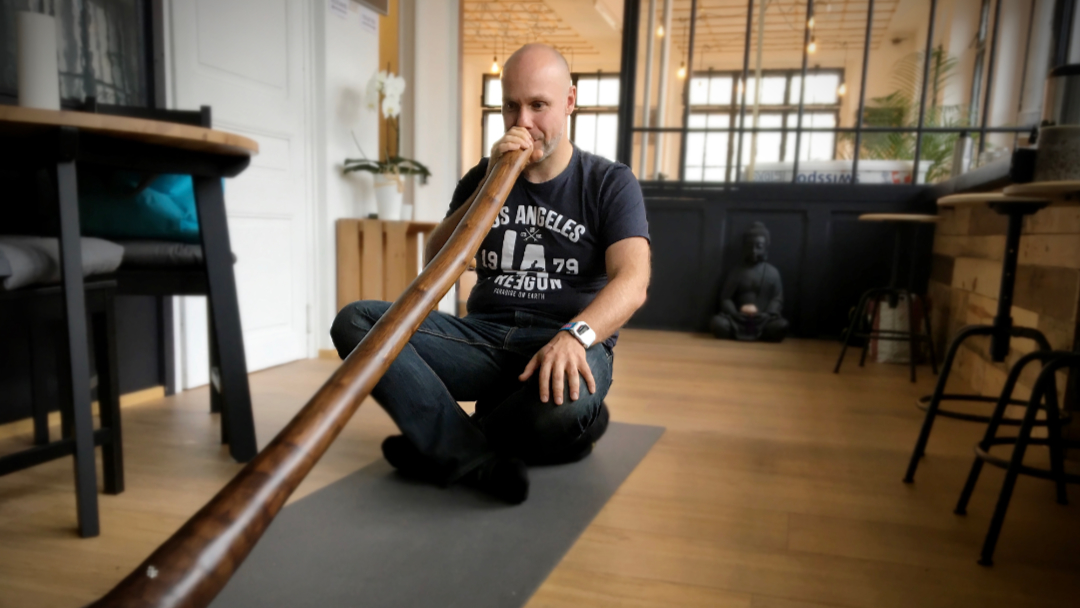
Definition
What is circular breathing?
Circular breathing allows musicians to play continuously without having to stop to get some air. The way it works is identical to that of the bagpipe, except that the air supply is not outside the body, but in the mouth (where the largest volume is obtained when inflating your cheeks). It is then enough to push the air contained in the mouth, and inhale through the nose at the same time.
The musician will have to use a reserve of air to continue the drone during inspiration.
“How can we breathe in while breathing out at the same time? That’s impossible!” Don’t worry, yes, it simply is impossible.
The mechanism
Cheeks or tongue?
During the breathing in phase, the musician must continue to expel air to maintain the drone. There are two main ways to push the air outside: the cheeks and the tongue.
Under MRI
What happens inside your mouth
Here is a video of Rodrigo Viterbo playing in an MRI. We can observe, at the moment of the WO (which marks the moment when he breathes in), that the back of his tongue is placed on the soft palate. Then, the back of his tongue goes forward to drive the air out of the mouth.
A real confusion
The big mistake
Let’s take for example this video by Kenny G explaining the circular breathing technique adapted to the saxophone. We can see very clearly that his cheeks inflate very little: it is his tongue that does most of the work. Cheeks are only accessories. And yet, he explains to us how to push the air with his cheeks!
Of course, I have nothing against Kenny G. This video is just a random example.
Most of the time, it is the tongue that plays the greatest role in circular breathing!
Before you start
Get ready for circular breathing
A perfectly straight drone
Don’t start by searching for your sound.
A powerful sound
It comes from your stomach. Use your lips too, and stay relaxed.
Cheeks you can control
Play your sound with your cheeks, then without your cheeks, using the corners of your mouth.
Take the time to understand it in your body and to feel it, before you even adapt it to the didgeridoo.
If your drone is not stable yet, start with my guide on how to play the didgeridoo.
Free course · 7 videos
Learn circular breathing in 4 steps
Most explanations of circular breathing are simply: use your cheeks and breathe in at the same time. If you learn it like that, it will be difficult. To learn it quickly, you need the right explanation.

Free course
Master circular breathing
- 7 videos in 4 steps

I remember very well the moment I understood the mechanism. One night, I was trying to follow an exercise without a didgeridoo. I thought to myself: “Okay Gauthier, you won’t sleep until you understand this.” After a few hours of training, I had managed to inhale through my nose while emptying my cheeks… I understood, and the sun had just risen. Certainly one of my most beautiful sleepless nights!
They took the step
★★★★★
“I mastered the basics of playing didgeridoo in my own living room. Thanks to your course, I was able to make that big step to circular breathing as well as master the basic sounds.”
Cyril, The art of the didgeridoo
“Circular breathing is a central theme in the course, and once we recognise that it’s of central importance in making progress, the need to grab our didge every day becomes obvious and even a PLEASURE!”
Ivan, The art of the didgeridoo
“I blocked on the circular breathing and left with it, at the end of the first 2-day course with you, as you had told me… Since then, blowing is a joy, an enchantment.”
Valérie T., workshop in Gimel-les-Cascades
Your breathing
5 reasons why you run out of breath
When you feel uncomfortable, it can be out of air, and it can also be too much air.
- You open your mouth too much. Feel a little quantity of air just in the middle of your mouth, like when you whistle very, very little.
- You push too much. Be quite dynamic with your stomach, not too much, and quite dynamic with your mouth, not too much.
- You take too little air. Close your mouth and let just a little quantity of air out: you will have time to breathe in.
- Your didgeridoo is wide open. Close the corners of your lips a little more and be a bit more dynamic with your stomach.
- You breathe with your chest. When you breathe in, your belly goes out; when you breathe out, your belly goes in.
Your body is the instrument; the didgeridoo is just the amplification.
From the largest air reserve to the smallest
To each rhythm its circular breathing
If you look at it more closely, you realize that the player has several choices to perform circular breathing.
The cheeks
The greatest air capacity: a longer sound for a greater inspiration.
The back of the tongue
Still a large volume of air. So it also suits rather slow playing.
The middle of the tongue
The rhythm should be quite fast, or there will be a small cut in the sound.
The tip of the tongue
Only usable for fast playing, because of the very small amount of air to be expelled.
A player will quickly get into the habit of using only one of these techniques. However, playing didgeridoo with only one circular breathing technique will greatly limit the rhythms and possibilities of variation.
The goal on the didgeridoo is to seek the maximum independence between these different options.
Your questions
Is circular breathing hard?
Let’s start with the most important thing: demystify the technique! Circular breathing is far from a mysterious technique, and believe in yourself: you can absolutely do it.
When you think about it, circular breathing is simply:
- an air reserve in your cheeks;
- then, while you breathe in through your nose, you push this air reserve out.
So start by putting circular breathing within your reach. Tell yourself: “Thousands of people have managed circular breathing, I don’t see why I wouldn’t!” With the right exercises, I guarantee it comes quite quickly!
How long does it take to learn circular breathing?
Learning and mastering circular breathing in all its forms takes years. But the basic technique is actually quite accessible, and rapidly: with good exercises and a previously stabilized sound, most of my students understand the mechanism in 2 or 3 classes, no more. If you still have a little gap but everything is synchronised, you have it: it is just a matter of running it in. Sometimes it can take longer, it’s true (a few months), but with regular practice and the right exercises, it ends up happening!
Can you circular breathe without a didgeridoo?
Yes. My way of teaching is to practise circular breathing without the didgeridoo first, then with it: it is the first of the four steps of my free course.
Does the straw and glass of water exercise help?
I have met a few people it helped. But water in a glass has very little resistance: with a tiny bit of air, you will see bubbles appear, whereas in a didgeridoo you have to send much more than a tiny bit of air. So it is an exercise I don’t particularly recommend, but give it a try anyway: you never know, it might trigger a click!
Do I need circular breathing to start?
It is better to start with the drone. Wanting circular breathing at all costs is one of the five mistakes most beginners make. Start with a very stable, straight sound, and learn to inflate and deflate your cheeks. In parallel, you can work on the circular breathing mechanism without the didgeridoo, then apply it to your instrument.
How do I play rhythms on the didgeridoo?
Circular breathing is the skeleton of your rhythm. Most of the time, we play sounds and breathe afterwards, as when we speak: on the didgeridoo, it is a mistake. Just breathe every time, regularly: a sound, a breath, a sound, a breath. That decides how fast or how slow you are going to be. See my lesson on your first rhythms
Going further
- Lesson 3: before circular breathing
- Lesson 4: the 4 steps
- Your sound and pressure
- Your first rhythms
- 5 wind instruments using circular breathing
The other guides

Choose a didgeridoo
Follow the guide, I have cleared the path for you.
Getting started
Start off on the right foot!
Which note should you choose?
Three big families of notes, each with its own character.
Good luck!
Any musician blowing into an instrument can acquire circular breathing very quickly and thus expand to new horizons.