


Skip to content

What Is a Didgeridoo and How Does It Work?

“Sorry… a what?” When I say I play the didgeridoo, this is often the reaction I get. So I learnt to say it slowly: a did-ge-ri-doo. Faces light up, but people still look doubtful.

The didgeridoo does not (yet) have the fame of the violin or the guitar. But this simple piece of wood has a lot to say. In this lesson, I explain what a didgeridoo is, where it comes from and how it works.

What is a didgeridoo?

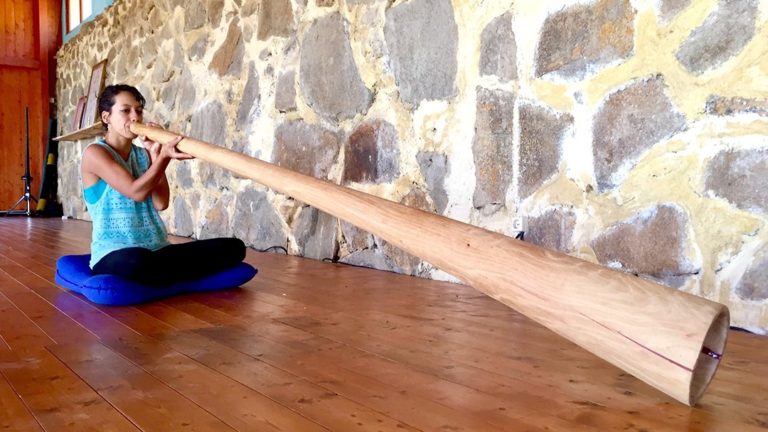
A didgeridoo is a musical instrument that comes from the Aboriginal people of Australia. It is considered the oldest wind instrument in the world.

Traditionally, it is not called a didgeridoo. Depending on where it comes from in Australia, it is called yidaki or mago. It comes from the Northern Territory, in Arnhem Land.

A tube, and only a tube

Traditionally, a didgeridoo is a eucalyptus trunk that termites have hollowed out from the inside. When the tree is cut, it still looks like a tree: a big piece of wood with a hole inside. The maker then takes wood off the outside to make it thinner.

In the end, a didgeridoo is a tube with nothing inside. As long as it measures between 1.20 m and 1.80 m, any tube will do: a PVC vacuum-cleaner hose (choose a new vacuum cleaner!), or even toilet paper rolls stuck together. Of course, they will not all sound as good.

That is why some people specialise in making didgeridoos: a good instrument requires real expertise. Makers who work with eucalyptus choose the right trunks, so that the instrument needs as few changes as possible. Nature shapes the instrument, and the player’s job is to make music with it.

An instrument with one single note

The didgeridoo only plays one note. That is why there are didgeridoos in E, in C, in D.

A violinist changes notes. A didgeridoo player uses one single note and brings out its natural harmonics. That makes the didgeridoo very close to the jaw harp and to overtone singing. It is a one-note instrument, but it has many surprises for anyone who takes the time to listen.

How does a didgeridoo work?

If you think about what a didgeridoo really is, it is an amplifier for your body. You only need to move something inside your body to change the sound. Here are the parts you use.

1. The lips

The lips make the sound. When you make them vibrate, the sound comes out of the didgeridoo.

2. The tongue

Move your tongue as if you were saying “yo yo yo”, without your voice: this is what I call harmonics. Move it with consonants like T and K, as in “ta-ko ta-ko”, and you get another kind of sound.

3. The cheeks

Moving your cheeks also changes the sound. The cheeks are used for circular breathing and for dynamics.

4. The voice

You can also use your voice while you play, for strong contrast.

Combine everything

The most interesting part is to combine all of them. For example, I can use a little of the K from the tongue and more lips to get a more dynamic sound.

Then comes circular breathing. With circular breathing, I breathe all the time, and I use all these sounds to make rhythms. Listen to the end of the video to hear it.

Why I fell for this instrument

Its history, the way it is made and its technique make the didgeridoo a fascinating instrument, with unbeatable originality. That is what attracted me when I started. I was looking for an original instrument to learn, and I was not disappointed.

If you want to try it yourself, start with my step-by-step guide to playing the didgeridoo.
Buying guide

Choose your didgeridoo

Being enthusiastic is one thing, but you still need to know what to start on! Follow the guide, I’ve cleared the path for you.

  • To get started: budget, note, pitfalls to avoid
  • To move up a level: my selection
Read the guide

5/5225 Google reviews

8996members

Read next

6 responses to “What Is a Didgeridoo and How Does It Work?”

  1. yves buclet Avatar
    yves buclet

    I bought your method, the booklet is really great, but I thought it came with a DVD with videos (didn’t pay attention)? so a bit disappointed… but congrats on your playing and your teaching work. Yves

    Automatically translated from French · See the original

    J’ai acheté ta méthode, très bien pour le livret, mais je croyais que c’était un dvd avec des vidéos (pas fais gaffe)? alors un peu déçu… mais bravo pour ton jeu et ton travail pédagogique.yves

    1. Hi Yves,
      Yes, The method is a paperback book that comes with a CD. I’m thinking about creating a video course but it’s a lot of work and I don’t have the time for it at the moment!

      Automatically translated from French · See the original

      Bonjour Yves,
      Effectivement la méthode est un livre papier accompagnée de son CD. Je réfléchie à faire une formation en vidéo mais c’est beaucoup de travail et pour le moment le temps me manque !

  2. Fanny Avatar
    Fanny

    How do you choose the right key based on your preferences and your voice’s tonality?

    Automatically translated from French · See the original

    Comment choisir sa note en fonction de ses envies, de la tonalité de notre voix ?

    1. Hello Fanny,
      Unless you play a lot with vocals (which is often not the case at the beginning), you’ll want to choose other criteria to pick your key.
      Actually, it’s enough to know what you want to play:
      • if you want to play slow and meditative rhythmic patterns, then you should look for keys like C or C#.
      • if on the contrary you want to play fast and sustained rhythmic patterns, try an E / E flat or even F (very high so harder to play).
      • if you want to do a bit of both, then D seems very well suited because it’s very versatile!

      I also wrote an article in which I recommend certain instruments to get started:
      https://gauthieraube.com/didgeridoo-choisir-apprendre-a-jouer/

      I hope that helps!

      Automatically translated from French · See the original

      Bonjour Fanny,
      À moins de beaucoup jouer avec la voix (ce qui n’est souvent pas le cas au début), on choisira d’autres critères pour choisir sa note.
      En fait, il suffit de savoir ce que tu veux jouer :
      • si tu souhaites jouer des rythmes plutôt lent et méditatif alors il faudra se tourner vers des notes comme DO ou DO#.
      • si au contraire tu veux jouer des rythmes rapides et soutenus, essaye un MI / MI bémol ou même FA (très aiguë donc plus dur à jouer).
      • si tu souhaites faire un peu des deux, alors le RÉ semble très bien adapté car il est très polyvalent !

      J’ai écris aussi cet article dans lequel je conseille certains instruments pour commencer :
      https://gauthieraube.com/didgeridoo-choisir-apprendre-a-jouer/

      J’espère que ça t’aidera !

  3. Gaudé Avatar
    Gaudé

    Gauthier can you mention the name of the artist you used on your blog? See you soon in Berne, congrats 🙂

    Automatically translated from French · See the original

    Gauthier peux-tu mentionner le nom de l’artiste utilisé sur ton blog? Xxx à bientôt à Berne congrats 🙂

    1. Good point, I’ve added it. Thanks!

      Automatically translated from French · See the original

      Tu fais bien de me le rappeler, c’est ajouté. Merci !

Leave a Reply