


Skip to content

Aboriginal Australians before the arrival of the settlers (1/10)

This episode is in French. My podcast is only available in French for now.

This episode marks the start of a series of conversations with Greg from Didgeridoo Passion. On Wakademy, I mainly talk about the didgeridoo (quite logically!) but not much about Aboriginal culture, because I’m far from being an expert in this field.

That’s why I asked Greg to come and answer my questions in a series of podcasts on this theme. Greg isn’t an expert (or is he?) but he wants to share his experience and knowledge of this culture he’s passionate about, so that we at least know its foundations.

In this first episode, we lay the groundwork by starting with an introduction to Aboriginal culture before the arrival of the settlers.

Enjoy the episode (in French)!

Subscribe and hear about the next episodes!

Apple Podcasts (iPhone)

Podcast resources

Books and comics written in French

Book

Pistes de rêve voyage en terre Aborigène by Barbara Glowczewski

Comics for children
• Didgeridoo by Frédéric Marais• Yidaki et le temps du rêve
• Yapa : Le Petit aborigène d’Australie

Books written in English

An Illustrated History of Australia from the Dreamtime to the New Millennium by A. K. MacDougall

Maps of Australia

Australia compared with other countries: France, Germany, Spain and many more fit inside it

The “real” size of this huge country, Australia.
You quickly realise it’s more of a continent than a single country.

Map of Australia locating Eastern Arnhem Land, north-east of Darwin

A 2,000-year-old rock painting is the oldest trace of the didgeridoo’s existence. It’s located in Arnhem Land.

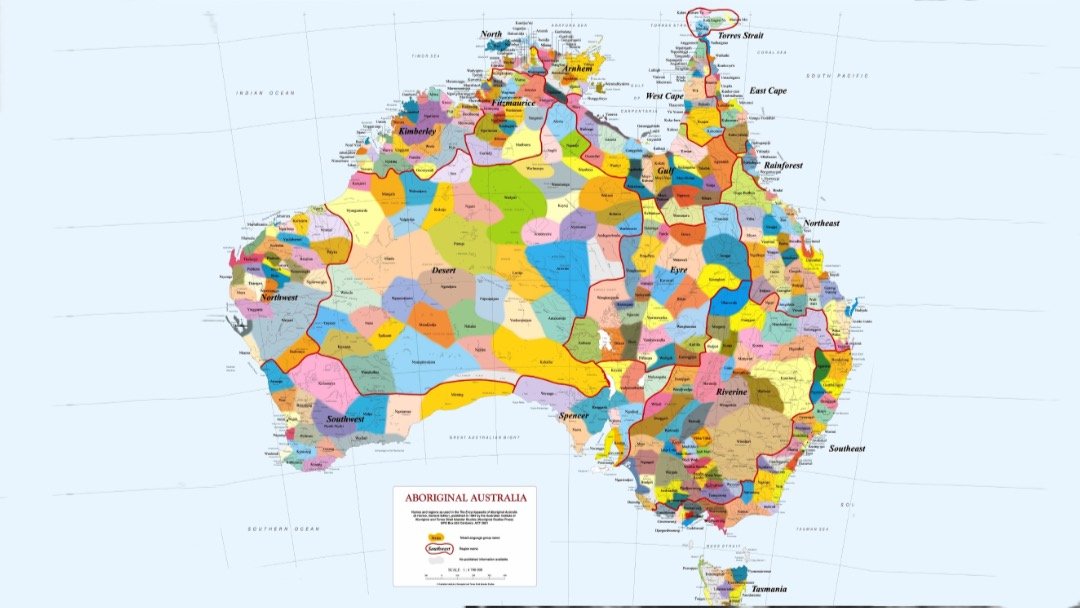
Map of Aboriginal Australia: the territories of the peoples and their languages

Map of the different Aboriginal cultures before the arrival of the settlers in Australia.

photo of Grégory Zwingelstein
About the author | Grégory Zwingelstein

Hi everyone! I’m Grégory Zwingelstein, the manager of Didgeridoo Passion. I’m happy to share my story and my experiences with the Aboriginal people of Arnhem Land, and to discover Didgeridoo Passion, click here!
Happy blowing, everyone!

Free course

Circular breathing in just a few days

Explanations that are clear, practical (!) and progressive. You’ll be surprised to see it’s simpler than it looks!

  • 7 videos in 4 steps

5/5225 Google reviews

9991members

Read next

11 responses to “Aboriginal Australians before the arrival of the settlers (1/10)”

  1. Thieum Thieum Avatar
    Thieum Thieum

    Fascinating and great podcast. Delicious information and great learning ahead ++++whetted my appetite for what’s next!++++YABON

    Automatically translated from French · See the original

    Passionnant et super PodCast.
    Savoureuses informations et grands apprentissages en perspective ++++mis enappétit pourla suite !++++YABON

  2. Patrick GARBOUS Avatar
    Patrick GARBOUS

    There are some books about Aboriginal people, but podcasts on this subject… there must be very few, at least one now.
    Thank you both and looking forward to the next ones.

    Automatically translated from French · See the original

    Des livres concernant les aborigènes, il y en a quelques uns mais des podcasts sur ce sujet… il doit y en avoir très peu, au moins un désormais.
    Merci donc à vous deux et vivement les prochains.

  3. Karl Esprit Nomade Avatar
    Karl Esprit Nomade

    Thank you both for this podcast.
    These 20 minutes are a great teaser for what’s to come!!

    Greg, to your knowledge, what was the social organization of Aboriginal people? A chief? A more horizontal organization? Did the organizational structure vary depending on the communities?

    300 years of post-colonial history… It unfortunately reminds me of Native Americans and English colonists in the Americas…

    Do we have any idea of the role the didgeridoo played in these different Aboriginal communities, between rhythms for rites of passage, dances and the simple pleasure of blowing?

    Thank you both anyway, I’m looking forward to the rest!

    Automatically translated from French · See the original

    Merci à vous deux pour ce podcast.
    Ces 20 minutes sont un super teaser pour la suite !!

    Greg, as ta connaissance, quel était le mode d’organisation social des Aborigènes ? Un chef? Une organisation plus horizontal? Est ce que le mode d’organisation variait en fonction des communautés ?

    300 ans d’histoire post colonial… Ça me rappel malheureusement les Amérindiens et les colons Anglais aux Amériques…

    A t’on une idée de la part que prenait le didgeridoo dans ces différentes communautés Aborigène, entre les rythmes pour les rites de passage, les danses et le simple plaisirs de souffler?

    Merci à vous en tout cas, j’attends la suite avec impatience !!

    1. Hi Karl,

      Thanks for all your questions, I’m noting them down and we’ll try to answer them in the next episodes. Don’t hesitate if you have more. 🙂

      Automatically translated from French · See the original

      Salut Karl,

      Merci pour toutes tes questions, je les note et on va tacher d’y répondre dans les prochains épisodes. N’hésite pas si tu en as d’autres. 🙂

      1. Karl Esprit Nomade Avatar
        Karl Esprit Nomade

        Hi Gauthier, hi Greg, one more question for your future podcasts – I’m wondering if the evolution of Aboriginal people (culture, beliefs, social organization…) was the same for communities on the continent and communities that migrated to Tasmania?

        Did they experience the arrival of settlers in the same way?

        Finally, how do you explain such a difference between the real Tasmanian devil and the cartoon one? :-; (just kidding of course :-=).

        Thank you both

        Automatically translated from French · See the original

        Salut Gauthier, salut Greg, une petite question supplémentaire pour vos futurs podcasts, je me demande si l’évolution des Aborigènes (culture, croyance, organisation sociale…) a été la même pour les communautés sur le continent et les communautés qui ont migré sur l’île de la Tasmanie?

        Ont-ils vécu l’arrivée des colons de la même façon?

        Enfin comment expliquez vous qu’il y ait une telle différence entre le diable de Tasmanie véritable et celui du cartoon ? :-; (non je déconne bien sur :-=).

        Merci à vous deux

  4. Hoël Avatar
    Hoël

    Wouldn’t the rock painting date back to 20,000 years ago instead?

    Automatically translated from French · See the original

    Elle daterai pas plutôt de 20000 ans la peinture rupestre ?

    1. Hello Hoël, as for the paintings themselves, they do date back around 2000 years.

      Didgeridoo Breath, which is also a didgeridoo shop (but located in Australia) mentions 3000 to 5000 years for the estimated age of the paintings.

      https://www.didgeridoobreath.com/kb_results.asp?ID=26

      Unless I’m mistaken, the 20,000 year figure is put forward but without “real scientific evidence” except that Aboriginal people say the didgeridoo has been there “since the beginning”.

      Personally, I tend to trust them by thinking that the didgeridoo is much older than 2000 years, so I “go with” the flow by mentioning around 20,000 years in my method.

      Don’t hesitate if you have any information to share!

      Automatically translated from French · See the original

      Bonjour Hoël, pour la peinture en elle-même, elle date bien de 2000 ans.

      Didgeridoo Breath qui est aussi un magasin de didgeridoo (mais situé en Australie) parle de 3000 à 5000 ans pour l’estimation des peintures.

      https://www.didgeridoobreath.com/kb_results.asp?ID=26

      Sauf erreur de ma part, le chiffre 20 000 ans est avancé mais sans “réelles preuves scientifiques” si ce n’est que les Aborigènes disent que le didgeridoo est là “depuis les origines”.

      Pour ma part, j’ai tendance à leurs faire confiance en me disant que le didgeridoo est bien plus vieux que 2000 ans donc je “suis” le mouvement en parlant d’environ 20 000 ans dans ma méthode.

      N’hésite pas si tu as des infos à partager !

  5. Martial Avatar
    Martial

    Great initiative, thank you both!

    Automatically translated from French · See the original

    Belle initiative, merci à vous deux !

    1. Thanks Martial!

      Automatically translated from French · See the original

      Merci Martial !

  6. Othello Ravez Avatar
    Othello Ravez

    Great idea for this podcast, and even the next ones.
    Shorter is nice too.

    Happy to hear Greg’s participation, who strikes me as a humble, passionate and warm person. It would be interesting to complete your duo with an exceptional guest (ethnologist) or someone else: Géraldine Leroux or others, and maybe even Aboriginal people in the future.

    What touches me about Aboriginal people is this relational link to the Earth but also between themselves through their codes of conduct. And these codes are governed by laws specific to clans, territories: food, water, elements. Notions we find in other root peoples, Navarro, Kagabas etc…

    So I imagine they had to manage their territory while living nomadically, and sometimes meet unfamiliar Aboriginal people with different codes, and decide amicably or not on the conditions of exchanges, crossings, negotiate with or without force…

    I can imagine a community meeting one of them with a stick in which he blows… the future didgeridoo…

    There is so much to say…

    Automatically translated from French · See the original

    Super idée ce podcast, et même les prochains.
    Plus court c’est sympa aussi.

    Heureux d’entendre la participation de Greg, qui est à mon ressenti une personne humble, passionnée et chaleureuse. Il serait intéressant de compléter votre duo par un ou une invité exceptionnel (ethnologue) ou autre : Géraldine Leroux ou autre voir peut être même dans le futur des Aborigènes.

    Ce qui me touche chez les Aborigènes c’est ce lien relationnel à la Terre mais aussi entre eux à travers leurs codes de conduites. Et ces codes sont régis par des lois propres aux clans, aux territoires : nourriture, eau éléments. Des notions que l’on retrouve chez d’autres peuples racines, Navarro, Kagabas etc…

    Ainsi, j’imagine qu’ils devaient gérer leur territoire en vivant nomade, et parfois rencontrer des inconnus Aborigènes avec des codes différents, et décider à l’amiable ou non des conditions d’échanges, de traversées, négocier avec ou sans force…

    J’imagine bien une communauté rencontrer l’un deux avec un bâton dans lequel il souffle… le futur didgeridoo…

    Il y a tant à dire…

    1. Hi Othello,
      I don’t know Géraldine Leroux but it could be a good opportunity to do an interview, maybe not a trio (since the interview would be remote, it could be hard to manage) but for a separate podcast.

      Thanks for the tip. 😉

      Automatically translated from French · See the original

      Salut Othello,
      Je ne connais pas Géraldine Leroux mais ça pourrait être une bonne occasion de faire une interview, peut-être pas une trio (car l’interview se faisant à distance, ça pourrait être difficile à gérer) mais pour un podcast à part.

      Merci pour le tuyau. 😉

Leave a Reply