



Today, I’m back with a short video to show you that a budget of €3 is enough to get your first didgeridoo! Of course, at that price you won’t get the Rolls-Royce of didgeridoos, but it’ll be more than enough to try it out and make your first sounds!
A PVC didgeridoo
A didgeridoo for less than €3? Well, it’s really simple: a plain PVC pipe between 1m and 1.30m long. Remember that the longer the pipe, the lower the sound. And so the rounder the vibration. So it’s up to you, depending on whether you like low or high notes. I wanted to make this video to show that with a PVC pipe, the drone still sounds pretty good. Obviously, this isn’t a high-end wooden didgeridoo, but remember it’s not quite the same price either!
The pipe diameter: between 30 and 40 mm
The diameter of the instrument should be between 30 and 40mm (50 mm for the adventurous!). In the video, the pipe has a diameter of 30/32 mm. The advantage of this diameter is that you don’t have to add wax or a PVC reducer. The size is directly 30mm, which is perfect for a didgeridoo mouthpiece.
It’s an easy solution that works well. All you have to do is lightly sand the end to smooth the edges so you don’t hurt yourself.
You can also use 40/42 or even 50/52 mm. Basically, the more open the diameter, the rounder and more enveloping the sound (but less precise). If you feel like playing a 40 mm didgeridoo with a reducer or a beeswax mouthpiece, it’ll still sound a bit better than this 30/32mm pipe.
Customise your didgeridoo
Well, let’s be honest, a PVC pipe like this does look a bit DIY! It even has the brand markings that really scream plumbing. It’s not exactly top-notch didgeridoo design. So you can paint it (it sounds silly, but it’ll change the look a lot). You’d feel a bit less like you’re holding a drainpipe!
Otherwise, you can also cut it into several sections:
- one third in 32 mm
- another in 40 mm
- and the last one in 50mm.
All joined with connectors.
Go for high-pressure PVC
Finally, the last tip is to consider using a high-pressure PVC pipe. These are dark grey pipes (not light grey). Since high-pressure PVC is thicker, the sound will gain in bass and be more “solid”. So it’ll sound a bit better, and even if it’s not essential, it’ll be a bit nicer to play.
If you’re interested, here are some photos kindly sent by Michael, a Wakademy member.

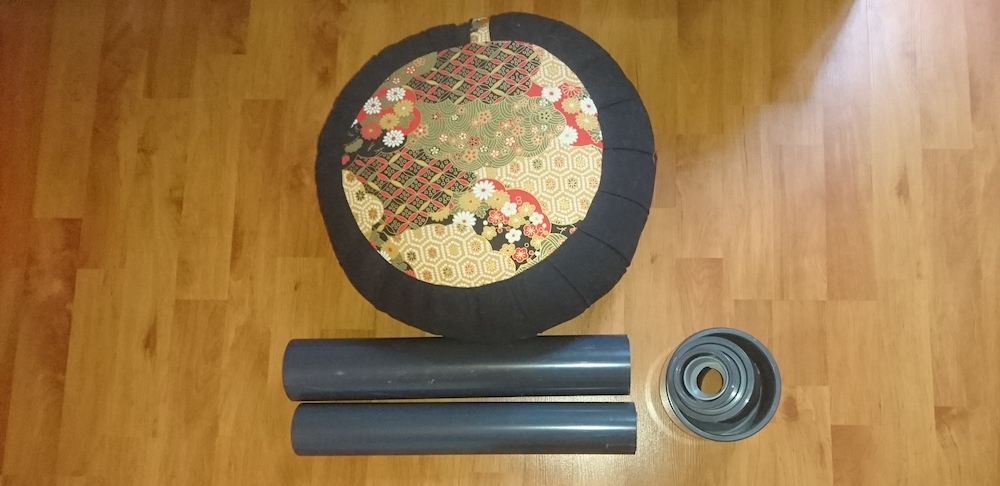

And I’ll hand over to Michael to tell us about his homemade didgeridoo:
“The total length of the didgeridoo is 175 cm. It’s made of 4 sections, each 40 cm long, plus the connectors. The connectors are female/female, so you simply slot the sections into one another.
However, even if the connectors are well made and fit fairly tightly, it’s not possible to adjust them with a heat gun. On my previous didgeridoo, I had to reshape the connectors by heating them, which in the end gave me perfectly fitting parts, with no air loss.
One small downside with high-pressure pipe: because the diameters of 2 of the pipes are too close and the pipe wall is too thick (high pressure), they don’t all nest inside each other, so it takes up more space.”
I’d like to add that if you want to make a take-apart didgeridoo, check carefully that there are no air leaks at the different connectors. The best thing is still to glue the connectors together once the didgeridoo is assembled. It’ll be harder to carry around, but you’ll make sure the air column of your didgeridoo is airtight.
Conclusion: don’t break the bank to get started!
Unless you’re fully convinced that you’ll keep blowing, there’s no point buying a very expensive first didgeridoo. As you’ve seen, a simple PVC pipe is very basic and accessible, and can help you produce your first vibrations. Once you’ve got your first sounds out and circular breathing in the bag (or not!), you’ll be able to try other didgeridoos. However, if you’re at that stage, I warmly recommend reading this article on which didgeridoos to choose to learn to play. It’ll save you from wasting money!
If you liked this or if you have any questions, don’t hesitate. I’ll be happy to answer!






Leave a Reply
You must be logged in to post a comment.