



Video in French
Eucalyptus or sandwich? Heavy or light? Wooden or beeswax mouthpiece? When you’re looking for a new didgeridoo, these questions keep coming back… and I’m asked them very often! In this last article of the series on choosing your didgeridoo, I give you my opinion on each of them. Let’s go!
Eucalyptus or sandwich didgeridoo: which one to choose?
There are two main ways of making a didgeridoo:
- termite-hollowed eucalyptus, which comes from Australia. The trunk is hollowed out naturally, then worked on by the maker (Read also: Five steps to make a eucalyptus didgeridoo);
- sandwich didgeridoos, made from dry wooden boards. The maker carves out two halves, then glues them back together to form the instrument.
At the end of the day, it doesn’t really matter! There are excellent didgeridoos in both categories (and I’m not the only one who thinks so). When you try an instrument, I advise you to close your eyes to this. That’s not what should guide your choice, but above all the sound, the feeling, and the criteria I presented in the other articles of this series. (Read also: Eucalyptus or sandwich didgeridoo: which one sounds best?)
The weight of the didgeridoo: a detail that isn’t one
I’m rarely asked about it, and yet it’s a very important criterion for me. A light didgeridoo will have a light sound, a heavy didgeridoo will have a heavy sound.
To give you a few landmarks (keeping in mind that all this remains very relative):
- under 2 to 2.5 kg: a light didgeridoo;
- around 3 kg: what I like. The didgeridoos of about 1.40 m that I weighed at Greg’s (Didgeridoo Passion) were between 2.4 and 3 kg, and my C weighs 3 kg for 1.60 m;
- 5 kg: that’s the weight of my Bob Druett. It’s a bit too heavy… but excellent in terms of sound!
Careful, this doesn’t mean that a very light didgeridoo is necessarily bad. Some instruments, short or narrow, couldn’t be any heavier anyway. But the lighter a didgeridoo, the less the sound, the bass and the harmonics are held: the sound becomes more ethereal, and the instrument sometimes hard to play.
Conversely, a didgeridoo that’s too heavy also becomes difficult. You can feel it on raw eucalyptus trunks, where there’s still a thick layer of wood that hasn’t been worked at all: they are almost unplayable. It feels like driving an ultra-heavy machine, with no flexibility at all!
So it’s all a question of balance. And the more didgeridoos you try, the more you’ll feel this link between weight and sound.
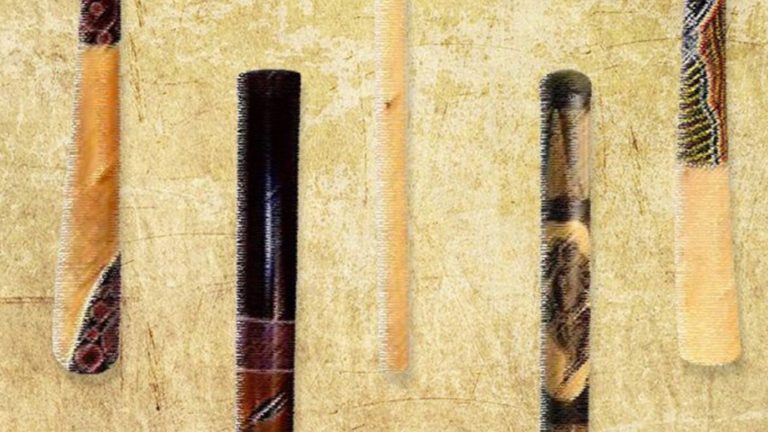
Wooden or beeswax mouthpiece?
In Australia, people still play a lot with beeswax mouthpieces. In Europe and the United States, on the other hand, wooden mouthpieces have become very widespread. 15 or 20 years ago, wooden mouthpieces didn’t exist: so we all started with beeswax! (Read also: 4 steps to make your beeswax mouthpiece)
Beeswax is fine. But once you’ve tried wood, you don’t want to go back! A wooden mouthpiece has real advantages:
- it doesn’t lose its shape,
- it’s cleaner and easy to clean,
- it offers a nice flat surface for your lips, whereas wax softens over time and ends up moving.
So I advise you to choose a wooden mouthpiece. And if your didgeridoo has a wax mouthpiece, you can do as I did: I bought a eucalyptus with a beeswax mouthpiece, removed the wax, and I’m making it a wooden mouthpiece. (Read also: When will we get mouthpieces worthy of our didgeridoos?)
What about yidakis and magos?
One last point: yidakis and magos are really made for playing traditional style. They are instruments designed for the traditional playing of Aboriginal Australians, two categories of instruments in their own right. It’s up to you to see if you connect with them!
To understand how they are used, and what sets them apart from all other didgeridoos, listen to the series of podcasts I recorded with Greg, a great enthusiast of traditional playing. (Listen: Introduction to the two main traditional playing styles of Aboriginal Australians, podcast in French)
The whole series
- How much does a didgeridoo cost? The 4 price ranges
- Didgeridoo notes: high, mid or low, which one to choose?
- Cylindrical or conical didgeridoo: which one to choose?
- Eucalyptus or sandwich didgeridoo: which one sounds best?
And you, eucalyptus or sandwich? Wood or beeswax? Feel free to share your experience or ask your questions in the comments!





Leave a Reply
You must be logged in to post a comment.