


Skip to content

Watch out for inexpensive didgeridoos!

The temptation to buy an inexpensive wooden didgeridoo can be great. But except for a rare gift of fate, the didgeridoos in this category are not a good choice! To be frank, the majority of didgeridoos found in music stores are of low quality. Here I’ll introduce you to four types of didgeridoos you should not waste your money on, thinking you have found a good beginner didgeridoo!

Mechanically bored teak and eucalyptus didgeridoos

These are the stars of the music stores. You will often find them standing in a corner with the rain sticks … Yes the rain sticks … (The didgeridoo is still not taken seriously by store owners!).


Unfortunately, the aforementioned are the “official” representatives of our good old wooden stick at all those retailers. You will find such didges all over the world (I’ve seen them for myself in India and even in Australia, home of the didgeridoo!).


Just because they are eucalyptus does not mean you should trust them – these come from Indonesia and not from Australia (a big difference!). They are hollowed out using a large drill bit, not by termites. These “instruments” have nothing going for them. The poor quality bore creates an air column cluttered with splinters, leading in turn to a muffled sound. As if that weren’t enough, the low-quality manufacturing renders them poor in harmonics with a weak bass and overall horrible playability.


In short, you can find much better quality and for less money.
Be aware of some unscrupulous sellers who will stubbornly attempt to convince you that the instruments are hollowed by termites. Not so fast; see below for some ways to recognize these types of didgeridoos.

How can you recognize a teak didgeridoo?

It is easy to detect. If you have in front of you a painted wooden instrument, with or without decorative carving priced between €30 and €80, then you are surely holding a teak.
Its shape is straight or slightly curved to allow a long drill bit to get through. You will often find it partially covered with a (poor) imitation of dot painting (an aboriginal painting technique that uses dots).

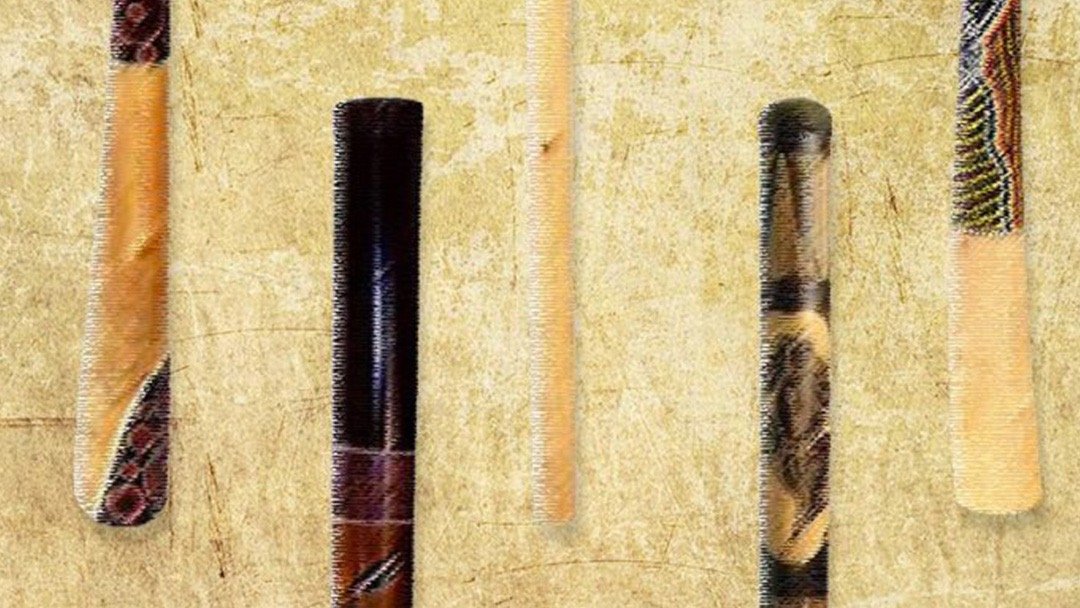
A teak looks like this:

Teck didgeridoo with painting dug by a drill An other Teck didgeridoo with painting dug by a drill A plain Teck didgeridoo dug by a drill

How can you recognize an Indonesian eucalyptus didgeridoo?

This type of instrument is most often made of rough wood and more rarely found carved. It is a light beige color but the bell is often darker then the rest of the instrument (or vice-versa). Its shape is very similar to the teak didgeridoo. Its weight should also be taken into account; it will be light, unlike the termite hollowed didgeridoo which will be denser and therefore usually heavier.

If you have already spotted all these criteria on the instrument, there is little doubt that it’s an Indonesian eucalyptus. However, you can always verify that a drill bit has been used by looking inside the didgeridoo. Look into the bell end of the didgeridoo, and aim the mouthpiece end toward a light source. You should see at least one, and maybe all, of the following:

  • splinters left by the drilling procedure (a eucalyptus didgeridoo that has been dug by termites will not have splinters);
  • the general shape of the air column is a pure cylinder (like the drill) as is the case in a teak didgeridoo;
  • at the far end of didgeridoo, the bell end is further gouged out and smoothed to widen the inside diameter.

These elements are the most striking and, of course, they can differ slightly from one didgeridoo to another. However, as was true with the teak, keep in mind that a wooden didgeridoo selling for between €90 and €220 is almost certain to be a mechanically bored instrument.

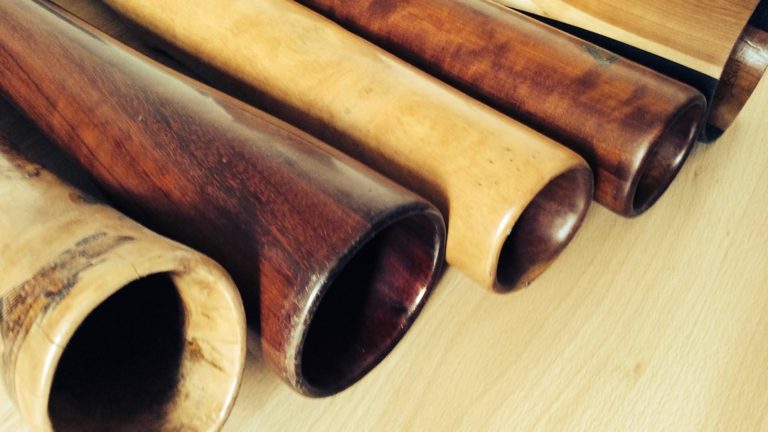
To get a better idea of what this might look like, here is an example:

An eucalyptus didgeridoo from Indonesia dug by a drill

Did you already buy one of these didgeridoos? (I can see that disappointment in your eyes!). Don’t despair. These can be fine to get you started playing the didgeridoo. I know because that’s exactly what I did. Later, when I felt the need to improve the sound and playability, I cut my didge in half lengthwise to be able to rework the inside. But in the end, I never undertook that work, nor did I even put it back together. I “solved” the problem by buying a much better didgeridoo. At least the thought was there!
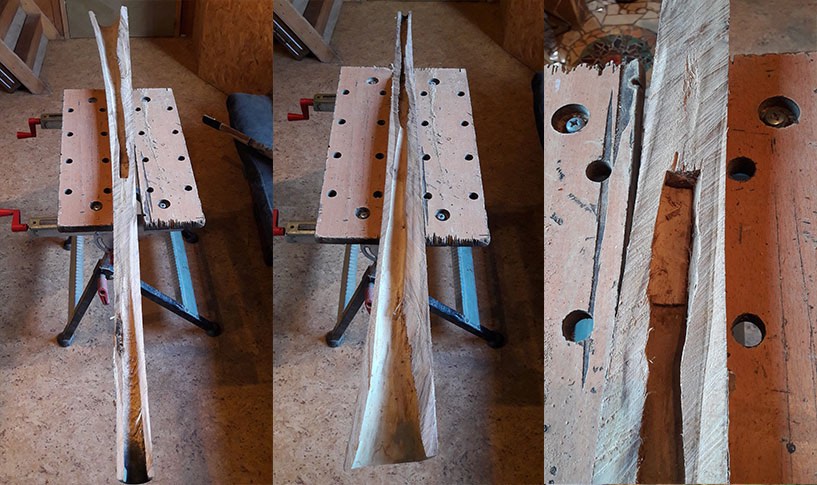
An example of a didgeridoo very badly dug by the drill
Thank you to Cedric for sending these pictures of his Indonesian didg which he cut in half.

When you see how this “didgeridoo” was bored through, there is no need for further comment. Just keep in mind that when you want to improve your playing after learning the basics, think about getting yourself a higher quality instrument. You will see, feel, and hear the difference!
In the meantime, you can rather simply vanish the interior of your didge to improve its sound somewhat.

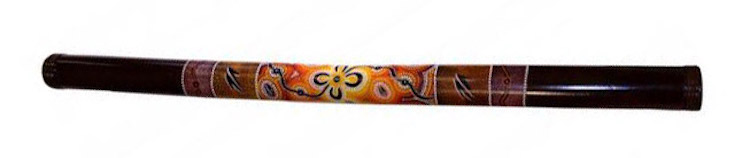
Industrial bamboo (prone to cracking)

This type of didgeridoo is even more widespread than the previous two. At the end of the 90s, when the music of the band Jamiroquai helped to spread the popularity of the didgeridoo, you could even find bamboo didges in some supermarkets!
Keep in mind their affordability is exceeded by their mediocrity. You will see them either painted (like their teak cousins) or engraved. The biggest disadvantage of these instruments is they typically don’t last long. They usually end up splitting.
Priced around €20, bamboo didges certainly seem like a a great deal, but they’re not. If you are moved by the thought of a bamboo didgeridoo, consider a handcrafted version like those made by David Defois. These are guaranteed to be quality instruments.
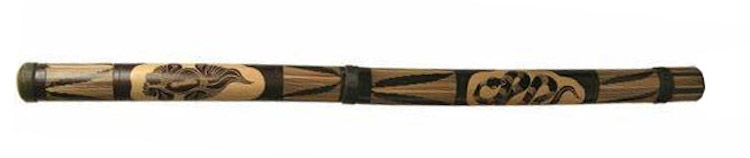
industrial bamboo didgeridoo with burned decoration
industrial bamboo didgeridoo with peint decoration

Eucalyptus hollowed by termites for less than around €400

Be careful with these, too . Being made from eucalyptus dug out by termites is not necessarily a sign of a quality didgeridoo. Why? Because in Australia the didgeridoo is almost always intended to be a decorative souvenir for tourists! No wonder most Australians do not take them seriously.


I still remember the customs officer’s reaction when I told them why I was coming to Australia. I had noted on the customs paper: “For the didgeridoo.” They burst out laughing: “No, but really, why are you coming?” And so began my journey…


In Australia, 95% of didgeridoos are sold in souvenir shops. They are manufactured quickly and with no attention to quality. One can even find didgeridoos as short as 50 cm to fit into a suitcase! Needless to say, they will end up as a decoration by the fireplace (or perhaps inside of it)!


All this to say that a termite-hollowed eucalyptus is not by itself a sign of quality. If you are there in Australia you can find a good deal for $100 (€75). A didgeridoo at that price will not be extraordinary, but you won’t be risking much. However, if you see a similar deal anywhere else on the planet, you better walk away.
For the same price you can get an incomparably better agave didgeridoo from Véfoun (FR) or Tyler Spencer (US) (check this article “What didgeridoo to start with“) which is incomparably better!

Conclusion: Most buyers and most sellers know very little about the didgeridoo

Obviously this article is not intended to shame music stores and other retailers handling didgeridoos. Most of them are not well informed about the instrument. They carry what the market seems to demand – and it is up to us, the players, to make an informed choice among what’s available out there. I hope this article will help you avoid getting lost in that jungle.

See the next article for several didgeridoos I can recommend for you.

If you have questions or comments, please leave them here. And if you enjoyed this article, please share it!

Free course

Learn circular breathing in a few days

Explanations that are clear, practical (!) and progressive. You’ll be surprised to see it’s simpler than it looks!

  • 7 videos in 4 steps

5/5225 Google reviews

8996members

Read next

22 responses to “Watch out for inexpensive didgeridoos!”

  1. Karine Avatar
    Karine

    I bought a Didgeridoo almost twenty years ago at a kind of flea market in Australia. Because I thought it was a beautiful object. Extremely heavy, I had it sent to France by mail. I don’t know anyone who could tell me what it’s made of and how much to sell it for or ship it to the Abo museum in Adelaide. I’m not a musician and I don’t know its sound…

    Automatically translated from French · See the original

    J’ai acheté il y a presque vingt ans un Didgeridoo, dans une espèce de brocante en Australie. Parce-que je trouvais que c’était un bel objet. Extrêmement lourd, je me le suis envoyé en France par voie postale. Je ne connais personne qui pourrait me dire en quoi il est et combien le vendre ou l’expédier au musée Abo d’Adelaide. Je ne suis pas musicienne et je ne connais pas son son…

    1. Gauthier Aubé Avatar
      Gauthier Aubé

      Hi Karine,
      I might be able to help you, even though I’m not sure I’m competent in this area and especially without being able to try the instrument.
      You can send me photos on WhatsApp:
      https://wa.me/message/NRMMBFQ5X6NLH1

      That will be easier!

      Automatically translated from French · See the original

      Bonjour Karine,
      Je peux peut-être vous aider, même si je ne suis pas sûr d’être compétent dans ce domaine et surtout sans pouvoir essayer l’instrument.
      Vous pouvez m’envoyer des photos sur WhatsApp :
      https://wa.me/message/NRMMBFQ5X6NLH1

      Ce sera plus simple !

  2. Hi and thanks for the advice!
    It’s hard to find some good didgeridoos to start!

    1. Gauthier Aubé Avatar
      Gauthier Aubé

      Hi Gary, sorry I didn’t see your comment!
      So my turn to thank you for your comment. It’s a good motivation for me. ?

  3. Scott Avatar
    Scott

    Thanks for this article. I am wanting to start the journey and haven’t pulled the trigger in one yet.

    1. Gauthier Aubé Avatar
      Gauthier Aubé

      Sorry Scott, I didn’t see your comment before.
      So, didn’t your start now ? ?

  4. Julien Avatar
    Julien

    Thank you for your quick response, that’s really kind of you… But I’m set on buying a didge in eucalyptus… I’ll follow your advice and I’m thinking of going with one from didgeridoo-passion.fr which I think is a good reference, unless you have other sites where I can order a good eucalyptus didge!!!

    Automatically translated from French · See the original

    Je te remercie pour ta réponse rapide c’est vraiment genial de ta part… Mais je suis vraiment parti pour m’acheter un didg en eucalyptus… Je vais suivre ton conseil et je pense me rabattre sur un didg de didgeridoo-passion.fr qui je pense est une bonne référence, à moins que tu aies d’autres site ou on peut commander un bon didg en euca !!!

    1. You can go to Didgeridoo-passion with your eyes closed. Greg is passionate and will never sell you a didge that doesn’t suit you… If you have a bit more budget then you should find a good eucalyptus! It’s especially the latter that determines the purchase. 🙂

      Automatically translated from French · See the original

      Tu peux aller cher Didgeridoo-passion les yeux fermés. Greg est un passionné et ne te vendra jamais un didg qui ne te conviendra pas… Si tu as un peu plus de budget alors tu devrais trouver un bon eucalyptus ! C’est surtout ce dernier qui détermine l’achat. 🙂

      1. Julien Avatar
        Julien

        Thank you again for your quick replies…

        Automatically translated from French · See the original

        Je te remercie encore pour tes réponses rapides…

  5. Julien Avatar
    Julien

    Hi,
    First of all your website is great…
    I’d like your opinion on this type of didge:
    https://www.didgeridoobreath.com/Didgeridoo-Starter-Pack-Large-Buy-Online-p/d-packh.htm
    They ship worldwide….
    Thanks for everything!!

    Automatically translated from French · See the original

    Salut,
    Tout d’abord ton site est super…
    Je voudrais ton avis sur ce type de didg :
    https://www.didgeridoobreath.com/Didgeridoo-Starter-Pack-Large-Buy-Online-p/d-packh.htm
    Ils livrent dans le monde entier….
    Merci pour tout !!

    1. Hi Julien,
      glad you like my website, thanks. 🙂

      As for didgeridoo-breath, it’s the reference shop in Australia. However, I wouldn’t order such an entry-level didgeridoo. I know it’s very tempting to get a termite-hollowed eucalyptus… But a didgeridoo from Véfoun in agave will be at almost the same price and will sound REALLY a lot better (like night and day!): http://vefoun-didg-kreation.kazeo.com/

      Of course, if you like the didge at didgeridoo-breath, go with what feels right to you. 🙂

      Automatically translated from French · See the original

      Salut Julien,
      heureux que mon site te plaise, merci. 🙂

      Pour didgeridoo-breath, c’est le magasin référence en Australie. En revanche, je ne commanderais pas un tel didgeridoo d’entrée de gamme. Je sais qu’il est très tentant d’avoir un eucalyptus creusé par les termites… Mais un didgeridoo de chez Véfoun en agave sera quasi au même prix et sonnera VRAIMENT nettement mieux (le jour et la nuit !) : http://vefoun-didg-kreation.kazeo.com/

      Après bien sûr, si le didg te plait chez didgeridoo-breath fait comme tu le sens. 🙂

  6. […] dans le monde entier (pour ceux qui recherchent un instrument pour débuter, lire cet article sur les didgeridoos pas chers) Au-delà de ça, je pense qu’il y a une place pour tous les styles et types de didgeridoos, […]

  7. Hello Gauthier,

    Thanks for this article. I’d like to find a didgeridoo in Airvault, but the more I read about it, the more I realize that choosing an instrument is a real headache!
    I’m a beginner (1 year in) and have been practicing with a PVC so far. I’m very tempted by a “Zéfoun”, but it’s going to cost me an arm and a leg budget-wise. (just an expression, of course!..)
    What I was wondering is whether as a beginner, the difference between an instrument at 200 and at 400€ will really be noticeable.
    Thanks for your advice.
    Christophe

    Automatically translated from French · See the original

    Bonjour Gauthier,

    Merci pour cet article. J’aimerai me trouver un didjeridoo à Airvault, mais plus je lis sur le sujet, et plus je réalise que le choix d’un instrument ‘est un véritable casse-tête !
    je suis débutant (1 an) et ai pratiqué avec un pvc jusqu’ici. Je suis très tenté par un “Zéfoun”, mais il va falloir que je m’arrache un bras au niveau du budget. (enfin, c’est juste une expression !..)
    Ce que je me demandais, c’est si en tant que débutant, la différence entre un instrument à 200 et à 400€ sera vraiment notable.
    Merci pour tes conseils.
    Christophe

    1. Hi Christophe,
      I can understand it’s a real headache when you’re just entering the didgeridoo world and don’t know anything about it!

      In reality, it’s quite simple, because many choices eliminate themselves naturally:

      If your budget is less than 250€
      I recommend you start with the plastic didgeridoo that I recommend in this article: https://gauthieraube.com/debutant-didgeridoo/didgeridoo-choisir-apprendre-a-jouer/

      If your budget is between 200 and 400€
      Then I strongly recommend Véfoun and his agaves.

      If your budget is between 650 and 1000€
      Alex-didg or didg-element are both an excellent choice.

      If you come to Airvault
      Then you’ll be able to try many instruments and that’s something to take into account. If I were you, I’d start by checking out the didgeridoo-passion stand (coming from me, Greg is really nice). You’ll get an idea of what a high-end instrument is (he sells the best makers including Alex-didg and didg-element).
      Then you can walk around and test all the other didges at the festival, but at least you’ll have the reference point of what a really great sounding instrument is.
      At Airvault, there are many makers selling didgeridoos around 300€ that can be interesting. Basically, you’ll have quite a few choices for didges under 400€. At that price, you’ll have globally identical quality and no scams. Trust yourself in your choice and pick the one that suits you.
      If you spot me there and need my opinion, don’t hesitate to come find me. I can help you (even though the festival goes by very quickly because I’m quite in demand).

      Automatically translated from French · See the original

      Bonjour Christophe,
      Je peux comprendre que ce soit un vrai casse-tête quand on arrive dans le monde du didgeridoo et que l’on ne connait rien à l’affaire !

      En réalité, c’est assez simple, car beaucoup de choix s’éliminent naturellement :

      Si ton budget est de moins de 250€
      Je te conseille de commencer avec le didgeridoo en plastique que je recommande dans cet article : https://gauthieraube.com/debutant-didgeridoo/didgeridoo-choisir-apprendre-a-jouer/

      Si ton budget est entre 200 et 400€
      Là je te conseille vivement Véfoun et ses agaves.

      Si ton budget est entre 650 et 1000€
      Alex-didg ou didg-element sont tous les deux un excellent choix.

      Si tu viens à Airvault
      Alors tu vas pouvoir essayer de nombreux instruments et ça c’est à prendre en compte. Je serais toi, je commencerais par voir le stand de didgeridoo-passion (vient de ma part, Greg est super sympa). Tu pourras te faire une idée de ce qu’est un instrument haute de gamme (il vend les meilleurs fabricants dont Alex-didg et didg-element).
      Ensuite, tu pourras te balader et tester tous les autres didg du festival, mais au moins tu auras le référentiel de ce qu’est un instrument qui sonne vraiment très bien.
      À Airvault, il y a de nombreux fabricants qui vendent des didgeridoos autour des 300€ qui peuvent être intéressants. En gros, tu auras pas mal de choix pour des didgs en dessous de 400€. À ce prix-là, tu auras une qualité globalement identique et pas d’arnaque. Fais-toi confiance dans ton choix et prend celui qui te convient.
      Si tu m’aperçois là-bas et que tu as besoin de mon avis, n’hésite pas à venir me chercher. Je pourrais t’aider (même si le festival passe très rapidement car pas mal sollicité).

  8. Hi Gauthier,

    Thanks for your articles that also reflect my own experience in the didgeridoo world for almost 20 years now… Choosing a real didgeridoo is always tricky both in Europe and Australia, both on a technical level and on the level of the misconception one can have about what a good instrument is when starting out. Regarding carbon fiber, I was able to design 2 with an entrepreneur specialized in this material and the result is very surprising especially in the bass and sub-bass frequencies.

    Automatically translated from French · See the original

    Bonjour Gauthier,

    Merci pour tes articles qui reflètent également ma propre expérience du monde du didgeridoo depuis maintenant presque 20 ans… Le choix d’un vrai didgeridoo est toujours épineux aussi bien en Europe qu’en Australie, aussi bien sur le plan technique que sur celui de la perception erronée que l’on peut avoir d’un bon instrument lorsqu’on débute. Concernant la fibre de carbone, j’ai pu en concevoir 2 avec un entrepreneur spécialisé dans ce matériau et le résultat est très étonnant notamment dans les basses et infra-basses.

    1. Hi Patrick,
      It’s true there are several schools when it comes to construction materials. But no matter what I try, wood is still what I find warmest and most balanced… I might get a chance to blow into a carbon fiber didge that will convince me. 🙂

      Automatically translated from French · See the original

      Bonjour Patrick,
      C’est vrai qu’il y a plusieurs écoles dans les matériaux de construction. Mais j’ai beau faire, c’est quand même le bois que je trouve le plus chaleureux et équilibré… J’aurais peut-être l’occasion de souffler dans un didg en fibre de carbone qui me convaincra. 🙂

  9. Great, thank you for this description. Having discovered the “practice” of the Didgeridoo through some of the worst instruments out there, instead of disappointment I feel rather the desire to discover a real model. I had a hunch about the quality of my first purchase (at a wine fair…;) ), nevertheless it was enough to spark the flame. I’m dying with impatience to be able to get myself a decent one at least, and even then, I’m using the links to get an idea of what the prices are etc… !!! While waiting to feel those unique vibrations again, I’m starting to research and practice for the circular breathing 😉

    Automatically translated from French · See the original

    Superbe , merci pour ce descriptif .Ayant découvert la “pratique” du Didgeridoo sur ce qui se fait de pire , au lieu de déception je ressent plutot l’envie de decouvrir un vrai modèle .Je me doutais bien de la qualité de mon 1er achat (dans une Foire aux vins …;) ), neanmoins cela a suffit à déclencher l’étincelle .Je piétine d’impatience de pouvoir m’en offrir un correct au moins déja , et la encore , je passe par les liens afin de me faire une idée de ce que sont les prix etc… !!! Dans l’attente d’à nouveau ressentir les vibrations uniques , je commence à me renseigner et m’entrainer pour le souffle 😉

    1. You seem really enthusiastic. That’s by far the main thing! The didge comes second. But you’ll see, a good didge really changes everything! 🙂

      Automatically translated from French · See the original

      Tu as l’air vraiment enthousiaste. C’est de loin le principal ! Le didg ne vient qu’après. Mais tu verras, un bon didg, ça change beaucoup de choses ! 🙂

  10. nadia Avatar
    nadia

    Not to mention that most didges made of bamboo, teak, or Indonesian eucalyptus (sold in non-specialized shops or at markets) are already cracked 🙁

    Automatically translated from French · See the original

    Sans compter que la plupart des didgs en bambou, teck, ou euca indonésien (vendus dans les commerces non spécialisés ou sur des marchés) sont déjà fissurés 🙁

    1. Yeah, it’s true they’re all patched up! Seriously though, our screwed-on friends have nothing going for them. 🙂

      Automatically translated from French · See the original

      Oui c’est vrai que ils sont tous rafistolés !
      Non vraiment, ils n’ont rien pour eux nos amis vissés. 🙂

  11. What do you think of carbon fiber and PVC didgeridoos?

    Automatically translated from French · See the original

    Qu’est ce que tu pense des didg en fibre de carbonne et pvc?

    1. I’m not a big fan of carbon fiber… But that’s mainly because of their shapes. They’re often pure cones with a very narrow mouthpiece and a bell that opens up a lot. This shape of didgeridoo gives a very distinctive sound. If manufacturers worked on the shape, then I think this material would have some advantages. That said, I’m one of those who think nothing beats wood! 🙂

      As for PVC didgeridoos, that depends on what you mean by that. Feel free to contact me by email to dive deeper into the question!

      Automatically translated from French · See the original

      Pour les fibres de carbone, je ne suis pas très fan… Mais cela vient surtout de leurs formes. C’est souvent des pures cônes avec une embouchure très étroite et une cloche qui s’ouvre beaucoup. Cette forme de didgeridoo donne un son très typé. Si des fabricants travaillaient la forme alors je pense que cette matière aurait quelques atouts. Ceci-dit, je fais parti de ceux qui pensent que rien ne remplace le bois ! 🙂

      Pour les PVCs, là ça dépend de ce que tu entends par là. Tu peux me contacter par mail pour plus approfondir la question, n’hésites pas !

Leave a Reply