



Video in French
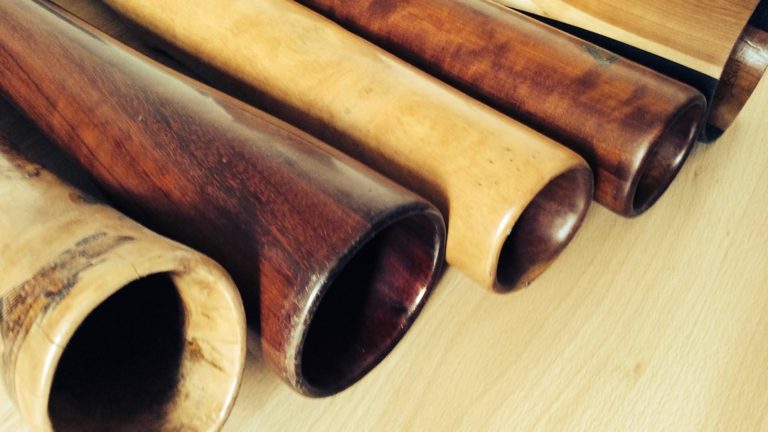
A didgeridoo only has one note. Apart from overtones (which remain a detail among all the didgeridoo techniques), you will never change note while playing. And yet, one look at a few instruments is enough to see it: didgeridoos come in all shapes! And it’s precisely this shape that shapes the way your single note expresses itself. This is what we call the character of the instrument.
So why care about it? Quite simply because it’s what will define your playing style, even more than the note! (Read also: What note to choose when starting to play the didgeridoo?)
In this article, I help you see more clearly so you can find the didgeridoo that suits you. Let’s go!
Cylindrical or conical: the two big families of didgeridoos
To put it simply, there are two main categories of didgeridoos: cylindrical ones, which are straight, and conical ones, which gradually flare out.
- Cylindrical didgeridoos generally have less backpressure, meaning less resistance from the air column. Their sound is less powerful but softer, and they use more air. Pushed to the extreme, they can feel a bit mushy… as if you were playing in mud!
- Conical didgeridoos have high backpressure. Their sound is much more powerful and their playing often very dynamic, punchy. Pushed to the extreme, however, they can become a bit aggressive.
(Read also: Backpressure and the didgeridoo: what if we’re focusing on the wrong debate?)
It all starts at the beginning of the air column
To understand a didgeridoo’s character, look at the beginning of its air column. Careful, I’m not talking about the mouthpiece here, but about the starting diameter of the didgeridoo once the mouthpiece is removed. On some instruments, the mouthpiece is carved directly into the wood. On others, the start is wider and a wax or wooden mouthpiece has been added, as on my D, which I made in Australia with Bob.
This starting diameter can vary enormously from one instrument to another. And it hugely, hugely, hugely conditions the character of your didgeridoo.
In the video, I let you hear two Ds side by side. The first starts very narrow and gradually flares out. The second starts much wider and flares out much less. The result: to get the same note, the second one is much shorter. That’s the rule to remember: the more cylindrical a didgeridoo, the lower it is; the more conical, the higher it is.
Open or closed: two ways of playing
This starting diameter doesn’t only change the sound, it also changes the way you play.
- On an open didgeridoo, you’ll use your cheeks much more, especially to play wobbles (those sounds that follow each other very quickly). The air column offers space, and this kind of playing comes naturally.
- On a closed didgeridoo, you’ll use your cheeks less. You’ll rather keep them inflated all the time and play more with overtones, those famous trumpet sounds.
Indeed, on a closed didgeridoo, the pressure naturally holds your cheeks inflated. On an open didgeridoo, this pressure is lower: keeping your cheeks inflated to play overtones becomes harder (but not impossible!). So it all depends on the colour you want to give your playing.
My opinion (and I’m not neutral!)
Those who know my work know it: I love open didgeridoos, meaning those that start at 40 mm minimum. To give you an idea, my open D is 50 mm inside, compared with 30 mm for the other one. Between 30 and 40 mm, the difference is already huge. So between 30 and 50 mm…
I find these instruments leave much more space. And above all, their sound is rounder and much more pleasant to the ear. I learned on this type of didgeridoo and, still today, I feel at home when I play one.
But let’s be honest: an open didgeridoo is much harder to play. In my eyes, this difficulty is well worth overcoming, but it’s up to you. Tastes differ, and I can’t choose for you!
Why are most didgeridoos closed?
If you look at didgeridoos for sale, you’ll notice that most of them start very narrow. There are several reasons for this:
- it’s a makers’ habit,
- they are easier to play,
- they sound louder,
- and it’s simply what most players are looking for.
In Australia, Greg actually told me that wide didgeridoos don’t sell: too hard to play, nobody wants them!
Also note that a wide didgeridoo is often a short one. An instrument that is both long and wide would have a huge bell… and that’s quite rare!
What it changes in the sound
In the video, I compare two Es: a big fat one with a huge bell and a very narrow start (it really kicks!), then a shorter and wider E. On the latter, you’ll hear many more harmonics, and above all much more space between them. That’s physically due to its open air column: the bass and the harmonics are as if separated from each other.
Of course, there are harmonics in both cases. The big difference shows mostly in the frequency analysis. The closed didgeridoo has more presence in the low mids, which can give a more boxed-in, busier sound, both when recording and when listening. On the other hand, it brings out the low voice more. (Read also: Why analysing your didgeridoo’s frequencies will help you play better!)
Same thing with the two Cs at the end of the video. My C, about 15 cm shorter and open at 50 mm, has a bass that spreads more and more roundness. In return, it demands a lot more from your playing.
A trick for choosing without trying: two PVC tubes
Ideally, of course, you should try the instrument before buying it. With a little experience, you’ll see that simply looking at a didgeridoo already tells you a lot (even if surprises are always possible!).
If you have to buy your didgeridoo remotely, here’s a trick: get two PVC tubes.
- one tube 30 mm in diameter,
- one tube 50 mm in diameter, to make the difference really clear. You’ll need to narrow its mouthpiece, either with beeswax or with a reducer.
As for length, a 1-metre tube plays an E, but the sound isn’t very pretty. I’d rather recommend 1.10 m to 1.20 m. (Read also: 4 steps to make your beeswax mouthpiece)
You’ll then be able to hear the difference, but above all to feel it. Because it’s first and foremost a matter of sensation:
- the open tube gives a feeling of resonance: as soon as you blow, it vibrates strongly!
- the closed tube gives a feeling of tension, which can be very pleasant too.
Some people hate playing an open didgeridoo, others a closed one. It’s up to you to find what suits you!
Last step: three questions I’m often asked, about the wood, the weight and the mouthpiece. (Read also: Eucalyptus or sandwich didgeridoo, weight, mouthpiece: 3 questions before buying)
And you, open or closed? What kind of didgeridoo do you play? Feel free to share your experience or ask your questions in the comments!






Leave a Reply
You must be logged in to post a comment.