



Termite-hollowed eucalyptus or sandwich didgeridoo: which one sounds best? It’s often the first question people ask when looking for a new instrument. And as you can guess, the answer isn’t that obvious… In fact, it all depends on you, your tastes and what you’re looking for.
To see more clearly, I took advantage of a visit to Didgeridoo Passion to compare the two. Let’s go!
Two ways of making a didgeridoo
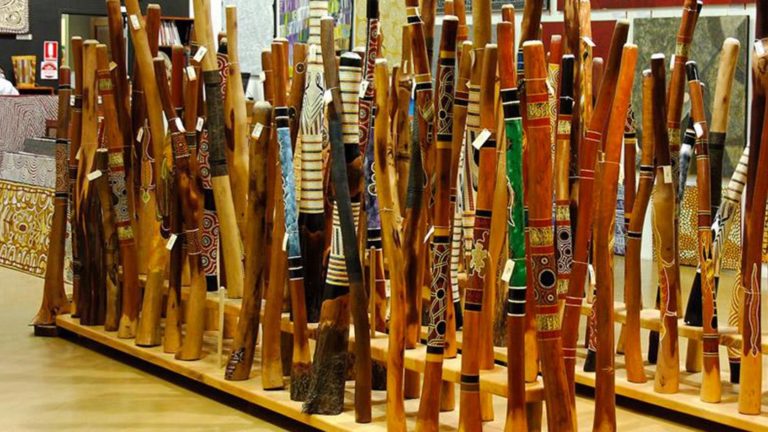
- Termite-hollowed eucalyptus is the image we all have of the didgeridoo, and the one closest to tradition. Careful though, that doesn’t make it a traditional instrument: among Aboriginal Australians, people speak of yidaki or mago. (Listen: Introduction to the two main traditional playing styles of Aboriginal Australians, podcast in French, with Greg, a great specialist of traditional playing)
- The sandwich didgeridoo (not the nicest name, I’ll grant you!) does without termites. The maker starts from two dry wooden boards, carves them out, glues them together, then shapes the outside of the instrument.
Eucalyptus: a unique piece
By definition, a termite-hollowed eucalyptus is a unique piece. The trunk is cut, cleaned, then shaped on the outside according to the galleries dug by the termites. The irregularity of the wood, its grain, the path of the termites… all this gives it a unique charm that you will never find on an instrument made from A to Z. That’s undeniable. (Read also: Five steps to make a eucalyptus didgeridoo)
Sandwich: a reproducible air column
On the other hand, the sandwich didgeridoo is made from A to Z, as any luthier would do. You can of course find unique pieces too, but it has one big advantage: the maker can reproduce exactly the same air column.
Imagine you hear an instrument at a festival and love it: its maker could potentially make you the same one! You can make series and be sure to find the same quality every time. Which isn’t the case with eucalyptus, often very irregular.
Making from A to Z also means being able to create a 100% custom-made didgeridoo, by shaping the air column perfectly. Termites, on the other hand, pre-shape the instrument, which somewhat limits customisation. That’s actually what I’m working on more and more with Chris from Didg Element, a French maker based in the Vercors, whose work I encourage you to discover.
In both cases, quality varies a lot
Unique piece or series, one thing is certain: quality varies enormously in both categories.
A good eucalyptus is an instrument whose maker has properly finished the termites’ work, and managed to get the best didgeridoo out of the trunk he had. Because from a 2-metre trunk, you can make many different instruments! How you hollow it out further, the thickness you leave, the drying of the wood, all the finishing work: all this will make the instrument more or less beautiful, and more or less good in terms of playability, resonance and acoustic quality.
And in Australia, 95% (or even 99%!) of eucalyptus didgeridoos are poorly finished, mass-produced for tourists and of poor quality. You’ll often have a better chance of finding a good eucalyptus at Didgeridoo Passion, in France, than by going to Australia, where you’ll be drowned among instruments of no interest at all. (Listen: Do you have to go to Australia to find the best didgeridoo?, podcast in French)
It’s a bit the same with sandwiches: some are made quickly, a bit hastily, with an average finish and an average sound. Personally, I have a preference for makers who start from beams or dry wooden boards and shape everything from A to Z: I find a consistency in the making and in the quality that I haven’t found in instruments made from a branch or a trunk found in the forest. But it can also be a philosophy, an ethic: making an instrument from wood that grew near home. (Read also: French makers of local, high-quality didgeridoos)
And the price?
Price-wise, honestly, it doesn’t change much. To keep it short, it’s from about €800 to €1,000 that you’ll find an instrument that holds up and sounds good, whether it’s a eucalyptus or a sandwich. Below that, it’s hard to find an instrument that really has these qualities (even if there are exceptions, of course). Eucalyptus can be a little more expensive, since they come from far away, but it’s not night and day. (Read also: How much does a didgeridoo cost? The 4 price ranges)
The comparison: two Ds side by side
In the video, I play two Ds of roughly similar size: a sandwich by Horizonde (made by Nicolas Aussel from dry wooden boards, a range that sounds really great from what I’ve been able to test), and a eucalyptus by Wix Stix, a maker who often offers very beautiful pieces. One of the two isn’t quite tuned to D, hence a small difference in pitch.
You may prefer one or the other, but both sound good. And the difference you hear doesn’t really come from one being a eucalyptus and the other a sandwich: it comes above all from the air column and the maker’s work. (Read also: Cylindrical or conical didgeridoo: which one to choose?)
In a blind test, I don’t think I could tell a eucalyptus from a sandwich. 20 years ago, yes, there could be big differences. But today, didgeridoos made from wooden boards have reached such quality that you hear very little difference.
In the end, it’s a matter of love at first sight
So, what speaks to you most: the unique piece, or a didgeridoo made from A to Z? For me, the didgeridoo remains above all a matter of love at first sight. Unique eucalyptus or sandwich, when you fall for an instrument, you know it. It’s not rational at all, it can’t be explained: there’s a spark! And I find that pretty amazing with the didgeridoo.
And you, eucalyptus or sandwich? I’ve surely forgotten a few things: feel free to add to it in the comments, so that this article is as complete as possible for those asking themselves the question!




Leave a Reply
You must be logged in to post a comment.