



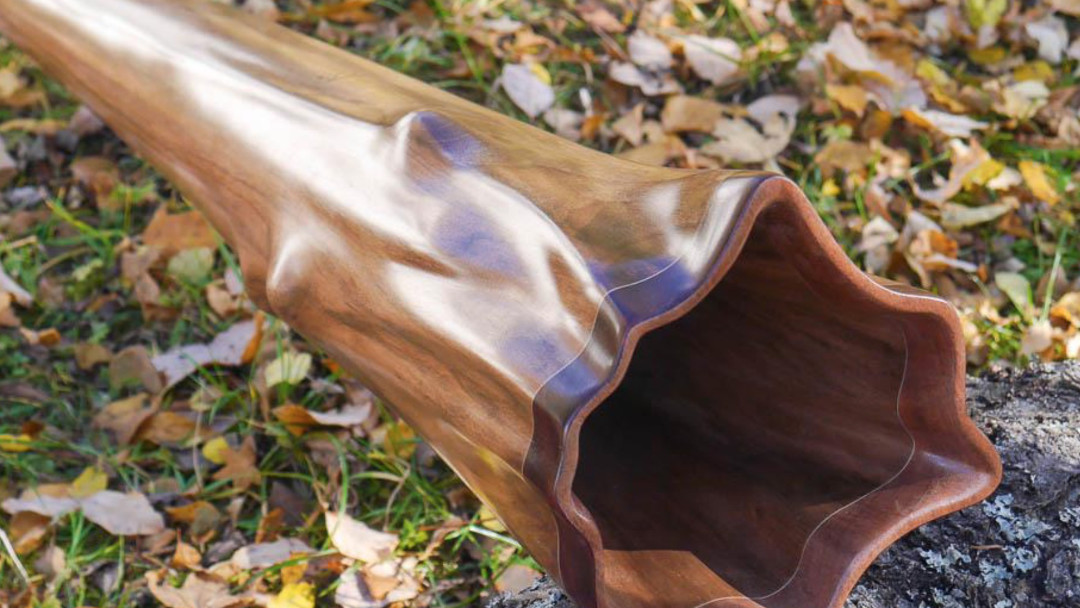
At a time when our dear planet is begging us to change our way of life, when COVID is forcing us to rethink trade across the globe, it is also time to think local for the didgeridoo. As you already know, historically, the didgeridoo is a eucalyptus hollowed out by termites that grew in Australia (see also: The origins of the didgeridoo, the Aboriginal people of Australia). However, since the mid-2000s, some enthusiasts have developed a know-how that makes it possible to get very high-quality didgeridoos made in France (and in Europe)… So here is a list of French didgeridoo makers that will interest all those who would like to buy a didgeridoo designed and made locally!
Making local didgeridoos: two main methods
Broadly speaking, to make a didgeridoo without the help of termites, the most common technique is to hollow out a piece of wood after cutting it in two (see also: How about making your own didgeridoo?!). But where the two methods differ is in the choice of material. So I’ve organized the article in two parts, each reflecting one of these two techniques:
• in the first, you’ll find the didgeridoo makers who start from dry wood panels.
• in the second, I’ll tell you about the didgeridoo makers who have opted for branches or tree trunks collected around where they live.
Didgeridoo makers who start from dry wood panels
This technique is directly inspired by traditional lutherie. The maker starts from two dry wood panels, which he hollows out as he wishes and then glues back together. The last step is shaping the outside of the didgeridoo to the desired design. This technique has the big advantage of giving access to very good quality wood, often of consistent density, with optimal drying. Personally, I really like this technique because it gives excellent results. The only ethical constraint is the wood supply, which can come from anywhere in the world. So it’s up to the maker to choose, according to his values and needs, the species he will work with (they can be local or exotic).
DidgElement
Christian started making his instruments in 2007. Christian starts from dry wood panels, like any luthier does. He then added a few curves and nuances to the design, bringing it closer to the natural shape of a trunk. He also invented the Evoludidge. This new-generation didgeridoo has an interchangeable part that changes the length of the instrument, and therefore its note. It’s an excellent idea and superbly executed (I talk about the pros and cons of multi-note didgeridoos in this article). That said, Christian doesn’t only make Evoludidges; you’ll also find more conventional didgeridoos at more affordable prices. I started working with Christian in 2025 to create a signature didgeridoo that truly “sings”, and I love this instrument. Feel free to contact Chris to find out more about it (it’s a little marvel).
Website: http://www.didgelement.com
Location: Autrans (38)
Price: between 600€ and 2500€
Ujazi
Julien Doutaz came to didgeridoo making a little later than Alex and Christian. Julien’s instruments are light, broadly inspired by the Didgelement style but with didgeridoos that often have more open air columns. If you know my work, you know I’m quite a fan of this kind of configuration (see also: 4 essential criteria to understand the psychology of your didgeridoo!). You can discover his journey by reading the interview I did with him in this article: Ujazi didgeridoo – A didgeridoo maker on the rise! Recently, he has been collaborating with Zalem to create signature instruments designed specially for Zalem’s playing.
Website: https://www.ujazididgeridoo.com
Location: Courtenay (38)
Price: between 600€ and 1000€
Alex-didgeridoo
Alexis Rousselle is the maker who popularized this building technique. I remember the first year Alex had his stand at the Rêve de l’Aborigène, it was in 2005 or 2006. He had termite-hollowed eucalyptus for sale and, in the middle of them, one or two very straight, very thin didgeridoos. Players were doubtful about this design, which clearly broke with the curves of eucalyptus (I have to admit I was wondering too!). It was new and you could feel it. But through the quality of his work and the acoustics of his instruments, Alex showed that this technique had big advantages, both in terms of design and of the musicality of the didgeridoo.
Website: https://alex-didgeridoo.com
Location: Lille (59)
Price: between 650€ and 1200€
Pivert didgeridoo
I’m happy to talk about Laurent Fradet in this article! Laurent started selling his instruments in 2010 and has kept improving ever since. He took up the principle of tunable didgeridoos developed by DidgElement to make his own version (T’n’T Didge). He also developed didgeridoo tuning with more or less retractable mouthpieces. I don’t know his instruments very well, but I’ve noticed a nice evolution in his approach. Othello Ravez, whom I fully trust, told me he appreciated Laurent’s work.
Website: http://pivertdidgeridoos.fr
Location: Allonne (79)
Price: between 600€ and 1000€
WoodSlide
I’ve often talked about Jean-Yves Redors and his WoodSlides (see also: Several notes in one instrument, a quick overview of slide didgeridoos!). Jean-Yves has established himself as the world’s leading maker of wooden tunable didgeridoos, quite an achievement! The quality of his work is well proven. This type of instrument will suit all players who need to have several notes with them.
Website: https://woodslide.com
Location: Bouguenais (44)
Price: between 600€ and 1000€
Didgeridoo making with plywood
Hexspira
Here is a didgeridoo that is original, to say the least: a hexagonal model made from plywood sheets. Whether or not you like the design, what’s striking about the didgeridoos of Colas (who is also an excellent player) is the acoustic quality/playability you get for the price. What’s more, he has created several ranges that make it easy to find your way. The value for money is almost unbeatable: the sound is rich, the playability excellent, and the price stays very reasonable. If you’d like to know more about Colas’s approach, I invite you to listen to the podcast “Hexspira, didgeridoos that are going to make some noise… meet Colas Tastu!”. And feel free to have a look at the Hexspira website to discover his world!
Website: https://www.hexspira.fr/
Location: Foissy-lès-Vézelais (89)
Price: from 350€
Didgeridoo makers who start from local branches
This third technique gives the instruments a more natural look, the instrument’s aesthetic is more “roots”, and you’ll “really” be blowing into a trunk or a branch. These didgeridoos are champions of local because the wood is often collected in the maker’s region. However, the maker has to make sure to select wood species not only for their looks but also for their acoustic qualities.
Kanarchoad
To tell the truth, I didn’t know where to put David Defois! You may have started blowing (or you may still play) on one of his bamboos. In fact, I highly recommend them for beginners (see also: Which didgeridoo should you choose to learn to play?). However, David also makes two other types of didgeridoo: the KornBass, an instrument between the trombone and the didgeridoo, and the Kromm Boud, a didgeridoo curved like a saxophone (see also: Interview with David Defois: creator of the didgeridoo-trombone!). You’ve probably understood why I didn’t know where to put David!
Website: http://www.kanarchoad.com/fr/accueil/
Location: Kergrist-Moëlou (29)
Price: on quote
Horizondes didgeridoo
Even though Nicolas Aussel sometimes works with dry wood panels, I’ve noticed that most of his instruments (he’ll correct me if I’m wrong!) come from locally collected branches or trunks. Nicolas’s choice is to avoid cutting down a living tree to get his wood. Nicolas has also teamed up with Kelu (a didgeridoo/beatbox-oriented player) to pool their skills as both players and makers. The result is a range of didgeridoos (from branches or from boards) that can suit as many people as possible: from beginners to experienced players.
Website: http://horizonde-didgeridoo.com
Location: Porchères (33)
Price: from 200€ to over 1000€
Eole didgeridoo
I met Guillem for the first time when I went to teach a workshop near Perpignan in 2018. He lived in the little village hosting the workshop, a simply beautiful place. At that time, Guillem had been making instruments for a few years but wasn’t officially “set up”. Since then, his website has gone online with instruments available, and I’m happy to see how he has progressed. He also regularly shares his new didgeridoos on the Wakademy forum. And, from what I’ve heard, his instruments are clearly improving in quality with each new creation!
Website: https://eoledidgeridoo.fr
Location: Sainte Colombe de la commanderie (66)
Price: from about 350€ to 1000€
Wood’n didge
Benoit-Pierre is one of the latest arrivals among French makers. He makes his didgeridoos from branches or trunks that have already fallen; just like Nicolas Aussel, he won’t cut down a living tree to make a didgeridoo. I don’t know Benoit-Pierre’s didgeridoos well; however, I was able to try one of his instruments during a workshop in Switzerland. I was pleasantly surprised! Even though experience will enrich his approach, it seems to me that his beginnings are rather promising and his prices rather attractive.
Website: https://www.woodanddidg.fr
Location: Bourg-de-Sirop (39)
Price: from 150€ to 600€
To finish, I want to make it clear that I’m not disparaging eucalyptus didgeridoos imported from Australia. I have many didgeridoos of this kind and I really enjoy playing them. In fact, I recommend the online didgeridoo shop run by Greg, didgeridoo-passion, where you can be sure to find quality.
And of course, if you want to share the details of your favorite maker or give feedback on the instruments you have, that’s what the comments are for! And believe me, they’re always a pleasure to read!
Leave a Reply
You must be logged in to post a comment.