


Skip to content

Several notes in one instrument: a quick tour of slide didgeridoos!

Over the last 20 years, a major development has shaken the didgeridoo world: tuning. The most common technique is to use a slide system. Ingenious, you’ll tell me. However, and even if it’s very appealing, the character of a didgeridoo is also very limited with this technique. Ingenious, then, but not necessarily suited to everyone.

Some makers have worked hard to make our dear piece of wood no longer a one-note instrument, but a tunable one. Before diving headfirst into a simple list of slide didgeridoos, let’s take a closer look at who this new kind of didgeridoo is for. It’s important to know whether this type of didgeridoo will suit your needs. Then, once we’ve weighed the pros and cons, we’ll review the most famous slide didgeridoos in their category!

Tuning a didgeridoo comes at a price

Several notes (in a single instrument) automatically means compromise. Let me explain.

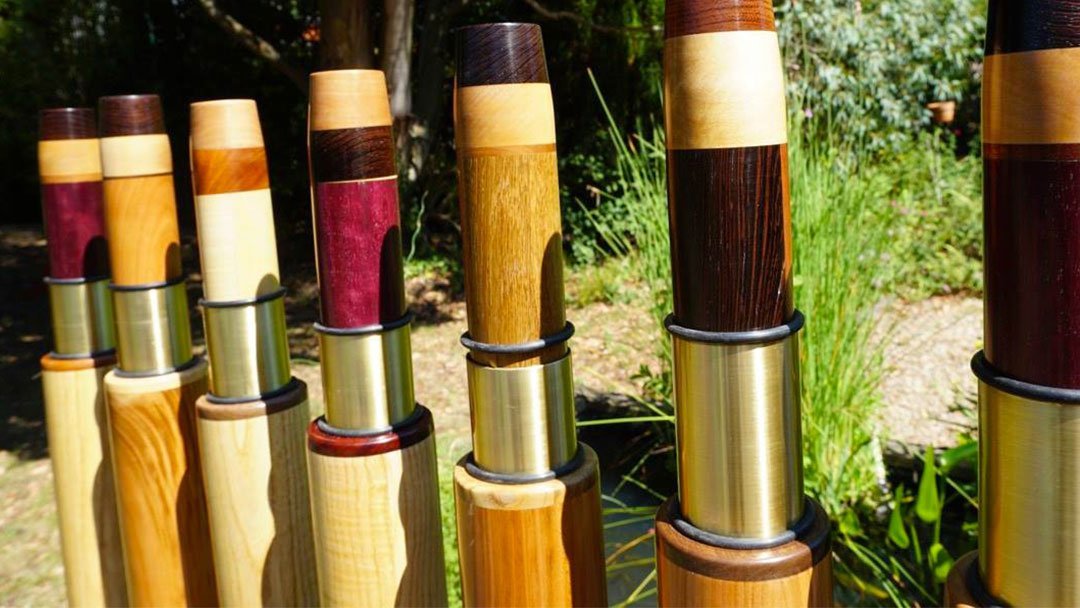
To adjust the notes of a didgeridoo, you have to change its length. To do this, the most common system (and the one I’m going to talk about here) is made of two or more tubes that slide into one another. Let’s say it straight away: the idea is good and works very well.

The thing is, a didgeridoo is (to keep it simple) a mix of a conical shape and a cylindrical shape (read also: 4 essential criteria to understand the psychology of your didgeridoo!). And as you’ll quickly have understood, for two tubes to slide easily into each other, the cylindrical shape is a must. The conical part can be placed at the bell, but you can imagine that this will remain limited.

And that’s the whole dilemma.

Having only one shape (or almost) in a didgeridoo will limit the character of each note. In other words, they will almost all have the same character. From this point of view, the expression of the didgeridoo is very limited.

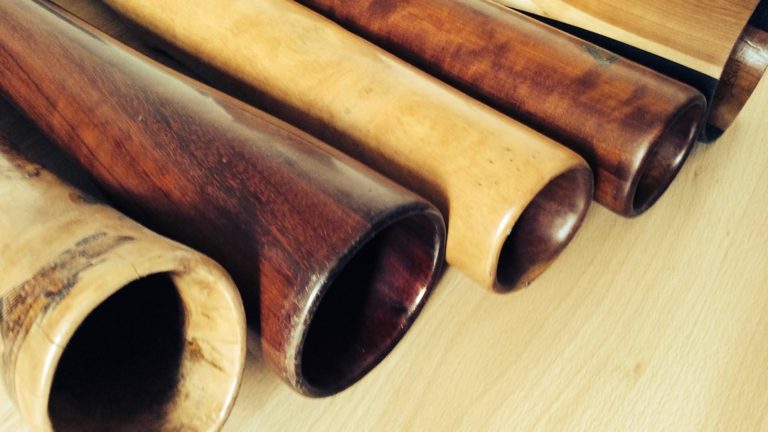
If we’re talking about character, then no slide didgeridoo can replace a unique instrument. It’s physically impossible. And yet, in my opinion, that’s what’s wonderful about this instrument: two didgeridoos in D can have a completely different timbre. For example, one might encourage you to develop attacks, rhythm or speed. While the other will support you in working on your cheeks or on the roundness of the sound, for example.

The drone of each of these didgeridoos will then develop very particular frequencies that belong to it alone. So each of them will have its own story to tell. And when that story meets yours, the alchemy of music will do its work. And your journey can begin. That’s the whole magic of the didgeridoo.

The Dalai Lama smiling

“Sow an act, and you reap a habit; sow a habit, and you reap a character; sow a character, and you reap a destiny.”

• • •

Dalai Lama

To illustrate my point, here are two audio examples taken from my research on didgeridoo acoustics (read also: Why analysing your didgeridoo’s frequencies will help you play better!)

Didgeridoo in D made with Bob Druett in Australia

Didgeridoo in D made by the Australian maker CrooKedStiXz

In these two sound examples, you can clearly hear the big difference in character. We’re dealing with two very distinct fellows here!

However, let’s not mix everything up, and let’s water down our wine a little (those of you who have been following me for a while will notice that I’m learning to be more tolerant! Haha!).

The slide didgeridoo, a didgeridoo for playing in a group

Right, we now know that with a tunable didgeridoo, the character of the instrument will be limited. That’s a fact. Fortunately, all is not lost! And Jean-Yves Redor (the inventor of WoodSlides, see below) wouldn’t have been selling hundreds of instruments all over the world for 10 years if his concept were pointless.

So against the strong character of the instrument, we have to set one of the great qualities of this world: adaptability. Indeed, it’s sometimes welcome to set aside a bit of character in order to fit in with others. And that’s exactly the role of slide didgeridoos: slipping into musical evenings and adapting to the many keys being played. Personally, I’m a solo player, so I look for maximum character in my instruments, but many of you want to play with other musicians.

In those conditions, you can guess that the slide didgeridoo becomes interesting. Being able to cover most of the commonly played notes with a single instrument is a feat that a one-note didgeridoo can’t pull off, despite all its goodwill (and its good character ;-)).

André Gide

“Intelligence is the ability to adapt.”

• • •

André Gide | French writer

So it’s mainly your needs that will determine whether to choose a slide didgeridoo. If you’re going to play with other musicians, then the question may come up. And of course, one doesn’t rule out the other. You can very well have several didgeridoos, some with character and some with a slide… In short, life is roomy, there’s space for everyone!

Come on, enough talking, let’s review these famous instruments! 🙂

Seven slide didgeridoos worth considering

NB: I want to make it clear that I earn nothing from sales. I’m independent and make my living by offering didgeridoo workshops and online courses. What I say in this article is only my opinion, and I can only encourage you to form your own.

The Didjeribone

The Didjeribone was invented by the Australian Charlie McMahon (read also: 10 Australian didgeridoo players you should know!). At the time it was a big success; if I’m not mistaken, it was the first slide didgeridoo on the market. I remember that in the early 2000s, you’d come across quite a few of them. I had one too (I actually wonder what became of it!). I might as well say it straight away: this didgeridoo is a bit outdated compared to what’s being made today. In its day it did a great job, but its plastic nature really limits its acoustics.
However, a player like Ronald Brown managed to develop his own style with the Didjeribone. In this specific case, the Didjeribone is indeed irreplaceable, unless you invest in a Korn Bass (see below)!

Ronald Brown playing a Didjeribone

Range: from low G to high G
Min length: 95cm
Max length: 170cm
Weight: about 0.5kg
Price: about €110
Where to buy it? Didgeridoo Breath – Australia

The Slide Didge

The Slide Didge is a variation of the Didjeribone. Because its plastic is thicker, it sounds much better than the Didjeribone. However, while it may be enough to start blowing, it will quickly become limiting, once again because of that plastic quality in the sound…

Greg from Didgeridoo Passion shows us how the Slide Didge works and sounds

Range: from low Bb to high F
Min length: 127cm
Max length: 200cm
Weight: 1.6kg
Price: €89
Where to buy it? Didgeridoo-Passion

The Phônodidg

Phônodidgs are developed and made by Franck Pillonetto, a Belgian player who has pushed the limits of PVC. Indeed, if you want to make a slide didgeridoo, you can fit two PVC tubes into each other. It works. But let’s be honest, the system has its limits too, both in terms of air leaks and acoustics. Starting from this idea, Franck developed his own instruments. And we have to admit that the resulting sound is good (and not too plasticky) for a very reasonable price. You can have up to 7 tubes (watch the weight in that case)! However, the 2-tube configuration already seems more than enough (at a very affordable price) and gives very promising results.
As I don’t have a Phônodidg, I asked Othello Ravez, who plays one regularly, for his feedback on the instrument. Here’s a summary of his answer:

  • It’s a heavy instrument (to be precise, Othello plays a 4-tube configuration with a large opening, weighing 5.5kg)
  • I like this didge for the low notes, mainly from low G to low B. For these notes, the bass is stable and the instrument is easy to amplify. On the other hand, for higher or lower notes, the sound has a plasticky timbre.
  • The instrument is fragile because of the plastic. One fall and it breaks. On the other hand, the plastic glues back together very well and the didgeridoo can easily be used again.
  • The maker’s mouthpieces still need improving.
  • All the same, in terms of sound quality for the price, it’s top notch. For travellers, the 2-tube configuration is excellent. It’s a good practice didge. And finally, I feel that with my 4-tube configuration, the sound is equal to that of WoodSlides.

The Phônodidg, an alternative used by many players including Othello Ravez, here with his band Oloji.

Range: Not provided
Min length: from 83cm to 85.50cm
Max length: Not provided
Weight: from 1.7kg to over 6.5kg
Price: from €90 to €730
Where to buy it? PhônoDidge
The information above is based on this PDF provided by Franck.

Hard Fiberglass Didgeridoo

With Andrea Furlan’s didgeridoos, we switch to colour mode! Even if colours are a matter of taste, you have to admit that the customisation work on Andrea’s didgeridoos is accomplished. Just like Phônodidgs, you can choose the number of tubes when ordering. A little bonus: the mouthpiece is interchangeable, and even if there’s still some way to go, it shows a real research effort! (read also: When will we get mouthpieces worthy of our didgeridoos?

In this video, DidgBreath presents Andrea Furlan’s Hard Fiberglass Didgeridoo

Range: from low G# to G
Min length: 142cm
Max length: 250cm
Weight: Not specified
Where to buy? Hard Fiberglass Didgeridoo
The information above may vary depending on the model.

WoodSlide

It’s kind of the star of slide didgeridoos. I have to say that Jean-Yves, its inventor, does a very good job. The finish is impeccable, and the instrument is rather elegant, with clean lines. And to top it off, the WoodSlide models evolve every year. Jean-Yves always finds a way to improve his instruments, despite the constraint of the shape. In short, an achievement worth highlighting! To put it simply, if you’re looking for a quality slide didgeridoo, I highly recommend them.

Zalem playing his WoodSlide – Live Looping – Multiverse

Range: from high F# to low G
Min length: 1m (classic range) or 0.78m (travel range)
Max length: 2.75m (classic range) or 2.15m (travel range)
Weight: 3.8kg (classic range) or 2.8kg (travel range)
Price: from about €900
Where to buy? Woodslide

Walter Strasser

Walter Strasser is a German maker. The first time I tried his instruments was at the Swiss festival Swizzeridoo. If I remember correctly, that was in 2007. To change the notes without distorting the character of the instrument too much, Walter was clever. He added a relatively short slide in the first part of the didgeridoo. That way, the body of the instrument can play with the conical aspect, while the slide stays cylindrical. A system that made a strong impression on me at the time, especially since these didgeridoos are very well made. The trade-off is a narrower range than a classic slide didgeridoo (see below).

Greg from Didgeridoo Passion (him again! ;-)) presents a didgeridoo by Walter Strasser.

Range: C, C#, D, D#, E, F, F#
Min length: About 1.65 m
Max length: About 2.18 m
Weight: About 4kg
Price: From about €1,450
Where to buy? Walter Strasser
The information above may vary depending on the model.

Korn Bass

I might as well warn you straight away: here, we’re entering another world. David Defois spent several years developing the Korn Bass. Can we still call it a didgeridoo? That’s the question raised by Sylvain Jargot, who now plays only the Korn Bass. For him and David, it is indeed a new approach, a whole other way of approaching the instrument, playing a lot on note changes. Here are two videos that will help you better understand the principle of this new instrument, which opens up a whole new field of research.

Sylvain Grosjat demonstrating the Korn Bass

Dodjoma with Ludo playing a Korn Bass

Range: from low G to F#
Min length: 0.77m
Max length: 1.46m
Weight: 3.2kg
Price: €3,000
Where to buy it? David Defois

And that’s not all…

As you’ll have gathered, there’s plenty of choice! And that’s not counting… I haven’t talked about the second option for tunable didgeridoos: take-apart didgeridoos. With this model, you swap the first section for a shorter one to change the note of the didgeridoo. Here, you can’t change the note while playing, but the character is partly preserved.

To tell the truth, I believe more in this kind of instrument. In fact, I’m currently developing my own range of didgeridoos along these lines (with a cabinetmaker from Lyon). There’s still a way to go, because having several notes with character in a single instrument body remains a big challenge. But the research has begun!

If you know other slide didgeridoos, I encourage you to share them in the comments. I’ve surely forgotten some. Long live diversity! Looking forward to reading you, dear didgeridoo friends!

Free course

Learn circular breathing in a few days

Explanations that are clear, practical (!) and progressive. You’ll be surprised to see it’s simpler than it looks!

  • 7 videos in 4 steps

5/5225 Google reviews

8996members

Read next

17 responses to “Several notes in one instrument: a quick tour of slide didgeridoos!”

  1. And the carlidooskope??

    Automatically translated from French · See the original

    Et le carlidooskope ??

    1. Gauthier Aubé Avatar
      Gauthier Aubé

      I was able to try it at Greg’s (didgeridoo-passion) but I prefer the qualities of the Walter Strasser, above it in my opinion.

      That said, thank you for mentioning it in the comments, here are some links for anyone interested:

      Automatically translated from French · See the original

      J’ai pu l’essayer chez Greg (didgeridoo-passion) mais je préfère les qualités du Walter Strasser, au-dessus à mon avis.

      Ceci étant, merci de l’avoir citer dans les commentaires, voilà des liens pour celles et ceux intéressé.e.s :

  2. Simon Avatar
    Simon

    Hi.

    Has anyone tried this one?
    https://carbony.com/product/carbony-three-section-super-boom-slide-didge-with-4-bell/

    It’s got a price tag that’s right in the middle between the first and last one….

    Automatically translated from French · See the original

    Salut.

    Quelqu’un a déjà essayer celui ci ?
    https://carbony.com/product/carbony-three-section-super-boom-slide-didge-with-4-bell/

    La synthèse du premier et du dernier a un prix médian….

    1. I’m not familiar with this model or this maker… So it’s hard for me to say. Personally, I prefer to save up to a certain price and buy a single-key wooden didgeridoo. But that’s depending on what each person needs!

      Automatically translated from French · See the original

      Je ne connais pas ce modèle, ni ce fabricant… Difficile donc à dire de mon côté. Je préfère pour ma part, arriver à un certain prix, acheter un didgeridoo a une seule note et en bois.
      Mais ça c’est suivant les besoins de chacun !

      1. Simon Avatar
        Simon

        I’m actually of the opposite opinion. Once it reaches a certain price (like my monthly salary, or more), I’d prefer it to be multi-purpose.

        As for the didgeridoo in question, you can hear it on Omnia’s channel:
        https://www.youtube.com/watch?v=KKwVGqXM8u4

        Automatically translated from French · See the original

        Je suis plutôt de l’avis contraire. Arrivé à un certain prix (genre mon salaire mensuel, voir plus), je préféré qu’il soit multi usage.

        Pour ce qui est du didg en question, on peut l’entendre chez Omnia :
        https://www.youtube.com/watch?v=KKwVGqXM8u4

      2. Haha I totally understand that people could have a different opinion! It even seems completely logical.

        To explain my point better, even though I think I’ve already done it. For me, nothing beats a didgeridoo that has its own character, its personality… Otherwise, I don’t enjoy playing.

        So if I had to invest in a multi-key model, I’d go for a version of slide didgeridoos equipped with several extensions. But again, that’s just my take!

        Automatically translated from French · See the original

        Ahah je comprends effectivement que l’on puisse être de l’avis contraire ! Ça semble même complètement logique.

        Pour expliquer mieux mon propos, même si je pense l’avoir déjà fait. Pour ma part, rien ne remplace un didgeridoo qui a son caractère, sa personnalité… Sinon, je ne prends pas de plaisir à jouer.

        Alors si je devais investir dans un modèle à plusieurs notes, j’irais vers une version de didgeridoos démontables équipés de plusieurs rallonges. Mais encore une fois, ça n’engage que moi !

  3. Hello Gauthier

    I’m very happy to have woodslide, it is easy to play with other instrument and high quality big sound! I can use it to busking with no amp, people can hear clearly. but it is a little heavy.
    And it helps me to practice in different key and style quickly.
    but I think 32mm mouth piece is a little big for me, sometime I can not really control the pressure, maybe I need to try 31 or 30mm 🙂 or I just need to practice more and more~~~

    by CHIA , from Taiwan.

    1. Hi Chia !
      Nice to see you on the French version. 🙂 The English version and blog of the website, will come soon.
      For the mouthpiece, it depends of your habits.
      For example, I like to play on 30mm. But if I spend time and play on 32mm mouthpiece, I will feel little in a 30mm… So that’s only how you feel. You are a good didgeridoo player so I don’t think it’s a matter of practice. Play on 30mm if you feel better. 🙂

  4. Didier Avatar
    Didier

    Hello everyone,

    I’ve been playing didge since September 18, so my experience isn’t really a reference, but here’s my opinion on the Air Didg.
    After bringing back a “Real” Didg from Australia in September, I quickly felt drawn to something more portable. I live in New Caledonia, and to get around here you have to fly.
    So I bought a Travel Didg, which I really like because I find it easy to play and I love its sound, but the threads are fragile and it scares me to unscrew and take it apart all the time.
    At Christmas I treated myself to the “AirDidg” – super light, super practical, I found what worked for me. Harder to play with but I’m getting used to it.
    Anyway, right now I’m traveling in Polynesia and then New Zealand, and I always have it with me in my bag.

    So yeah, I love it for its practicality for transport and I love its sound when it’s all unfolded in “B”.
    Have a great day everyone

    Automatically translated from French · See the original

    Bonjour a tous,

    Je débute le didg depuis septembre 18, donc mon expérience n’est pas vraiment une référence, mais voici mon avis sur l’Air Didg.
    Après avoir ramené un “Vrais” Didg d’Australie, en septembre, je me suis vite senti attiré par qq chose de plus transportable. J’habite en Nouvelle Calédonie, pour bouger d’ici la case avion est obligatoire.
    J’ai donc acheté un Travel Didg, que j’aime beaucoup car je trouve facile a jouer et j’aime sa sonorité, par contre les filetages sont fragiles et ça me fait peur de dévisser démonter tout le temps.
    A Noël je me suis offert le “AirDidg” super léger, super pratique, j’ai trouvé ce qui me correspondait. Plus difficile à jouer avec mais je m’y fait.
    En tout cas là je suis en voyage en Polynésie et ensuite en Nouvelle Zélande, je l’ai toujours avec moi dans mon sac.

    Donc voilà moi je l’aime beaucoup par son coté pratique de transport et j’aime sa sonorité quand il est tout déplié en “B”.
    Belle journée à tous

  5. Alexandre Avatar
    Alexandre

    Hey everyone!

    What do you think of the Airdidge?

    https://www.youtube.com/watch?v=S6cZ-n91fTM

    Automatically translated from French · See the original

    Salut à tous !

    Que pensez-vous du Airdidge ?

    https://www.youtube.com/watch?v=S6cZ-n91fTM

    1. Hi Alexandre,

      Personally, I don’t know much about this instrument.

      That said, it really depends on what you want to do with it (play with other musicians or not?) because otherwise nothing will replace a single note.

      On the other hand, you can go ask your question on the forum, lots of people seem happy with it and you’ll get more opinions than just mine. 🙂

      Automatically translated from French · See the original

      Salur Alexandre,

      Pour ma part, je ne connais pas beaucoup cet instrument.

      Après, tout dépend surtout de ce que tu veux en faire (jouer avec d’autres musiciens ou non ?) car sinon rien ne remplacera une seule note.

      En revanche, tu peux aller poser ta question sur le forum, beaucoup en ont l’air content et tu auras plus d’avis que juste le mien. 🙂

  6. Cédric Abeck Avatar
    Cédric Abeck

    Hi Gauthier,
    I’d go for a “pan flute” type didgeridoo,
    several didgeridoos for example 3 glued together.
    Or even, I don’t know anything about it, but a main tube for all, which splits into 3 outlets…anyway, something like that. It would allow you to have pure sounds but to switch from one to the other.

    Automatically translated from French · See the original

    Bonjour Gauthier,
    je plancherais pour un didgeridoo type “flute de pan”,
    plusieurs didgeridoo exemple 3 collés les un autres autres.
    Voire, je n y connais rien, mais un tube majeur pour tous, qui se sépare en 3 sorties…bref dans l idée. ça permettrait d avoir des sons purs mais de jongler de l un à l autre.

    1. Hi Cédric,

      For glued didgeridoos, there are players who play with didgeridoos next to each other. It picks up on your idea but these aren’t glued together for practical transport reasons.

      For the trunk that splits, it’s possible but you’ll get three notes coming out at once. That can quickly become cacophonic! 🙂

      Automatically translated from French · See the original

      Bonjour Cédric,

      Pour les didgeridoos collés, il y a des joueurs qui jouent avec des didgeridoos les un à côté des autres. Ça reprends ton idée mais ces derniers ne sont pas collés pour des questions pratiques de transport.

      Pour le tronc commun qui se sépare, c’est possible mais tu auras trois notes qui sortiront d’un coup. Ça peut vite être cacophonique ! 🙂

  7. colas Avatar
    colas

    Haha I’m becoming predictable, blast it :p

    It’s true I do like slide didges, but I agree with your article – it really is a big constraint on the didge’s geometry… a nice chunky log in an off-key really hits different!

    And indeed a didge with modular sections and a mini slide for tuning, even if it’s a bit over-engineered, would still be the best solution sound-wise!

    A tunable didge, even if it lets you have 3-4 awesome didges in 1, if none of them are in tune I find that a bit of a shame.

    I reckon only Laurent (Pivert) makes that kind of contraption, hats off to him!

    Good luck with your research on your end, it’s cool that you’re getting into making 😉

    Automatically translated from French · See the original

    Héhé je deviens prévisible, diantre :p

    C’est vrai que j’aime bien les didgs à coulisse, mais je suis d’accord avec ton article ça reste une grosse contrainte sur la géométrie du didg… un bon gros tronc à la note batarde c’est souvent plus savoureux!

    Et en effet un didg à tronçons modulables et avec une mini coulisse pour la justesse, même si ça fait usine à gaz ça resterai la meilleure solution côté son !

    Un didg juste modulable, même si ça permet d’avoir 3-4 super didgs en 1, si aucun n’est juste je trouve ça un peu dommage.

    Je crois qu’y a que Laurent (Pivert) qui fasse ce genre de bouzin, c’est tout à son honneur !

    Bonne recherche de ton côté, c’est cool que tu te mettes à fabriquer 😉

    1. Yes, I saw that not too long ago. Indeed, as you say, it does him credit.

      Alright, see you in the next article about didgeridoo making. 😉

      Talk soon!

      Automatically translated from French · See the original

      Oui j’ai vu ça il y a pas longtemps. Effectivement, comme tu dis, c’est tout à son honneur.

      Allez on se voit au prochain article qui tourne autour de la fabrication. 😉

      À plus !

  8. colas Avatar
    colas

    Hi Gauthier, I’d add a small note about the interest of a slide: playing in tune, not just having multiple notes but making sure those notes are actually in tune… I haven’t found any other solution than the slide to adjust the note with temperature variations, which simple removable didgeridoos can’t do.

    Automatically translated from French · See the original

    Salut Gauthier, je rajouterais une petite précision pour l’intérêt que peut avoir une coulisse : jouer juste, pas simplement avoir plusieurs notes mais que ces notes soient justes… j’ai pas trouvé d’autre solution que la coulisse pour rattrapper la note avec les variations de température, ce que ne peuvent pas faire les didgs simplement démontables.

    1. When I wrote the article, I had a feeling that my friend Colas would come by to comment. 😉 Thanks for taking the time to do it!

      You’re right, a slide really does let you play in tune simply. That said, tuning is relative and it’s useful if you’re playing with other instruments. I thought about it after publishing the article. I should have said “if you want to play with other instruments (not just other musicians)”.

      However, for tuning the key, I really believe in the adjustable mouthpiece. The way Walter Strasser does it, but just for one note. That way, you have a didgeridoo that’s both detachable and tunable. Anyway, life is well made, there’s something for everyone!

      Have a great day Colas!

      Automatically translated from French · See the original

      Quand j’ai écrit l’article, je me doutais bien que l’ami Colas allais venir commenter. 😉 Merci d’avoir pris le temps de le faire !

      C’est vrai, tu as raison, une coulisse permet de jouer tout simplement juste. Après, la justesse est relative et elle est utile si tu joues avec d’autres instruments. J’y ai pensé après avoir publié l’article. Il faudrait dire “si vous souhaitez jouer avec d’autres instruments (et pas seulement d’autres musiciens)”.

      Cependant, pour accorder la note, je crois beaucoup dans l’embouchure réglable. À la manière de Walter Strasser mais juste pour une note. Ainsi, tu as un didgeridoo démontable et accordable. Bref la vie est bien faite, il y en a pour tous les goûts !

      Bonne journée Colas !

Leave a Reply