



A few weeks ago, I went to see Greg at Didgeridoo Passion. I go there from time to time to make my selection of didgeridoos that, I think, stand out from the crowd (you can see my selection here). But this time, Greg had just got a new instrument in and he asked me to test it: the telescopic didgeridoo.
And I have to admit I was rather surprised!
Because in a single instrument, you get:
- eight notes, from low B to high G;
- a very compact didgeridoo: 64 cm folded;
- and a light one: 1.7 kg, 1.85 kg with its carrying bag.
To be completely transparent: Greg gives me a share of the sale of the didgeridoos in the Gauthier Aubé selection. When you buy one, you support my work at the same time. But on the telescopic didgeridoo, I don’t earn anything: it was just an opportunity to tell you about it.
From low B to high G: eight notes in a single didgeridoo
You make it longer by pulling the sections out more or less, and that’s how you set the length, and so, by extension, its note. Folded, it’s 64 cm. Unfolded, 195 cm!
It’s rather well designed, because there are no air leaks at all. And when you unfold it all the way, there’s a stop: you can’t pull the sections apart by accident.
Fully folded, it goes up to a high G. Now let’s be clear: a high G on a didgeridoo like this isn’t going to sound great! It’s very high-pitched, a typical mosquito sound. So, no surprise, that’s not where you’ll get the most out of it.
But once unfolded, it goes down to a low B, and there, it actually sounds pretty good: it’s a real big didgeridoo!
In between, you can look for different note characters, depending on how far it’s folded. And you can even land on the same note in several ways, by folding one section more than the other.
Compact and light: made for travelling
The same maker as the Travel Didge
If you know the Travel Didge, it’s the same maker. His speciality is trying to make the most compact didgeridoo possible, with several notes, so you can travel with it.
The Travel Didge fits together by screwing. It’s the same material, PVC. Its little problem is that it tends to have a rather fragile thread (blame the plastic). So be careful if you put it together outdoors or by the sea: sand can damage it very quickly.
That was the Travel Didge’s small weak point. But here, there’s nothing left to screw: you unfold it, you play, you fold it back. And at 64 cm and 1.7 kg, it slips easily into its carrying bag.
A silicone mouthpiece (and a word about hygiene)
The mouthpiece is made of silicone and clips onto the end. It comes off very easily, and it goes back on just as easily.
That’s rather a good thing for cleaning it. I don’t often talk about hygiene on the didgeridoo (I really should, by the way!) but sometimes, you get a few surprises… So remember to clean your instruments!
Its small weak point: no marks for the notes
There are no marks for the notes. If you play on your own in your corner, you don’t care whether the note is in tune. All you have to do is unfold it, and at some point you’ll feel the didgeridoo vibrating more easily. I’d advise you to play with that note.
You can also draw a line, so you always come back to the same note.
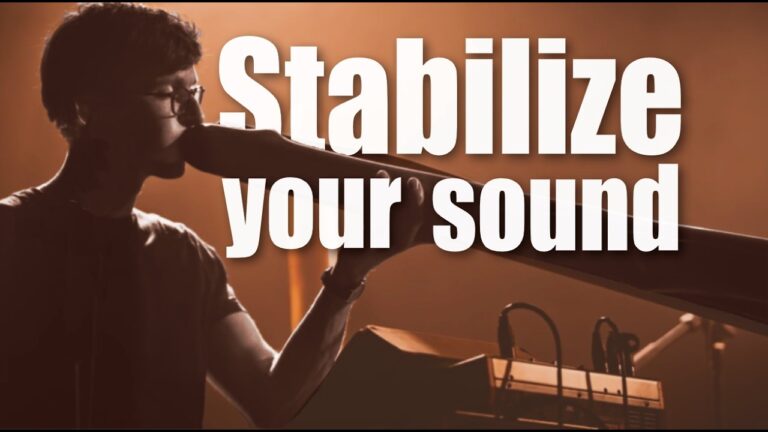
Because at the beginning, it’s important to train your lips to vibrate the same way every time. I see it regularly in my workshops: if you’re a beginner and you feel comfortable with a note, make the most of it and anchor your sound!
For example, you could always pull the first part out all the way, and draw a line or two on the other one. Or the other way round, keep the first section always folded and only unfold the second one. It’s up to you!
And if you’re wondering which note to choose, I talk about it in this article on the note to start with.
My opinion
I won’t keep you in suspense any longer: I recommend it! It’s great for getting started, or for travelling.
Between the Travel Didge, very light but with rather fragile threads, and this telescopic didgeridoo, I find that this one solves a big part of the problems. It’s a very good compromise.
Of course, it’s still a PVC didgeridoo. But it costs less than €100! And if you’d like a more natural instrument, there are still David Defois’s bamboos, I talk about them in this article: What didgeridoo should you start with?
In short
According to the Didgeridoo Passion product page:
- Notes: from low B to high G (B, C, C#, D, D#, E, F, G)
- Length: 64 cm folded, 195 cm unfolded
- Weight: 1.7 kg (1.85 kg with the carrying bag, included)
- Mouthpiece: silicone, 3.1 cm in diameter
- Material: PVC
- Price: €99
If you’d like to compare with other instruments, I’ve done a little overview of slide didgeridoos and a selection for those who travel a lot.
Don’t hesitate if you have any questions!
Happy blowing!



Leave a Reply
You must be logged in to post a comment.