



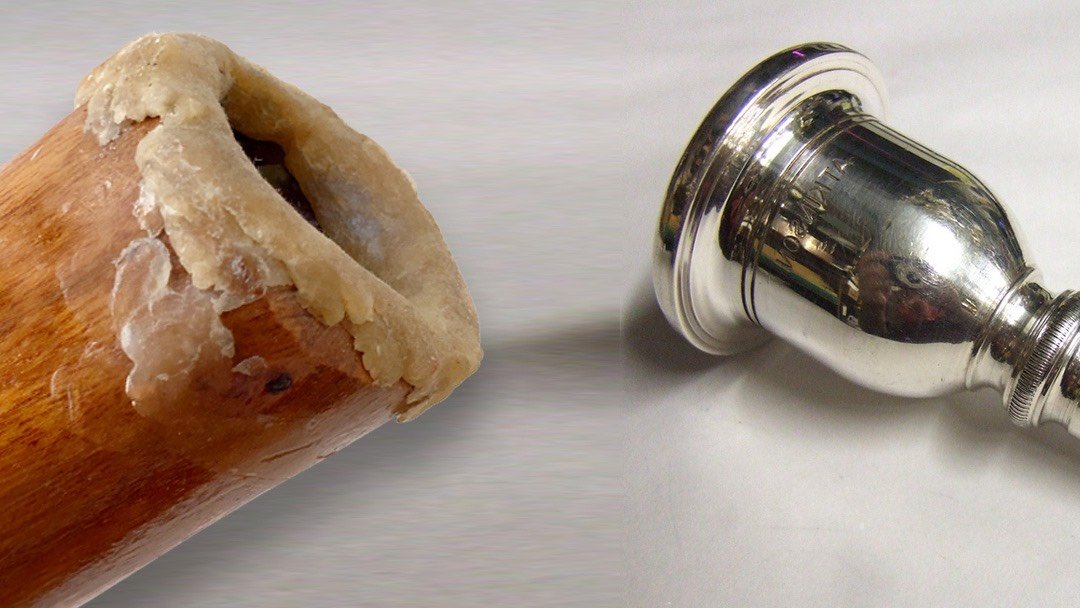
There’s one part of the didgeridoo that is still unexplored: its mouthpiece. The arrival of the wooden mouthpiece in the mid-2000s quickly established itself as the successor to beeswax. Unfortunately, innovation stopped there. And yet nothing would stop us from imagining removable mouthpieces inspired by those of brass instruments!
The body of the didgeridoo has been explored in many ways for more than 20 years now. Makers have never stopped hollowing, creating shapes, testing materials and different building processes. From glass didgeridoos to slide didgeridoos, not forgetting take-apart didgeridoos, research has been going full steam ahead! All these creations are fascinating. But it’s surprising to see that the mouthpiece has escaped it. So here’s a quick overview and a few leads for inventive makers who’d like to dig into this overlooked part of the instrument!
A short history and the advantages of a wooden didgeridoo mouthpiece
For thousands of years, Aboriginal Australians used (and still use) beeswax (read also: 4 steps to make your beeswax mouthpiece) gathered in the Australian bush for the mouthpieces of their Yidaki or Mago (read also: The origins of the didgeridoo: the Aborigines of Australia). A natural material, easy to handle and shape, beeswax had all the advantages of a good mouthpiece. So quite logically, white people kept the same technique for contemporary didgeridoos. Even today, most didgeridoos sold in Australia come with what they call “bee’s wax”. But since the mid-90s, the didgeridoo has spread widely around the world. Europeans and Americans started making their own instruments, and many players started blowing.
It was in the mid-2000s that the first wooden mouthpieces appeared. Today, most mid-range and high-end didgeridoos have a wooden (or resin) mouthpiece. At first, some makers thought that players would prefer to have their own mouthpiece shapes, and that wood wouldn’t be adopted by everyone because it was too standardised.
A few years later, we have to admit that the advantages of the material quickly won over most didgeridoo enthusiasts. And for good reason, there are many:
- no risk of the mouthpiece melting in the sun (anyone who has left a didgeridoo in their car in summer will understand!)
- no softening of the mouthpiece, unlike wax, which has an annoying tendency to soften and lose its shape after a few minutes of playing.
- more hygienic: wood is very easy to clean, unlike wax, which sometimes collects quite a bit of dirt!
- and finally, for men: wood doesn’t stick to beard hairs… wax does!
So these wooden mouthpieces have become the norm on most didgeridoos. But it seems that since this definite improvement of the mouthpiece, nothing has moved. Well, when I say nothing has moved, I’m being a bit provocative all the same. Because some makers have started exploring leads, and even if they’re only at an early stage, it’s worth taking a look… So let’s take a little tour of current research!
Some research on didgeridoo mouthpieces
William Thoren
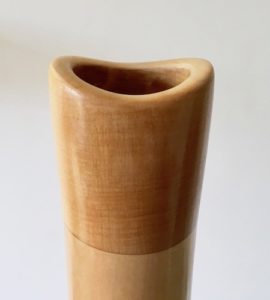
This American player has developed his own multidrone technique. That is, he plays the sounds below the drone of the didgeridoo, what we call “sous-vibrations” (sub-vibrations) in French. In other words, he makes his lips vibrate more slowly than the note of the didgeridoo, thus lowering the note of the instrument. To get more control over his technique, he drew inspiration from the shape of brass mouthpieces and their cup (see diagram below). This borrowing from brass instruments has the advantage of improving playability for his multidrone technique.
William didn’t stop there. His mouthpieces are slightly curved (see the photo opposite: my old didgeridoo made by William and by Julien Doutaz, read also: Ujazi Didgeridoo – A didgeridoo maker on the rise!) to better follow the shape of the jaw, so it adapts to the player’s mouth. It’s far from a silly idea, and very comfortable once you get used to it! Finally, he went from a circular shape to an oval mouthpiece. This has the advantage of putting more lip into the didgeridoo without losing the precision of the drone.
Walter Strasser and David Defois
The didgeridoo is a wooden instrument. And like any living material, wood moves, warps, works… So a didgeridoo tends to go out of tune depending on the season, the heat, the humidity… And that can be a real problem when you play with other musicians. So a few makers have developed a mouthpiece that slides over the first few centimetres of the didgeridoo. This rather clever trick lets you tune your didgeridoo. Walter Strasser, for example, developed a long slide that lets you tune and change the notes of the didgeridoo (read also: Several notes in one instrument: a quick tour of slide didgeridoos!). I should point out that in this particular case, Walter’s didgeridoos are designed as slide instruments and not only as tunable didgeridoos.
As for David Defois (read also: Interview with David Defois: creator of the didgeridoo-trombone!), he developed the same system but over just a few centimetres. The aim here is to be able to tune your instrument, very clever! Alexis Rousselle and Laurent Fradet (Pivert) then took up David’s idea on their didgeridoos. This technique has the small drawback that the first centimetres of the bore must be cylindrical, which by definition conditions the start of the instrument… But let’s accept that, in this world, everything has its advantages and disadvantages. 🙂
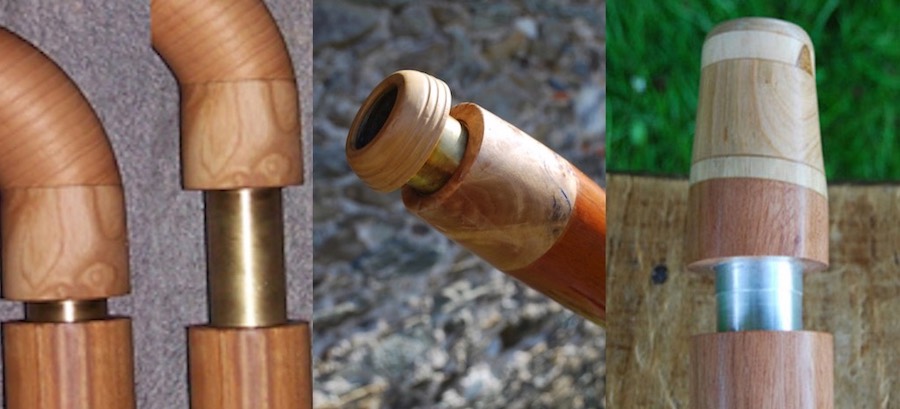
From left to right: David Defois’s Kromm Boud, the Alex-didge system and the Pivert didgeridoo system
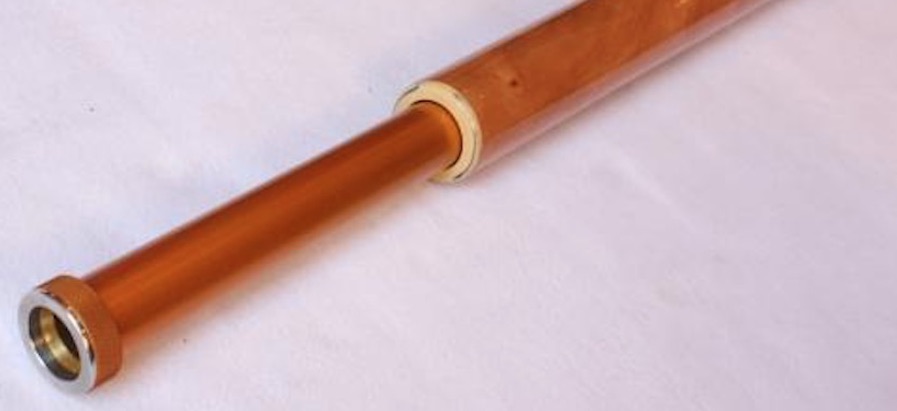
Didgeridoo by Walter Strasser
A few ideas for innovation and research
The diameter of the mouthpiece
As I said above, the most common diameter today is 30mm. But we could very well imagine this standard changing in the years to come. While talking with
When will we get removable mouthpieces?!
If we want to improve our mouthpieces, we need to look at brass instruments. The same trumpet player may have several mouthpieces. So why not imagine this being possible on our dear pieces of wood? Many of today’s high-end didgeridoos are made from A to Z using the sandwich technique. In other words, termite-hollowed eucalyptus is no longer the only option. Even some Australian makers, like the excellent CrooKedStiXz, make sandwich didgeridoos to complete their range of eucalyptus didgeridoos. In this context, we could very well imagine a standardised bore: 30mm, 35mm, 40mm… with mouthpieces that would fit each bore. So if the piece being played calls for tongue attacks, the player would use one mouthpiece. While a more meditative piece would be played with another. It would then become natural to swap mouthpieces depending on the desired effect.
Let’s take a look at brass mouthpieces
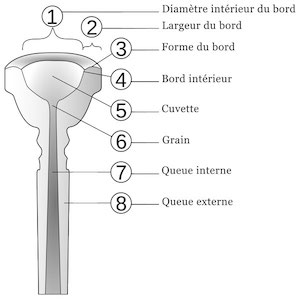 A quick Google search led me to an article about trumpet mouthpieces. Here’s the diagram presented in it, and a few brass mouthpiece criteria briefly explained (for the most curious, I encourage you to read the full article on the French blog “apprendre la trompette“).
The diameter of the cup and its rim
greatly affects the quality of the sound and playing endurance. The deeper and wider your cup, the “bigger” your sound and the more “physical” your trumpet playing.
The width of the rim
It can be narrow or wide. It affects the flexibility and comfort of the lips.
The shape of the rim
Flat or rounded, it’s chosen for comfort on the lips. A flat, wide rim increases endurance, while a thin, rounded rim marks the lips more and improves flexibility.
The inner rim
A sharp or more rounded angle affects flexibility and attack.
The cup
It comes in several shapes: U-shaped, V-shaped, and combinations of the two. A deep cup gives a round, wide sound. A shallow cup makes high notes easier and gives a bright, resonant sound.
The throat
This is the diameter of the mouthpiece hole, and it has a big effect on the resistance of the air blown into the trumpet. A wide throat gives a big sound and increases fatigue; a narrow throat makes high notes easier at the expense of intonation.
The backbore
It’s a very important part of the mouthpiece, because it combines the cup/throat choice. If you take a wide backbore with a shallow cup and a narrow throat, that’s contradictory. A wide backbore will give you a generous sound with beautiful overtones, while a narrow backbore will make high notes easier. A good cup/throat/backbore combination can correct or worsen the instrument’s intonation: if your low notes are sharp and your high notes flat, try other combinations. Although this part is very important for brass mouthpieces, it will have less impact on the didgeridoo. The diameter is much wider on our piece of wood!
I also found this video (there isn’t much in French!) for a quick, concise presentation of mouthpieces by tuba player Bernard Lienard.
Conclusion: dream or reality?
That already gives a few leads… Of course, the subject still needs digging into, but you can be sure of one thing: everything is still to be discovered! But in concrete terms, is it feasible? As we know, mid-range and high-end didgeridoos are handcrafted. Since each craftsman has their own codes, techniques and other design secrets, it will be difficult to arrive at a standard. So at first, mouthpieces can only be improved individually, by each maker. That takes motivated, organised researchers who have the time… And they’re not easy to find! So such mouthpieces certainly won’t reach the world market tomorrow, but nothing stops us from dreaming. In fact, maybe one day a maker will find a way to fit mouthpieces to all types of didgeridoo… You never know!
And you? What would your ideas be to improve your mouthpieces? Do you still play on beeswax? Share your experience, it’ll move the debate forward!

Leave a Reply
You must be logged in to post a comment.