



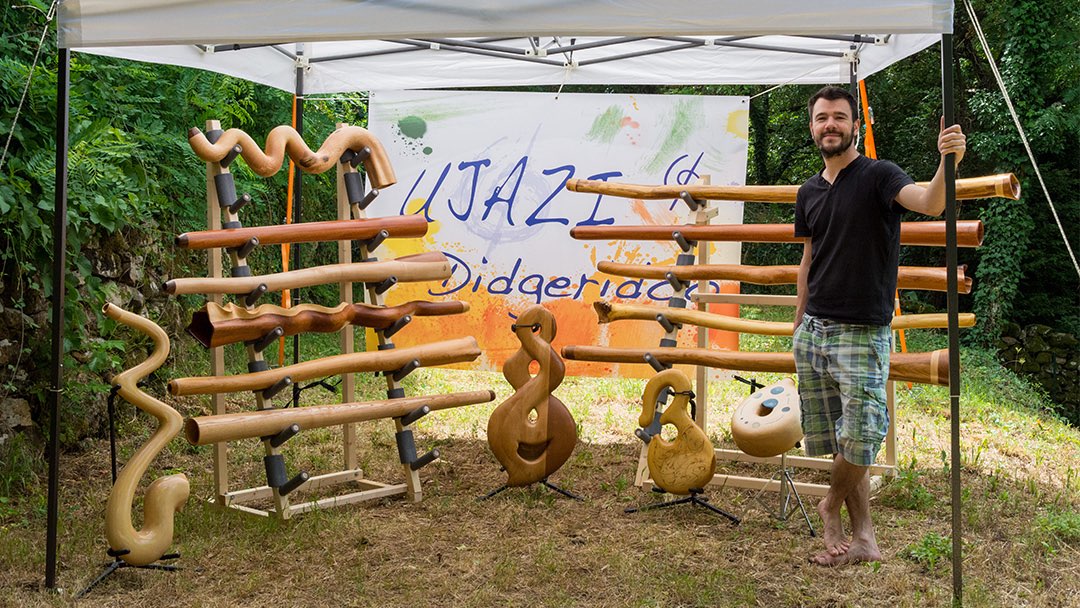
Here’s the new interview! This time, Julien Doutaz, aka Ujazi Didgeridoo, kindly agreed to answer my questions. Among other things, you’ll learn how this French maker went from sound engineer to didgeridoo maker with a growing reputation. Let’s go on a journey that starts in New Zealand and ends in a workshop in the Rhône-Alpes region, hollowing out wood. 🙂
Hi Julien, you discovered the didgeridoo in New Zealand. Can you tell us how that first encounter went?! How long ago was it?
It’s been almost 7 years now. At the time, I was travelling around New Zealand, drifting here and there, and I had stopped for a few weeks in a small village called Takaka. I was WWOOFing with a couple (the woman was a professional singer) and there were several of us, from different countries, making music. It was a very inspiring, creative time, full of life and strong sharing, where music was everywhere. One day, an Australian couple turned up with a fantastic two-year-old kid, a caravan packed to the brim with their years of travel, and lots of didgeridoos!
Grant was a player and a maker. Back then he was a friend of Adam Henwood (the maker of Crookedstixz), who had taught him how to make them. For me it was a very powerful encounter. A human one first, because I stayed very close to that couple, but also a musical one, because the didgeridoo really resonated with me. The object and the sound. Grant talked to us about it in a very “spiritual” way, as an ancestral, earthy, ceremonial object that carries messages and stories in its music. It’s hard to put into words where my connection with the didgeridoo comes from. It’s full of dreams, of slightly forgotten emotions, of the smell of earth, of the vegetable garden, of sand and sea… That’s what I’ve carried with me all these years, and that’s what I try to bring to life through Ujazi Didgeridoo.
Well, a beautiful encounter indeed! You talk a lot about the way Grant described the didgeridoo. Can you tell us more about your own vision? What does playing the didgeridoo mean to you? What does it symbolise?
There’s definitely more than one musical instrument in the didgeridoo. And playing the didgeridoo isn’t just “playing a piece of music”. Playing the didge is wanting to travel, to take yourself somewhere, near or far, on purpose or not, inside or outside yourself, and to take others somewhere. It’s also meditating, relaxing, letting a primitive part of yourself express itself. It’s telling a story. There isn’t necessarily a meaning, just lots of different directions, which make the didgeridoo something complex and complete.
It symbolises creativity and imagination through simplicity! It’s crazy that a simple tube can bring so much.
Yes, I bet! And beyond the didgeridoo, do you have a connection with Aboriginal culture? Did you pop over to Australia from New Zealand to meet them?
I’m very sensitive to their culture, their beliefs, the land they come from and the bond they have with nature, especially in a country as brutally wild as Australia. But I have no personal connection with Aboriginal people. Nor do I claim to make didgeridoos the way they do, or even to play in a traditional way.
I went to Australia later on, 2 years after discovering the didgeridoo, but it wasn’t a trip focused on the didgeridoo and Aboriginal culture. We visited Aboriginal sites and I brought a didgeridoo back from there, but that’s all.
You could say that what really hooked me was mainly the didgeridoo.
You’re a didgeridoo player, but above all a maker. Can you tell us more about that? How long have you been making didgeridoos? What drew you to this craft?
I made my first didgeridoo myself: a spiral C# in New Zealand pine. When I discovered the instrument, I thought: I absolutely have to ask Grant to help me make one so I can bring it back to France! That was my first experience of making one, and of intensive sanding.
I’ve been making them since 2011, but I played that first didgeridoo for almost a year and a half before I started making others. And that’s really when I got into making them. That was in 2013.
At the time I was a sound engineer in live performance, and I was handling lots and lots of very sophisticated equipment. I felt the need to come back to something “simpler”, more natural. And working with wood seemed obvious to me.
I didn’t plan to sell them, or to make different keys to have more playing options, or even to show them to other players. In fact, I didn’t know any other players, I knew nothing about the didgeridoo community in France or in Europe.
In short, what I liked was simply the idea of working with wood (which I had never really done) and making an object with my own hands.
Of course, as you can imagine, getting set up wasn’t easy! I lived in the centre of Lyon, I had to find a place to do it, wood to work with, a few tools. It was complicated and I thought I’d never manage to make another one. Especially since I didn’t start with a straight, classic didgeridoo. But when that “first” didgeridoo finally sounded (it was a sort-of D), and everyone around me told me it was crazy what I had managed to do, I told myself I’d carry on. After that, the second one was easier to make, and so on…
Since those first attempts, making didgeridoos has become your job. There’s a world between making them for yourself without knowing anyone and making a living from it! Could you explain how you did it? Do you live only from making didgeridoos, or do you offer other services on the side (lessons, workshops…)?
At first I made didgeridoos alongside my job as a sound engineer. I was working on a freelance “intermittent” schedule, and that gave me the chance to devote myself to the didgeridoo regularly. I quickly got excellent feedback on the quality of my instruments, and that encouraged me to work so that each piece would be better than the last. I managed to sell a few, then a few more, and then I left my job at a theatre to move and follow my partner. At that point I didn’t know exactly what I was going to do.
That’s when I decided to see whether I could live only from making didgeridoos. It’s been two and a half years now, and the answer seems to be yes, more or less hahaha.
I don’t only make didgeridoos, even if it’s the biggest part of my activity. I also run events, give private lessons and workshops, and play a few concerts.
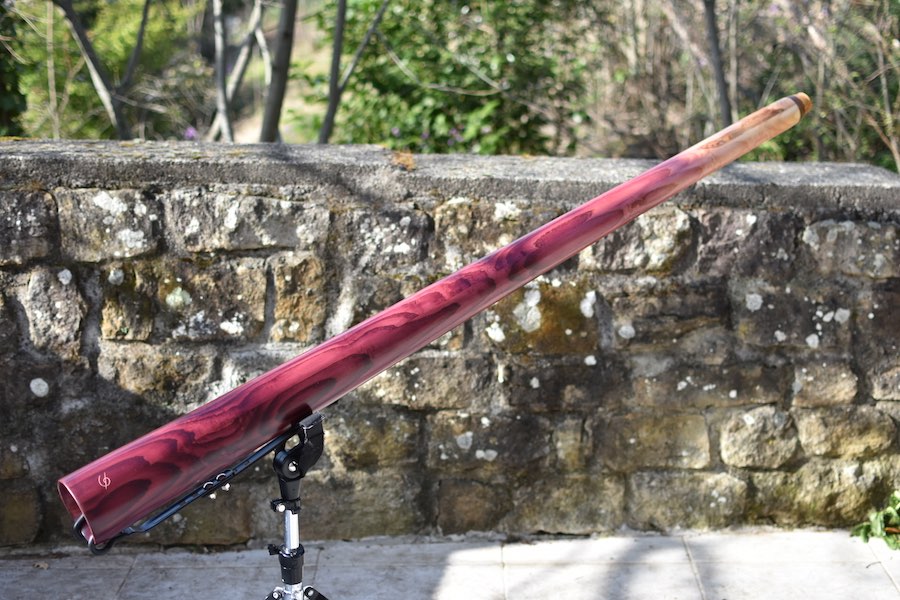
One of the many didgeridoos made by Julien.
Yes, it’s true that you often have to diversify to make a living from the didgeridoo! When it comes to making them, there are also many ways to build didgeridoos. Could you explain how you go about it? Do you do everything by feel? Do you use the DidgMo software?
I make my didgeridoos using the “sandwich” technique (read also: How about making your own didgeridoo?!). I don’t like saying that, I find the name really lame. Unlike many makers, I only work with wooden boards, not with branches that I cut in half and glue back together.
That first came from necessity, to be able to make didgeridoos with the shapes I had in mind. And also, it’s what I discovered first. So I get large raw wooden boards and rework them entirely to create the inside and the outside of the didgeridoo, giving it the shape I want. That gives total freedom, but you have to create everything from scratch, which isn’t the easiest thing.
I started making them without even realising that a “too” short tube would give me a “too” high, unplayable note, just to give you an idea! I hadn’t calculated anything, hadn’t imagined any sound characteristics. All I could see was the saxophone shape or the Maori symbol I wanted to get. So I had surprises, good and bad.
Over my attempts I improved by trying something new each time: longer, shorter, wider, narrower, bigger. And for a long time I forgot to write down my results, but I stored them in my head, in my lips, in my hands as I handled my tools.
That’s still how I work, by the way: I try things out to bring general principles to light. That allows me to make anything, because I know that by changing this or that, I’ll head towards this or that characteristic. And the more time goes by, the more I refine this knowledge and gain precision. It’s a fascinating exercise, and as didgeridoo makers we’re lucky to work on an instrument where there’s still a lot to do and to discover. I don’t really use DidgMo or modelling software, or only very occasionally, for something very specific and often with exaggerated values. I think it’s a tool that can be fantastic and I might end up using it more, but that’s not where I want to put my energy when I’m making a didgeridoo.
Can you tell us more about the different stages of making one?
I start by selecting my wood at my supplier’s: perfectly dry wood, suited to the didgs I have in mind or that I know people might ask me for.
Then I draw my template on the boards and roughly shape the outside a little, the parts that would be impossible or too much of a pain to do precisely after gluing. Then I hollow out each of the two halves identically. After many tests, I glue the two parts together. I then shape the outside of the didgeridoo a bit more precisely, and after that I work on the mouthpiece and the tuning. These three stages can vary from one didgeridoo to another and be done in a different order depending on what I want, on what I hear.
Finally, when everything is glued and the didgeridoo is tuned, you have to sand, sand, sand and sand some more. And when you’ve finished sanding, it’s good to sand again. Then I take care of the outer finish. Of course, these stages aren’t all done in one go. There are more or less long waiting times after gluing or after certain stages, so the wood can work, move and warp as it wants if needed. Sometimes I forget about a didge for more than a month before picking it up again!
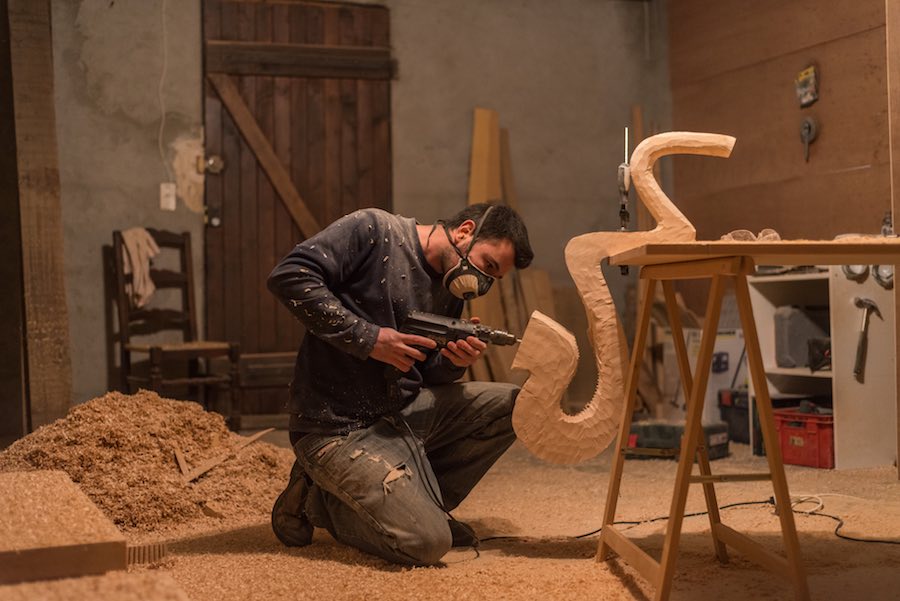
Julien Doutaz hard at work! The heavy artillery is out. 🙂
When it comes to wood, what’s your preference: local wood? Exotic wood? Other materials?
I don’t really have a preference. I mainly use French, local woods: ash, wild cherry, maple, walnut, elm, olive, pear, lime, boxwood. I like knowing that these woods come from close to me. I’m not trying to make didgeridoos out of Australian eucalyptus. Anyway, I have neither termites nor Aboriginal roots. But I sometimes use exotic woods too, for variety, to find other textures, other colours and looks. Sometimes I’d like to work with them more, but for me they’re not especially easy to get hold of, and our native species are fantastic and varied enough to satisfy me.
That said, I do have my favourite species depending on the didgeridoo I want to make and the specific qualities I want to give it. Each wood brings something different to the sound: warmth and roundness in the low mids, or crisper highs, for example.
People also talk a lot about using dense woods to make didgeridoos, but I also like exploring what lighter woods that vibrate more can give. After all, that’s what we’re looking for: vibrations. On the other hand, I’m very attached to making my didgeridoos only out of wood. That was what I wanted from the start, to stay close to the instrument I had originally discovered, and I stay true to that.
Every maker has their specialities and develops didgeridoos with their own qualities. If you could name three qualities of your didgeridoos, what would they be?
That’s a tough question… It’s not easy to put yourself forward. First, I’d talk about the width of the bore and the stability of the drone. Some of my didgeridoos have a fairly wide air column (well over 4 cm after the mouthpiece). They offer a very stable bass that allows subtle playing on the overtones. That’s what I’ve tried to develop the most. Next, I’d mention the harmonic richness. Again, that’s what I work hardest to enrich. I like rich, not very compressed didgeridoos. I want you to be able to hear a multitude of well-defined overtones, whatever the pitch of the drone.
And I can also talk about the look of my instruments, the design and the finish. I put a lot of energy into creating visually interesting objects. That’s what people often tell me when they discover my didgeridoos.
Do you make custom didgeridoos?
Yes, I make custom didgeridoos. More and more, and that’s really great. The goal will be to do only that. I offered it and highlighted it right from the start of the Ujazi Didgeridoo project, because that’s what motivates me above all: creating THE didgeridoo that the person wants at that point in their exploration. The aim is to meet their expectations, wishes and needs as closely as possible, and to offer them a didgeridoo that will go along with them and help them progress.
On my side, it brings me more challenges and helps me progress as a maker. Sometimes I get requests for things that are different from what I would have made naturally. Those are the requests that interest me most. That, and the pressure not to disappoint!
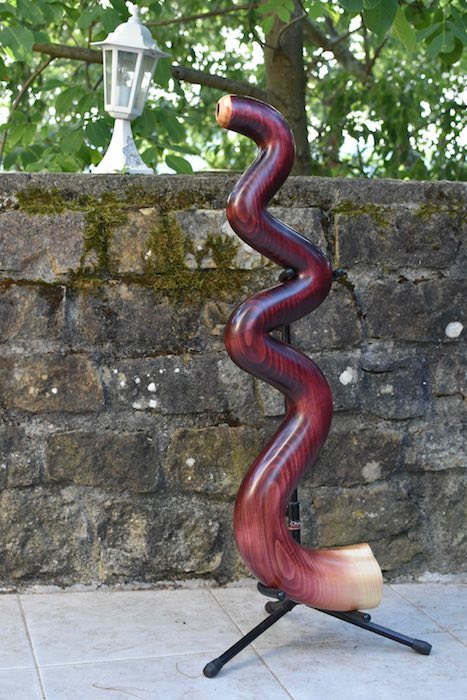
An Ujazi didgeridoo with shifting shapes.
Clearly, making a good didgeridoo takes a lot of know-how and research. If you had one piece of advice for someone who’d like to give it a go, what would it be?
I’d say above all, start without overthinking it. Tell yourself: “Hey, my parents, a friend or a neighbour have a few woodworking tools, I’ve got a bit of time and I’m curious, I’m going to try making myself a didge and see.”
It helps you understand lots of things and approach playing music from a completely different angle. It’s about enjoyment first. Otherwise, it’s doomed to fail. I’m not saying you should give up at the slightest difficulty, of course not. There will be some, but you shouldn’t put pressure on yourself.
As for making lots of them, for other people, I think that comes later. And that’s when it gets more complicated and more of a headache hahaha.
But if you’ve got a few tools, some glue, a tree branch, a bit of imagination and you’re fairly resourceful, you can manage to make a tube that gives a drone that isn’t too awful, or even a very interesting one. But don’t think it’s going to bring in the salary of a dynamic young engineering graduate every month. We’d know about it otherwise.
Haha yes, I bet, everyone would be making didgeridoos. But that’s not happening any time soon! Do you have an anecdote to share about your journey as a didgeridoo maker / player?
Yes, I have one that taught me a lot. For a long time, I had to fight to have a place to make my didgeridoos. I did a lot of trips with the gear and the wood in the car. Then I made a series of three didgs, and that’s when I reached a new level. The last of the three was a C, the most accomplished one. I had spent a crazy amount of time on it. I was very proud of it. The evening I finished the last rounds of sanding, I dropped it while taking it out of the car. The bell hit the ground hard and the didg split along a good half of its length. I’ll let you imagine how I felt…
Anyway, I had to rework it completely, and given how fragile the fall had made it, I didn’t feel at all comfortable selling it. So I kept it. In the end, that didg is still with me today. I use it to gauge every new didg I make, I compare them to it. It’s a fantastic didg that I know by heart.
All this to say that you learn a huge amount from your mistakes. You just have to accept them and use them to progress and improve.
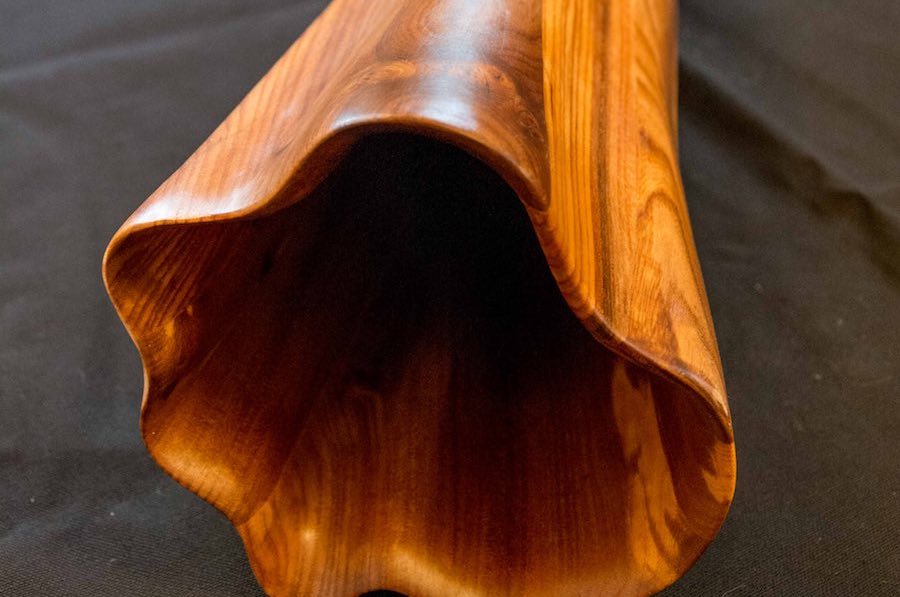
The bell of an Ujazi didgeridoo
How do you see your future as a maker? Do you have any particular plans? A revolutionary didgeridoo concept?!
I often think about that. You have to keep the passion and the desire alive. To be honest, I’m letting things happen a bit. I know I want to keep going in the same direction: offering classic or original didgs, but always of excellent quality. I really like the idea of developing custom work.
I’d also like to have (or take) more time to work on my playing, because I think it’s essential to develop even better didgeridoos.
The didgeridoo is evolving a lot, and one of the major directions seems to be tunable, take-apart, slide didgeridoos. Lots of fellow makers are offering superb things and even developing new instruments, the Korn Bass for example (read also: Interview with David Defois: creator of the didgeridoo-trombone!
). I’d like to try to bring my own stone to the building. I’m quite attached to the wooden didgeridoo in a single piece, it’s what I love above all, so I’m working on finding a concept that suits me and stays fairly true to that basic idea… It’s not easy, but I have some leads. To be continued.
And finally, if a player wants to discover and/or try your instruments, what should they do? Where can they try them?
First of all, there’s my website, Facebook and YouTube with photos and videos of my didgs. I also have instruments available at Didgeridoo Passion or at Didgeridoo House. And then there are the festivals. This year, I’ll have a stand at the Nomadidge festival and at Rêve de l’Aborigène (read also: Which didgeridoo festivals to go to this summer?). And for the most motivated, you can come directly to my place near Lyon to try the didgeridoos and chat about this extraordinary instrument.
Thank you Julien for taking the time to answer all my questions. It’s always inspiring to read about a passionate person’s journey, and I’m sure yours will motivate more than one of you! For everyone interested in Julien’s didgeridoos, you can find him at all the places mentioned just above. See you soon, fellow blowers!

Leave a Reply
You must be logged in to post a comment.