



Have you ever taken the time to notice everything that moves inside you when you speak? Your lips, your jaw, the tip, the middle or the back of your tongue, your throat opening or tightening, your vocal cords… While your belly sends the air that feeds all of it. Since we were very small, we have learned to speak, to chew, to swallow, without ever really looking at what was going on inside. And yet, everything works together, like a perfectly tuned orchestra, without us even noticing.
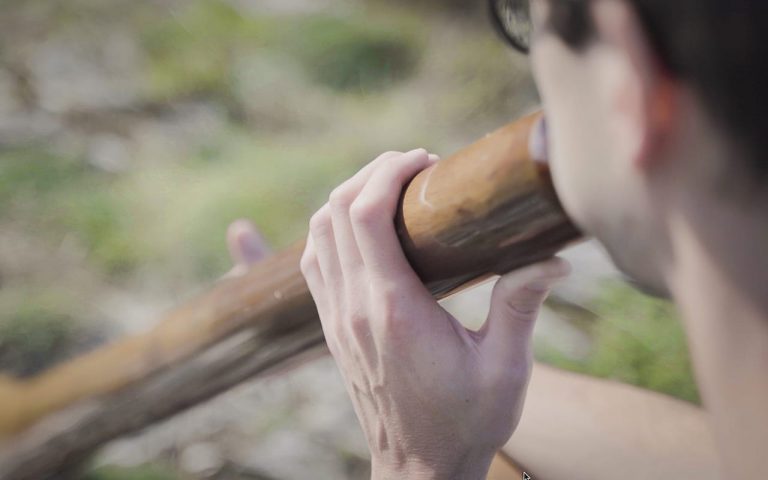
The didgeridoo invites us to take a look at this little inner world. And that’s where, in my view, the good habit that makes all the difference is hiding.
The trap: playing “a bit all over the place”
When you’re not quite sure which direction to take your playing, you tend to move everything at the same time. A bit of cheeks here, a bit of tongue there, the throat joins in… And the result, I see it very often in my workshops: it doesn’t really sound. You can feel there’s energy, there’s desire, but the sound stays messy, without any real structure. In short, it’s a bit of a mess!
It’s not a question of talent. It’s simply that each organ has never been worked on for its own sake. So when you mix them, they end up stepping on each other’s toes a little.
Isolating each organ, like the layers of a mille-feuille…
The good habit is to learn to make each part of your body independent from the others. I like the image of the mille-feuille: your sound is made of several layers stacked on top of each other.
In practice, here is the order I recommend if you’re a beginner.
Your lips first. This is the very foundation. Your drone must be clean and stable before anything else. As long as it isn’t, leave the other organs alone, your lips need all your attention. If your sound is still giving you a hard time, the article on pressure should help you.
Then your tongue. It produces most of the sounds on the didgeridoo. Take the “t” and “k” tongue attacks, keep your cheeks nicely deflated, and play “to-ko-to-ko”… without adding anything else. Just your tongue.
Then your vocal cords. The high-pitched cry, for example (everyone is interested in that one!) Here again, you work on it alone: one cry, then you breathe in. One cry, then you breathe in.
Your cheeks, later. For now, they’re only used for circular breathing.
…But never without your breathing
You may have noticed: each exercise above keeps the breathing with it. That’s no accident. On the didgeridoo, it’s the breathing that sets the sound in motion and gives birth to the rhythm. A technique practised “flat”, without breathing, very often becomes a second difficulty on the day you have to slip it into your circular breathing.
So as soon as your “to-ko”s are more or less understood, combine them with a breath. A “ton” for example, breathing in on it: “to-ko-to-ko-ton”, “to-ko-to-ko-ton”… And the next day, why not add a high-pitched cry on the first “to”?
You’ve just laid a second layer on your mille-feuille, without losing the first one!
• • •
“Whatever is well conceived is clearly said.”
• • •
And then, we mix!
Once you’ve worked on each organ on its own, something very pleasant happens. You can decide to use a bit of the tip of your tongue, a bit of the back of your tongue, to open your throat, add some voice, relax or pinch your lips, puff out your cheeks… and this time, you know exactly what you’re doing. It’s a bit as if you were pressing buttons to set this or that organ in motion.
It’s this control that will create the richness of your sound. Your rhythms become clearer, richer, and you start producing sounds you would never have imagined (as long as you have good pressure!). Your first mixes won’t necessarily be clean, don’t worry, that’s normal! What matters is that you’ve started working on each layer independently.
Two kinds of practice time
Be careful not to fall into the opposite extreme, though. There’s no point spending months on your lips or your “to-ko”s! The risk, if you only ever work on one thing, is that you no longer know how to connect it to the rest of your playing.
So I encourage you to keep two kinds of time in your practice. One where you isolate an organ, with attention and patience. And another where you simply enjoy yourself without asking any questions at all. The two feed each other, and it’s in this back-and-forth that you’ll progress the most.
If you’re wondering how to organise all this day to day, I’ve put together a complete routine in the article How to progress on the didgeridoo: a 4-step practice routine.
To conclude
The didgeridoo has this wonderful little power of making us discover what we’ve always been doing without knowing it. Taking the time to isolate each organ is a bit like getting to know yourself again, one layer after another. And it’s from this knowledge that, little by little, your own sound will be born.
This way of building your playing, organ by organ and always with your breathing, is at the very heart of my course The Art of Didgeridoo, if you’d like to be guided step by step.
And you, which organ gives you the most trouble? Tell me in the comments. Happy blowing!

Leave a Reply
You must be logged in to post a comment.