
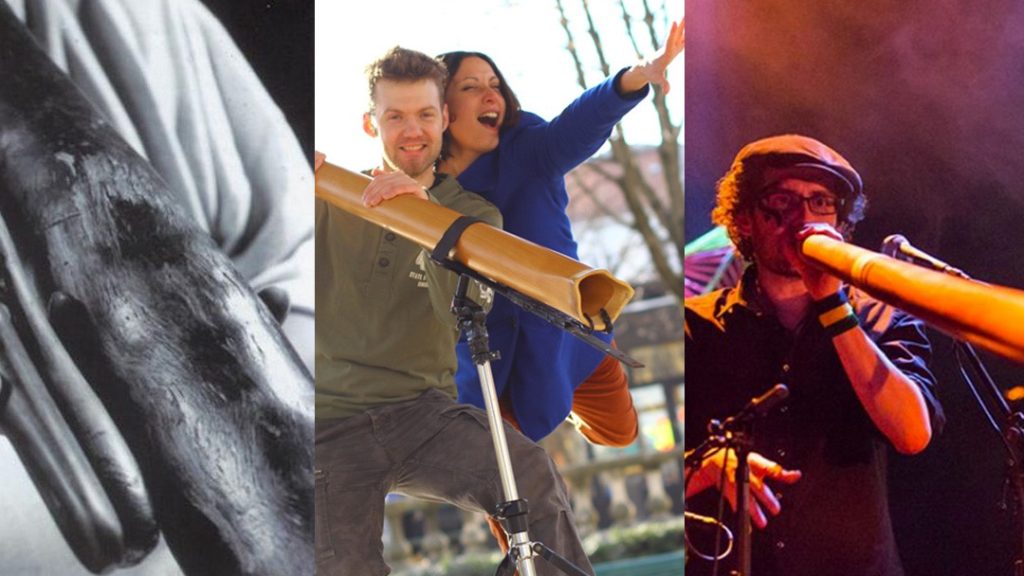
For nearly 20 years now, the didgeridoo has brought together in France—just after Australia—the largest community of players in the world. Today, France is the most dynamic country when it comes to blowing into the didgeridoo! Over all these years, a number of players have developed their own approach to the didgeridoo. So I’d like to take you on a little tour of France, highlighting the players who have shaped—and are still shaping—the French didgeridoo scene!
Music evolves through generations, and the didgeridoo is no exception. When you look closely, these players can be grouped into three major generations: the first, the second, and finally the third (quite logical, right!?). This classification should help you better understand the evolution of the didgeridoo in France. Of course, this short overview is written in a very subjective way—and that’s fully intentional! Still, I’ve tried to remain (at least a little!) objective. I don’t claim this article to be exhaustive, and I apologize in advance to any players I may have forgotten—comments are here to add them 😉
The first generation of didgeridoo players in France
Jamiroquai launched the big didgeridoo craze worldwide in the mid-1990s. At that time, only poor-quality bamboo instruments were available, but like any trend, it reached a wide audience.
During that period, some people truly committed themselves to the didgeridoo. Either they already knew the instrument, or they discovered it thanks to Jamiroquai’s hit. I should point out that this article focuses on French didgeridoo soloists; another article will be dedicated to bands that have marked the didgeridoo scene. Mentioning everyone here would make the article far too heavy!
Phillip Peris
Phillip Peris is of Malaysian origin. He lived in Australia and has been living in France since the late 1980s. No one would dispute his influence on today’s players. Many of us discovered the didgeridoo thanks to his solo album, which could be found in every Fnac across France. There was a text on the cover that said something like: “A 26-minute solo without stopping breathing!” That was definitely a strong selling point!
Phillip Peris has what we would now call an old-style approach (even though I’m not a big fan of labels!): a round sound based on harmonics, fluid breathing, few tongue attacks, very present vocalizations, and little use of overtones. Here’s what he sounds like on stage.
Christophe Mad’dene
From the same generation as Phillip Peris, Christophe Mad’dene’s albums could also be found in the early 2000s. His sound is duller, with much more cheek work, and his albums are often accompanied by percussion. I remember that at the Dijon association, Greg—my mentor at the time—told us about meeting one of Mad’dene’s students. He said the guy could perform three over-vibrations with disconcerting ease!
We were all impressed! At that time, playing styles were more focused on roundness and less on tongue attacks and over-vibrations (this aspect was later developed by Eastern European countries). Here’s the track I’ve probably listened to the most from Christophe Mad’dene!
Alexandre Bartos
Alexandre Bartos was one of the first to release a didgeridoo method in France (with Paul Baudoin) in the late 1990s / early 2000s. These two methods helped many players progress. I haven’t heard many recordings of him, but it’s definitely worth knowing his name. Like many players of that time, he had a bass-heavy, rather dull sound with back-of-the-tongue breathing. Beyond the didgeridoo, Alexandre Bartos is also a sound designer and sound creator, and he plays dozens of traditional instruments.
Unfortunately, I couldn’t find any video of Alexandre Bartos…
Sylvestre Soleil
Sylvestre Soleil started playing in 1998. He soon encountered one of the first French didgeridoo associations: Vent du Rêve. The following year, he began teaching there and founded the group “Drum’n Didg” (two didgeridoos + drums). Two albums were recorded, but they are now very hard to find. He was also a co-founder of the “Le Rêve de l’Aborigène” festival. His playing is probably the most dynamic of his generation. The music moves away from harmonic drones toward punchy, moving rhythms! He currently plays in Hypnotic Trio.
Kristian Jyoti
At the time, Kristian had a very atypical style, and what I heard from him really struck me. In fact, he was the first player I heard develop KOUF sounds (a sound somewhat reminiscent of drums) on the didgeridoo. It was on an album sold at Fnac, featuring four didgeridoo tracks followed by traditional Oceanian chants. From what I was told, Kristian had his copyrights stolen for those four tracks. In any case, one of them was so good that I adapted it in my own way on my first album, “Terre inconnue.”
I don’t know if Kristian still plays the didgeridoo, but he remains deeply immersed in yoga and in the impressive balance/juggling of crystal balls.
The second generation of didgeridoo players in France
In the early 2000s, many of us started playing, driven by the launch of the “Rêve de l’Aborigène” festival and, a few years later, by the France-didgeridoo forum. Inspired by the albums available at the time, we continued the exploration begun by our elders. This momentum gave birth to distinct styles drawing from various techniques, ranging from wobbles (a breathing technique) to beatbox, as well as a clear and precise sound. The foundations of a “French-style” didgeridoo were emerging. Here’s a brief overview of players from my generation.
Othello Ravez
Othello’s playing is full of flexibility and subtlety. He increasingly develops sound massage sessions with the didgeridoo, as well as meditative concerts. He also created a lovely project with other musicians: Oloji.
Jasper
It’s been a long time since we last heard Jasper on stage! I don’t know whether he still plays or not… But back then, he was probably the fastest player in terms of tongue attacks. His articulation speed was truly impressive!
Zalem and Adèle
Zalem and Adèle are certainly the most well-known didgeridoo duo. They managed to create a partnership where each has a clear role. Zalem, combining beatbox with the didgeridoo, handles the rhythmic side, while Adèle brings harmonics, voice, and over-vibrations for a more melodic approach. This is a brief description, but it gives the idea!
Kelu
Undoubtedly the player who most strongly associated beatbox with the didgeridoo. His technique combining the two is impressive. Over the years, Kelu has built a solid reputation as a “lumberjack,” as they say in the didgeridoo world—meaning a player who plays fast, loud, and with breathtaking technique! He recently started his own band, Kosmoz… And from listening to the project, it seems that our friend Kelu is mellowing a bit with age 😉
Agustina Mosca
Agustina grew up in Argentina, but since she has been living in France for several years now, her influence on the French didgeridoo scene is undeniable. Her playing is strongly inspired by Latin American rhythms. If you’re in Paris and walk past the Centre Pompidou, you might be lucky enough to hear her play. She shares the spot with Adèle!
Gauthier Aubé
It’s always tricky to talk about oneself! Here lie the limits of being part of a movement while also recounting its history… If you’re reading this, you probably already know my playing. To sum it up: I particularly enjoy clarity of sound, storytelling, letting the didgeridoo breathe and develop on its own—and of course, I have a special fondness for eating chocolate. Chocolate is very important for playing the didgeridoo well.
The third generation of French didgeridoo players
Around 2007 / 2008, a third generation of players began to emerge. Most of these players came from local associations, workshops, and didgeridoo-related events. At that time, for example, the organizers of the “Rêve de l’Aborigène” festival held a (big!) three-day workshop every year at the Château d’Airvault. It brought together 45 students and 3 teachers for three days. It was intense—but it generated an incredible dynamic!
Here are five players who managed to combine techniques from our generation to create their own unique approach!
Tom B
Colas Testu
Kid
Sylvain Bamdara
Underground Cosmic Didgs
A duo formed by Adrien and Julien, active since 2016, with great compositional ideas! To hear more and discover their journey, you can find their website here.
Conclusion: developing your own didgeridoo style
By analyzing these three generations, it becomes clear that the sound initially leaned toward something more cavernous, earthy, and round, evolving today into a clearer vibration (harmonics) and a more fragmented, rhythmic approach (wobbles and beatbox).
It’s fascinating to see how each player absorbs previous influences and reshapes them to forge their own style within a generational context. I’ve focused here on French players, but of course there are other influences as well, such as European ones (also read: Didgeridoo in Europe: styles and players from each country) and Australian ones (also read: 10 Australian didgeridoo players you should know!).
All of this raises questions about the future of the didgeridoo… What new styles might emerge given the evolution of the past 20 years? What will the next generation look like??
What do you think? How do you imagine the future of the didgeridoo?!
Share your thoughts!









19 Responses
Eh Gautier, tu viens là
https://www.facebook.com/events/459649514429567/
Ce sont précisément les 20 ans de Vent du reve.
Sur les 3 générations, t’en as 2 au moins passées par vent du reve, (la troisième je ne la connais pas, … j’ai décroché)
Salut François, je te réponds en privé. 🙂
Avec plaisir !
Très bonne idée pour l’article, j’affectionne particulièrement ce style de musique…
Bonne continuation,
Ben.
Bonjour Gauthier,
Merci pour cet article très intéressant, plein de sons à écouter !
Personnellement le groupe qui m’a fait découvrir le didgeridoo est Hilight Tribe qui a créé par la même occasion un style de musique à la fin des années 90 où le didgeridoo est très présent et qui a suscité beaucoup d’autres groupes (Kaophonic tribu, Goayandi, La P’tite Fumée, Secret Vibes…) par la suite : la Natural Trance !
Merci pour ce super site !
Musicalement.
Ben.
Merci Ben ! C’est vrai que je n’ai pas parlé d’Hilight Tribe dans l’article bien qu’ils aient eu une grande influence.
Je suis parti sur le côté “technicien” et soliste, mais tu me donnes une idée, je ferais bientôt un article sur la Natural trance, ça n’est pas le style que j’écoute mais ça peut intéresser du monde. 🙂
On ne peux pas citer tout le monde,mais je trouve que Amanitalinda a vraiment quelle que chose que je ne trouve chez personne d’autre.
à bientôt Gauthier !
Christophe
Ça, ça va lui faire plaisir. 🙂
Aurais-tu un lien d’une vidéo à partager ? Ca serait parfait !
Au plaisir Christophe !
Super article Gauthier, je viens d’en prendre plein les oreilles, Haaa ce bon Phil Perris entre autre, et Jasper que j’avais rencontré à Byron Bay en 2000 et il commençait à peine, un sacré gars, Merci à toi 😉
Nicolas Fourré (Belgique)
Salut Nicolas, moi aussi Peris me rappelle beaucoup de souvenirs de cette époque du didge. 🙂
Merci pour cet article Gauthier, je sais ce que ça représente comme travail car j’en écrit aussi!! J’ai appris plein de truc, merci encore 🙂
Merci de prendre le temps de le dire, c’est vrai que c’est du boulot mais j’en apprend aussi beaucoup ! 🙂
Chouette article!
Le reve de l’aborigène a porté la 2°Génération, le Didg to didg stimule la 3°, hâte de voir comment la 4° va arriver. =)
Concernant Jasper, j’ai adoré “SOUNDS OF ATLAS” il y a quelques années.
Aujourd’hui, il reprend la scène avec son groupe “Yélé”, magnifique mélange avec un guitariste et un chanteur burkinabé.
Merci Kid pour les précisions sur Jasper, je n’étais pas au courant qu’il avait un projet à l’heure actuelle…
Et pour les deuxième et troisième générations, c’est vrai que l’on peut dire ça. Chaque génération à son évènement. 😉
L’article a été rapide à lire, mais il va me falloir des semaines pour aller tout écouter !
Merci pour ces découvertes super inspirantes, long live Didjeridoo !
C’est vrai qu’en 20 ans il s’en passe des choses. 🙂 Bonne découverte à toi !
Pour avoir commencé le didg en même temps que Sylvestre et avoir fait partie des débuts de l’asso “vent du rêve”, il y a aussi Thierry Van de Candelaer (désolée pour l’orthographe ! qui a joué aussi dans drum ‘n didg) et Pierre Navelou (qui a joué dans Adidjio). 🙂
Merci Nadia pour avoir compléter. 🙂 J’en ai certainement oublié quelques autres !
La prochaine génération sera celle des joueurs chanteurs n’est-ce pas Gauthier ? 😉
Ahah, oui je pense que c’est effectivement à explorer. 😉