



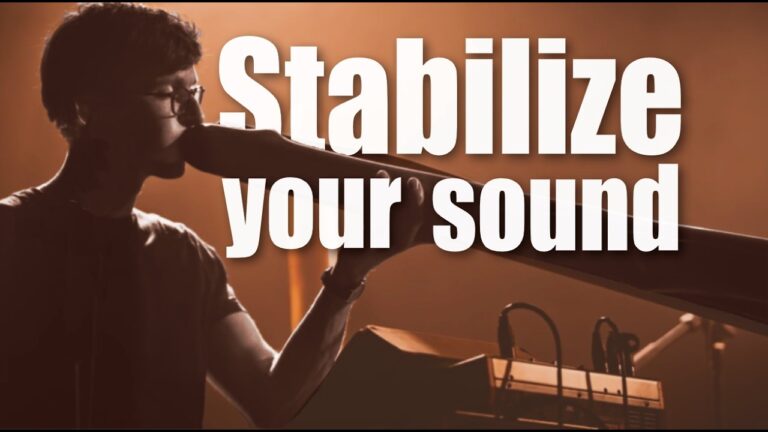
About ten years ago, I posted a song on YouTube called Le vent dans le dos, “the wind at your back” (from my album “Renaissance”). One of those pieces you play without thinking too much, carried by the groove, and you’ve never really stopped to wonder how it’s written. I’m sure you know the feeling! So years later, I gave myself an exercise that I’d like to offer you too: trying to write down the theme of this song.
So here’s a little game: grab a sheet of paper and a pen, listen to the first few seconds, and try to write down what you hear. You’ll see… it’s not that easy!
And no wonder: sounds, techniques, rhythmic structure, everything blends together. Above all, we don’t really have a shared language for writing the didgeridoo. Everyone tinkers with their own, in their own corner, with their own understanding of the didgeridoo.
Why it’s so hard to write down what you play
On the didgeridoo, a rhythm isn’t a series of notes. It’s a series of sounds, small tongue attacks, vowels… and breaths. Circular breathing never stops, it carries everything else, so it feels like a river where nothing really stands out. So to write down a rhythm, you first have to learn to recognise each technique being played, to name them and to organise them…
That’s what I’m offering to do in this video. I show you a very simple way of reading a rhythm, in three steps, that you can apply to my song, to your own, or to one by a player you love!
Step one: find the loop
A didgeridoo piece (or any piece of music) is almost always a few loops that turn, come back and answer each other. Here, we’ll try to break down three of them from my song Le vent dans le dos. So before writing anything, start by isolating one loop (in other words, one rhythm): listen, listen again, and find the exact moment the pattern starts over.
And slow down! The original tempo is often too fast to make out the rhythm. My song runs at around 110 beats per minute (BPM). At that speed, there’s no way to hear everything. I bring it down to 75 for the video, and you can go even lower. YouTube actually lets you slow down any video, which is a precious tool for this kind of exercise.
Step two: name each sound… and each breath
Once the loop is isolated, you write it down, sound after sound. For the three loops of the song, it gives something like:
The syllables in capital letters, in my own language that I’ve called “Wakatoo”, are the sounds played with puffed cheeks.
Don’t worry, the exact spelling doesn’t matter much in the end! Whether you write “e toko” or “ke toko” makes no difference. What counts is the rhythm: where the strong sounds fall, and where the breaths go. Because they’re the ones, the breaths, that give the rhythm its shape. In my cards, breathing sounds have their own colour: I write them in green. And I’d advise you to write them down first: once you know where you breathe, the rest almost comes by itself.
Step three: play with the loop
Writing is good. But you only really understand a rhythm when you play it! Slowly at first, taking care of the quality of your sound, then speeding up little by little.
You’ll quickly realise that the breaths shape everything (I talk about this in my course The Secret of the 7 Breaths). If you manage to breathe in at the same spot as the player whose rhythm you’re copying, you’ll get much closer to the right rhythm!
And to come back to Le vent dans le dos: when I speed up, my TOHs turn into TOHOs. Without even thinking about it, I slip into wobbles: sounds chained very fast, carried by quick breaths. If this technique intrigues you, I explain the two main wobbles in the free wobbles course. It’s all about fast breathing.
Towards a world index of rhythms
To write down my rhythms, I use Wakatoo, the app I’ve been developing for a while to bring together didgeridoo players from all over the world.
For example, you’ll be able to search for a YouTube video in it, loop it, then write the rhythm in a sequencer, card after card. Here, in my example, the result sounds a little robotic, it’s true, but it gives a very accurate idea of what is being played.
When I recorded this video, about fifteen Wakademy members were testing Wakatoo, with all the little bugs that implies. There’s still some way to go before the app comes out, but I’m actively working on it!
And the idea that drives me goes far beyond a tool: thousands of us, around the world, writing our versions of the songs we love, comparing them, telling each other “I think he’s playing this instead”. And over time, building together a true world index of didgeridoo rhythms!
If you’d like to know when Wakatoo comes out, the waiting list is here: wakatoo.com.
And you, have you ever tried to write down a rhythm?
Pick a song you love, just one. Isolate its main loop, slow it down, and write down the breaths first, then the sounds. Don’t look for perfection: look for the shape. You’ll be surprised by everything you hear once you’ve learned to listen and write this way.
And if you want to go further in understanding rhythm, that’s what the course At the Heart of Rhythm is all about. You can also start with the free wobbles course to set off on the road to speed!
Happy blowing!


Leave a Reply
You must be logged in to post a comment.