



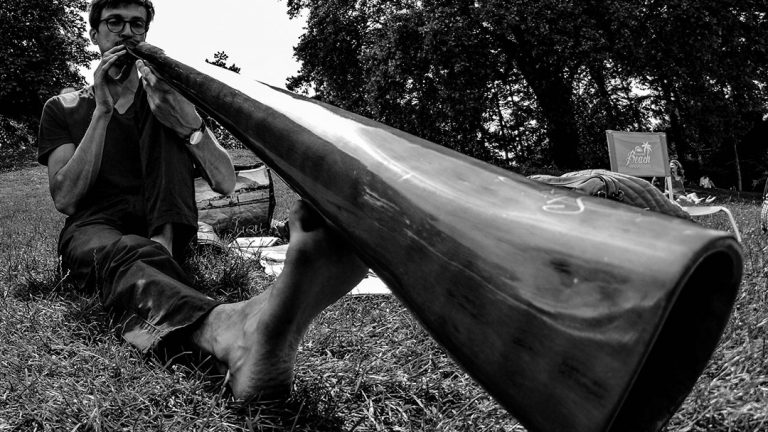
Look on the internet and you will see some didgeridoo players play from the front, and others from the side. When you start, most players will tell you it doesn’t matter: front or side, it’s a detail.
It is not a detail. Here is why I think you should play your didgeridoo from the front, and not from the side.
1. Your neck and your head
When you play on the side, your head is tilted like this all the time. Try spending an hour like that, or even 20 minutes if you play seriously: it gets really tense, and it can become really painful.
For your neck and your head, it is not the best. When you play from the front, your head straightens up naturally.
2. Articulation
In 2007, when I went to Australia, Bob Druett, a very good didgeridoo maker, explained it to me: it is much more difficult to speak with the corner of your mouth than with the front of your mouth.
It’s true. Try speaking with the corner of your mouth: it is very difficult, because we never use that part of the lips to speak. We use the front. In the same way, it is much easier to play with the front of your lips.
3. Both cheeks
When you play on the side, most of the time the cheek on that side is the one that inflates: the left cheek if you play on the left, the right cheek if you play on the right.
At my masterclasses, I see many side players who cannot use their other cheek. It is a big weakness, and it takes a very long time to change. With intensive practice, even your smile can become unbalanced. From the front, your cheeks are balanced and their muscles build up in the same way.
4. Some techniques need the front of your lips
Some didgeridoo techniques are much easier with the front of your lips, like the overtones. They don’t sound very good on their own, but you can use them as percussion.
Voice, overtones and many other techniques are also much easier when you play in the centre.
5. Brass players play from the front
Look at people who play the trumpet and the whole brass family: they play from the front. Of course, some of you will find an exception who plays on the side. But in an orchestra, everybody plays from the front.
6. Traditional Aboriginal players
Most traditional Aboriginal players from Australia, those who play the yidaki and the mago, play from the front. Some Aboriginal players play a little on the side, but it is really an exception.
So why do people play on the side?
When you start, it is a little easier to play on the side. You can choose how much of your lips you put in the mouthpiece: you make only part of your lips vibrate, so you reduce the amount of air going out.
But you can choose this from the front too. You just need to understand the corners of your mouth:
- If you push them a lot, you close your lips and you choose how much air goes out.
- If you don’t push, the air goes out everywhere.
- If you push too much, only a very little air goes out: that is too much.
So you have to find a good balance.
Playing on the side is not a disaster
If you play on the side, it is not a big problem. It works, and you will find some very good didgeridoo players who play on the side.
But if you ask most of them, they will say: “I started on the side and I don’t want to change all my habits. But if I started again, I would play from the front.” And I have never met a player who plays from the front and thinks about switching to the side.
I don’t want to say that playing on the side is really bad. I think playing from the front is much better, but it’s fine if you play on the side.



Leave a Reply
You must be logged in to post a comment.