


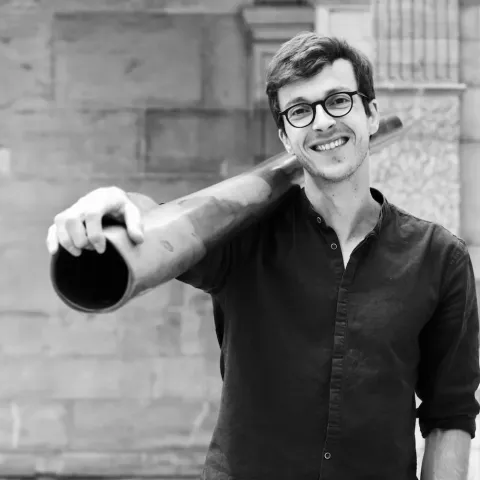
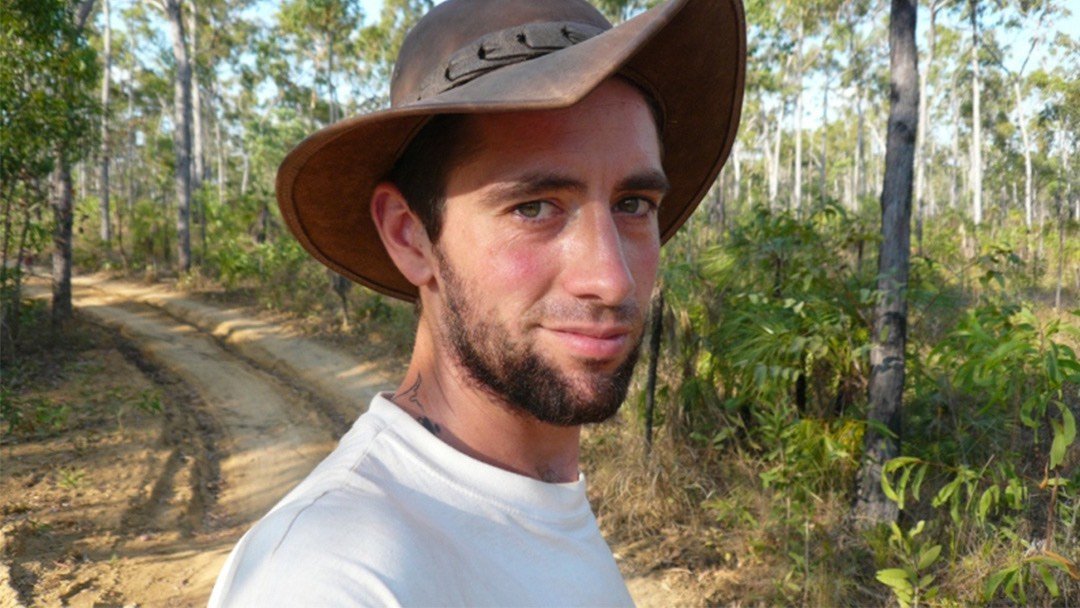
We’re continuing this series of interviews, this time not with a didgeridoo maker but with the creator of didgeridoo-passion, one of the world’s reference didgeridoo shops since 2006. So we’re going to have a chat with Grégory Zwingelstein, who pulled off the feat of setting up an ethical and respectful didgeridoo shop! He’s here to tell us how he managed to make a living from his passion, build bonds with Aboriginal people, and share with us his vision of traditional and contemporary didgeridoo. Full steam ahead for this journey stretching from Alsace to Aboriginal lands!
Hi Greg! And thank you for taking the time to answer these questions, which will help players get to know you a bit better. Let’s start at the beginning. Can you tell us a bit about your story with the didgeridoo?
It all started in 1999 when I was in high school: one of my teachers had just come back from Arnhem Land (Aboriginal land in Australia). He gave a demonstration during the school’s open day. When I heard that sound, which was totally unknown to me, I felt a call from the very depths of my being. Later on, this teacher became a friend and a guide. I started my first vibrations with him.
What drew you to this unusual instrument?
It was a call that’s hard to explain, the sound literally flooded my body. I felt something like a message, as if I absolutely had to do something with this instrument. As if someone were sending me a message saying: learn!
Everyone who has been to Australia knows that meeting Aboriginal people is far from simple. You’ve travelled to the other side of the world many times and spent time with them. Can you tell us more about this encounter?
All I can say is that it changes your life… The way Aboriginal people think and live is so different from ours. You don’t come back unchanged from a trip to Aboriginal land. You face the reality of things head-on, by which I mean you need to hold on tight, because life isn’t easy for Aboriginal people. Alcohol, pollution, money… All these notions that were originally of no use to them, but which are now part of their daily lives.
Fortunately, it’s not all bad and the traditions live on. For my part, I had to go and learn at the source and live within communities in order to discover, understand, know, learn!

Grégory Zwingelstein with the famous Djalu Guruwiwi
I was adopted in August 2007 by Mirarra Burarrwanga, as his brother. Of course, you have to be careful with the word adoption, because I’m not adopted in the French sense of family ties. I simply have the right to live with them and the right to apply the laws of the Gälpu and Gumatj clans. Mirarra gave me the name Djapana “sunset dreaming”, the dream of the sunset. Since then I can go into the bush to cut yidakis and work on them with them. But I’m not allowed to paint yet. That will be part of a future initiation!
If you had one message about Aboriginal people to pass on to the players reading you, what would it be?
Today, we’re facing a big problem with lies around the didgeridoo. Many didges are sold all over the world as authentic Australian didgeridoos made by Aboriginal people when they aren’t. I want to help, and I do help, the traditional owners to be recognised and respected.
As such, I hope that everyone, and all those interested in the didgeridoo, will one day end up buying authentic objects from these craftspeople. I hope they’ll learn to identify and avoid the cheap tourist fakes and “junk” commonly available all over the world (for those looking for an instrument to start with, read this article on cheap didgeridoos)
Beyond that, I think there’s room for all styles and types of didgeridoos, as long as they aren’t presented as something they’re not!
In the West, many of us play contemporary didgeridoo. Here you’re telling us about Aboriginal people who play traditional didgeridoo (Yidaki or Mago). Knowing you a little, I know you’re hooked on this style! What are the main “character” traits that define trad playing for you?
Indeed, my playing style leans towards what Aboriginal people call the “right way”, I particularly love this style. For me, it’s the most complex one, it’s all about pressure. And if I had to give character traits, I’d start with strong pressure, followed by ‘hard tongue’ and perseverance. Indeed, traditional playing is acquired through practice… Lots of practice!
Guyanya Gurruwiwi playing a Yidaki by Djalu Gurruwiwi
Can you tell us more about what you call “strong pressure” and “hard tongue”? What does it mean in practice when playing the didgeridoo?
Well, it’s quite simple. First of all, you have to play facing forward. Then, have what Aboriginal people call the smiling face. Next, when you blow into the didg, you need to send pressure by pushing really hard so the instrument sounds to its full capacity. This usually applies to yidakis, because they’re instruments that require that kind of pressure. But careful, because some types of didgeridoos won’t have an optimal sound if you send too much pressure.
As for hard tongue, it refers to tongue movements in playing. You pronounce “Dith”, “Lith” “Laith” “Dhirll” etc… The tongue, or tongue movements, play a very important role in traditional playing. Same for everything related to the transition from hoots (overblowing or trumpet sound) to the drone, which is used a lot; a very common phrase is for example: “dup-pu dhirrl”. On the other hand, Aboriginal people rarely use the second or third hoot.
Beyond pure technique, can you tell us what you like about the traditional approach to playing?
First of all, it’s the original way of playing, and that alone moves me. Then, having learned the different rhythms and patterns within communities, what I love most are the stories around traditional playing: the dolphin, the rain, the storm, the sunset…
And finally, practising traditional playing gives you a playing pressure that lets you play any didgeridoo.
Listening to you, it seems obvious that playing trad brings another way of looking at the didgeridoo, more perspective. With that in mind, would you have any advice for contemporary players? What can trad playing bring us?
Of course, I invite all players to take lessons on the basics of trad playing: tongue movements, hoot/drone transition, passive voice… A whole bunch of techniques that contemporary players aren’t necessarily used to playing. And yet they can be a big plus for mixing styles. Personally, I don’t play 100% copy/paste trad, but I love mixing modern playing with traditional techniques.

Greg on stage
You’re pretty convincing when you talk about trad… How do you go about learning it!? Do you have any trad teachers to recommend? Do you give lessons? YouTube videos or a learning method?
Well, I’ll point you straight to the Yidakiwuy Dhawu website, the “bible” on the yidaki and Yolngu culture. It’s available in French. I took part in a large part of the translation of the subtitles and other information.
Then, if you want a method coming straight from Aboriginal people, I recommend the Hard Tongue Didgeridoo CD by Milkay Mununggurr.
There’s also Jeremy Cloake’s method Balanda Yidaki Dhukarr (= The Yidaki way for non-Aboriginal people), which is a reference for me.
And I also give workshops, for an approach to and understanding of this playing style, so just ask. 😉
Now let’s come back to France a bit to talk about your job. As I said above, you’re the creator of didgeridoo-passion.com, one of the few reference didgeridoo shops in the world. Can you tell us more about where this idea came from? What pushed you to embark on such an adventure?! It’s not exactly the most common idea! Proof of that: you’re the only one in France.
Well, it’s very simple: 15 years ago, I was the one looking. I wanted to get a quality didgeridoo, ethically. But in France and most European countries, there was nothing. So the idea of starting out in this field began to take shape in my mind. I decided to go to Australia to find contacts and create Didgeridoo Passion. At the time, I was working in the car industry. So I had to juggle both jobs for almost 4 years, until the day I decided to throw myself 100% into the adventure and try to make a living from my passion…
You sell a lot of didgeridoos imported from Australia. And regularly, you introduce us to new makers like the excellent Crooked Stixz. How do you find these gems when you live 20,000 kilometres away from them??
At first, the contacts were made directly, since I went to their homes. Then I started to make a name for myself in the field, through my ethics and above all the quality of the instruments. You have to know that good didgeridoo makers aren’t many in Australia, and they all know each other. It’s a big family in which everyone has their little secrets. However, I want to point out that I owe a lot to a dear friend: Bruce Rogers. He taught me an enormous amount and shared a lot with me.

Bruce Rogers was an Australian didgeridoo maker. He passed away in 2016.
Can you tell us what, in your eyes, makes a good didgeridoo maker?
With my playing experience, having learned to cut and make yidakis, and having also organised 5 didgeridoo-making workshops here in France, I can very easily tell a good didgeridoo from a bad one.
However, the world of the didgeridoo is huge, because you have to understand that there isn’t just one type of instrument. Indeed, each style will call for different types of didgeridoos.
So if I have to list criteria, the first one for me is the human relationship, or put another way: how do I feel about the maker?
Here’s a whole set of questions I ask myself: is this a good person? Is he doing it for the money (and only for the money) or out of passion? Is he a didgeridoo player or just a maker? What perspective does he have on Aboriginal culture? How does he get his trunks? How does he work? Does he use a lot of machine tools? What kinds of finishes do his didgeridoos have? And of course, there’s also the question of price. Because with experience, I’ve learned how much it costs to make an instrument…
Well, Australians aren’t the only ones making didgeridoos, we’re not badly off in France and Europe either. If a maker wants to offer you their instruments to sell in your shop, how should they go about it? Do you accept everyone?!
For French makers, I work on a consignment basis. That means I don’t buy the didgeridoo outright, I take a margin on the sale. This way the maker gets more money from the sale, and on my side I don’t need to invest in buying, so everyone wins.
Here again, I don’t take just anyone, the reputation of didgeridoo passion is at stake. For French makers, I ask to test the instruments before taking them into the shop. This lets me see the quality of each didgeridoo. If the test is conclusive, then I add it to the shop. In that case, I guarantee the maker visibility on the internet as well as a page describing their work.
Let me step a little outside the didgeridoo world, because you also sell Bali Steel pans (Hang pan type) alongside didgeridoo-passion. Can you tell us in a nutshell about this equally unusual adventure?!
Yes indeed, I even dedicated a website exclusively to this percussion instrument: www.bsp-percussion.com. I’m open to all kinds of instruments. And a little less than ten years ago, I was lucky enough to set up a partnership with a friend to sell this instrument. Today, I handle its distribution in Europe. This melodic instrument is very intuitive and goes wonderfully with the didgeridoo.

The Bali Steel Pan
People always talk about the positive side of living from your passion, and it’s true, it’s wonderful. However, it also takes a lot of resources. What was (or maybe still is?) the biggest challenge for you in this adventure?
One of the biggest challenges was making the decision to leave my old job. I had the security of a permanent contract with a comfortable salary, and I dropped everything to live 100% from didgeridoo-passion. Then I had to face comments from the people around me, like: “You’re crazy! You have a good job and you don’t even know if you’ll make it!”.
These days, living from your passion isn’t easy: you have to be able to cover all the costs that come with running a business, as well as everyday life. But I was lucky enough to get good advice and to be surrounded by people who helped me a lot. All of this allowed me to make didgeridoo passion a quality showcase with strong ethics.
I hope I can keep going this way for a very long time!
And finally, to end this interview on a lighter note, after all these years you must have plenty of anecdotes to tell. Would you be willing to share one with us?!
Yes, there are several. One moment that’s still etched in my memory happened at the end of a concert I’d given in a bar. A man came up to me and started touching my hair. I asked him what he was doing. He told me he was convinced I had a tube hidden somewhere on my head so I could breathe while playing the didgeridoo… !
Thank you Greg for taking the time to answer all these questions. I hope your journey will motivate many people to make their dreams come true, whether with the didgeridoo or elsewhere. Whatever form it takes, a dream is still a dream. 🙂
And for you reading these lines, I strongly encourage you to turn to ethical didgeridoos by buying from didgeridoo-passion.com. You can be sure you’re supporting a passionate person who respects Aboriginal and contemporary craftspeople.
You’ve been told! 🙂

Leave a Reply
You must be logged in to post a comment.