



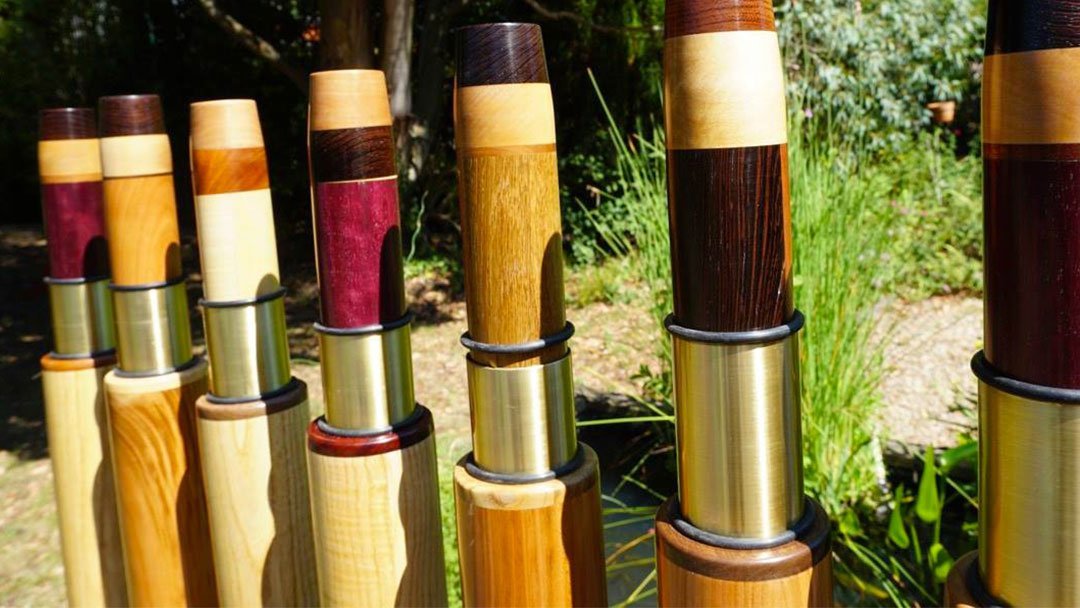
Over the last 20 years, a major development has shaken the didgeridoo world: tuning. The most common technique is to use a slide system. Ingenious, you’ll tell me. However, and even if it’s very appealing, the character of a didgeridoo is also very limited with this technique. Ingenious, then, but not necessarily suited to everyone.
Some makers have worked hard to make our dear piece of wood no longer a one-note instrument, but a tunable one. Before diving headfirst into a simple list of slide didgeridoos, let’s take a closer look at who this new kind of didgeridoo is for. It’s important to know whether this type of didgeridoo will suit your needs. Then, once we’ve weighed the pros and cons, we’ll review the most famous slide didgeridoos in their category!
Tuning a didgeridoo comes at a price
Several notes (in a single instrument) automatically means compromise. Let me explain.
To adjust the notes of a didgeridoo, you have to change its length. To do this, the most common system (and the one I’m going to talk about here) is made of two or more tubes that slide into one another. Let’s say it straight away: the idea is good and works very well.
The thing is, a didgeridoo is (to keep it simple) a mix of a conical shape and a cylindrical shape (read also: 4 essential criteria to understand the psychology of your didgeridoo!). And as you’ll quickly have understood, for two tubes to slide easily into each other, the cylindrical shape is a must. The conical part can be placed at the bell, but you can imagine that this will remain limited.
And that’s the whole dilemma.
Having only one shape (or almost) in a didgeridoo will limit the character of each note. In other words, they will almost all have the same character. From this point of view, the expression of the didgeridoo is very limited.
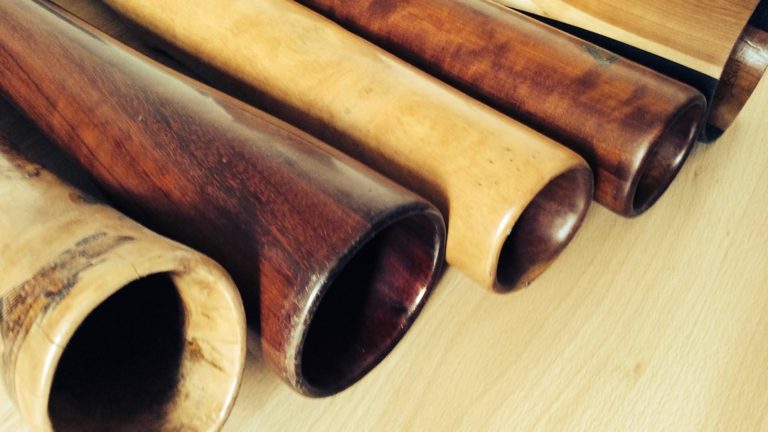
If we’re talking about character, then no slide didgeridoo can replace a unique instrument. It’s physically impossible. And yet, in my opinion, that’s what’s wonderful about this instrument: two didgeridoos in D can have a completely different timbre. For example, one might encourage you to develop attacks, rhythm or speed. While the other will support you in working on your cheeks or on the roundness of the sound, for example.
The drone of each of these didgeridoos will then develop very particular frequencies that belong to it alone. So each of them will have its own story to tell. And when that story meets yours, the alchemy of music will do its work. And your journey can begin. That’s the whole magic of the didgeridoo.

“Sow an act, and you reap a habit; sow a habit, and you reap a character; sow a character, and you reap a destiny.”
• • •
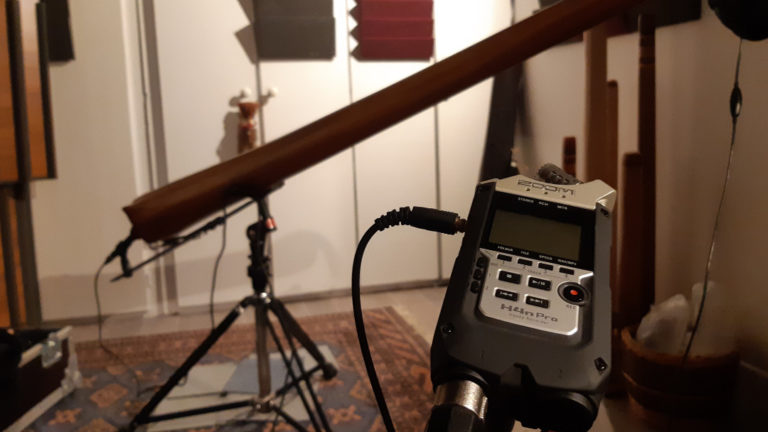
To illustrate my point, here are two audio examples taken from my research on didgeridoo acoustics (read also: Why analysing your didgeridoo’s frequencies will help you play better!)
Didgeridoo in D made with Bob Druett in Australia
Didgeridoo in D made by the Australian maker CrooKedStiXz
In these two sound examples, you can clearly hear the big difference in character. We’re dealing with two very distinct fellows here!
However, let’s not mix everything up, and let’s water down our wine a little (those of you who have been following me for a while will notice that I’m learning to be more tolerant! Haha!).
The slide didgeridoo, a didgeridoo for playing in a group
Right, we now know that with a tunable didgeridoo, the character of the instrument will be limited. That’s a fact. Fortunately, all is not lost! And Jean-Yves Redor (the inventor of WoodSlides, see below) wouldn’t have been selling hundreds of instruments all over the world for 10 years if his concept were pointless.
So against the strong character of the instrument, we have to set one of the great qualities of this world: adaptability. Indeed, it’s sometimes welcome to set aside a bit of character in order to fit in with others. And that’s exactly the role of slide didgeridoos: slipping into musical evenings and adapting to the many keys being played. Personally, I’m a solo player, so I look for maximum character in my instruments, but many of you want to play with other musicians.
In those conditions, you can guess that the slide didgeridoo becomes interesting. Being able to cover most of the commonly played notes with a single instrument is a feat that a one-note didgeridoo can’t pull off, despite all its goodwill (and its good character ;-)).

“Intelligence is the ability to adapt.”
• • •
So it’s mainly your needs that will determine whether to choose a slide didgeridoo. If you’re going to play with other musicians, then the question may come up. And of course, one doesn’t rule out the other. You can very well have several didgeridoos, some with character and some with a slide… In short, life is roomy, there’s space for everyone!
Come on, enough talking, let’s review these famous instruments! 🙂
Seven slide didgeridoos worth considering
NB: I want to make it clear that I earn nothing from sales. I’m independent and make my living by offering didgeridoo workshops and online courses. What I say in this article is only my opinion, and I can only encourage you to form your own.
The Didjeribone
The Didjeribone was invented by the Australian Charlie McMahon (read also: 10 Australian didgeridoo players you should know!). At the time it was a big success; if I’m not mistaken, it was the first slide didgeridoo on the market. I remember that in the early 2000s, you’d come across quite a few of them. I had one too (I actually wonder what became of it!). I might as well say it straight away: this didgeridoo is a bit outdated compared to what’s being made today. In its day it did a great job, but its plastic nature really limits its acoustics.
However, a player like Ronald Brown managed to develop his own style with the Didjeribone. In this specific case, the Didjeribone is indeed irreplaceable, unless you invest in a Korn Bass (see below)!
Ronald Brown playing a Didjeribone
Range: from low G to high G
Min length: 95cm
Max length: 170cm
Weight: about 0.5kg
Price: about €110
Where to buy it? Didgeridoo Breath – Australia
The Slide Didge
The Slide Didge is a variation of the Didjeribone. Because its plastic is thicker, it sounds much better than the Didjeribone. However, while it may be enough to start blowing, it will quickly become limiting, once again because of that plastic quality in the sound…
Greg from Didgeridoo Passion shows us how the Slide Didge works and sounds
Range: from low Bb to high F
Min length: 127cm
Max length: 200cm
Weight: 1.6kg
Price: €89
Where to buy it? Didgeridoo-Passion
The Phônodidg
Phônodidgs are developed and made by Franck Pillonetto, a Belgian player who has pushed the limits of PVC. Indeed, if you want to make a slide didgeridoo, you can fit two PVC tubes into each other. It works. But let’s be honest, the system has its limits too, both in terms of air leaks and acoustics. Starting from this idea, Franck developed his own instruments. And we have to admit that the resulting sound is good (and not too plasticky) for a very reasonable price. You can have up to 7 tubes (watch the weight in that case)! However, the 2-tube configuration already seems more than enough (at a very affordable price) and gives very promising results.
As I don’t have a Phônodidg, I asked Othello Ravez, who plays one regularly, for his feedback on the instrument. Here’s a summary of his answer:
- It’s a heavy instrument (to be precise, Othello plays a 4-tube configuration with a large opening, weighing 5.5kg)
- I like this didge for the low notes, mainly from low G to low B. For these notes, the bass is stable and the instrument is easy to amplify. On the other hand, for higher or lower notes, the sound has a plasticky timbre.
- The instrument is fragile because of the plastic. One fall and it breaks. On the other hand, the plastic glues back together very well and the didgeridoo can easily be used again.
- The maker’s mouthpieces still need improving.
- All the same, in terms of sound quality for the price, it’s top notch. For travellers, the 2-tube configuration is excellent. It’s a good practice didge. And finally, I feel that with my 4-tube configuration, the sound is equal to that of WoodSlides.
The Phônodidg, an alternative used by many players including Othello Ravez, here with his band Oloji.
Range: Not provided
Min length: from 83cm to 85.50cm
Max length: Not provided
Weight: from 1.7kg to over 6.5kg
Price: from €90 to €730
Where to buy it? PhônoDidge
The information above is based on this PDF provided by Franck.
Hard Fiberglass Didgeridoo
With Andrea Furlan’s didgeridoos, we switch to colour mode! Even if colours are a matter of taste, you have to admit that the customisation work on Andrea’s didgeridoos is accomplished. Just like Phônodidgs, you can choose the number of tubes when ordering. A little bonus: the mouthpiece is interchangeable, and even if there’s still some way to go, it shows a real research effort! (read also: When will we get mouthpieces worthy of our didgeridoos?
In this video, DidgBreath presents Andrea Furlan’s Hard Fiberglass Didgeridoo
Range: from low G# to G
Min length: 142cm
Max length: 250cm
Weight: Not specified
Where to buy? Hard Fiberglass Didgeridoo
The information above may vary depending on the model.
WoodSlide
It’s kind of the star of slide didgeridoos. I have to say that Jean-Yves, its inventor, does a very good job. The finish is impeccable, and the instrument is rather elegant, with clean lines. And to top it off, the WoodSlide models evolve every year. Jean-Yves always finds a way to improve his instruments, despite the constraint of the shape. In short, an achievement worth highlighting! To put it simply, if you’re looking for a quality slide didgeridoo, I highly recommend them.
Zalem playing his WoodSlide – Live Looping – Multiverse
Range: from high F# to low G
Min length: 1m (classic range) or 0.78m (travel range)
Max length: 2.75m (classic range) or 2.15m (travel range)
Weight: 3.8kg (classic range) or 2.8kg (travel range)
Price: from about €900
Where to buy? Woodslide
Walter Strasser
Walter Strasser is a German maker. The first time I tried his instruments was at the Swiss festival Swizzeridoo. If I remember correctly, that was in 2007. To change the notes without distorting the character of the instrument too much, Walter was clever. He added a relatively short slide in the first part of the didgeridoo. That way, the body of the instrument can play with the conical aspect, while the slide stays cylindrical. A system that made a strong impression on me at the time, especially since these didgeridoos are very well made. The trade-off is a narrower range than a classic slide didgeridoo (see below).
Greg from Didgeridoo Passion (him again! ;-)) presents a didgeridoo by Walter Strasser.
Range: C, C#, D, D#, E, F, F#
Min length: About 1.65 m
Max length: About 2.18 m
Weight: About 4kg
Price: From about €1,450
Where to buy? Walter Strasser
The information above may vary depending on the model.
Korn Bass
I might as well warn you straight away: here, we’re entering another world. David Defois spent several years developing the Korn Bass. Can we still call it a didgeridoo? That’s the question raised by Sylvain Jargot, who now plays only the Korn Bass. For him and David, it is indeed a new approach, a whole other way of approaching the instrument, playing a lot on note changes. Here are two videos that will help you better understand the principle of this new instrument, which opens up a whole new field of research.
Sylvain Grosjat demonstrating the Korn Bass
Dodjoma with Ludo playing a Korn Bass
Range: from low G to F#
Min length: 0.77m
Max length: 1.46m
Weight: 3.2kg
Price: €3,000
Where to buy it? David Defois
And that’s not all…
As you’ll have gathered, there’s plenty of choice! And that’s not counting… I haven’t talked about the second option for tunable didgeridoos: take-apart didgeridoos. With this model, you swap the first section for a shorter one to change the note of the didgeridoo. Here, you can’t change the note while playing, but the character is partly preserved.
To tell the truth, I believe more in this kind of instrument. In fact, I’m currently developing my own range of didgeridoos along these lines (with a cabinetmaker from Lyon). There’s still a way to go, because having several notes with character in a single instrument body remains a big challenge. But the research has begun!
If you know other slide didgeridoos, I encourage you to share them in the comments. I’ve surely forgotten some. Long live diversity! Looking forward to reading you, dear didgeridoo friends!
Leave a Reply
You must be logged in to post a comment.