


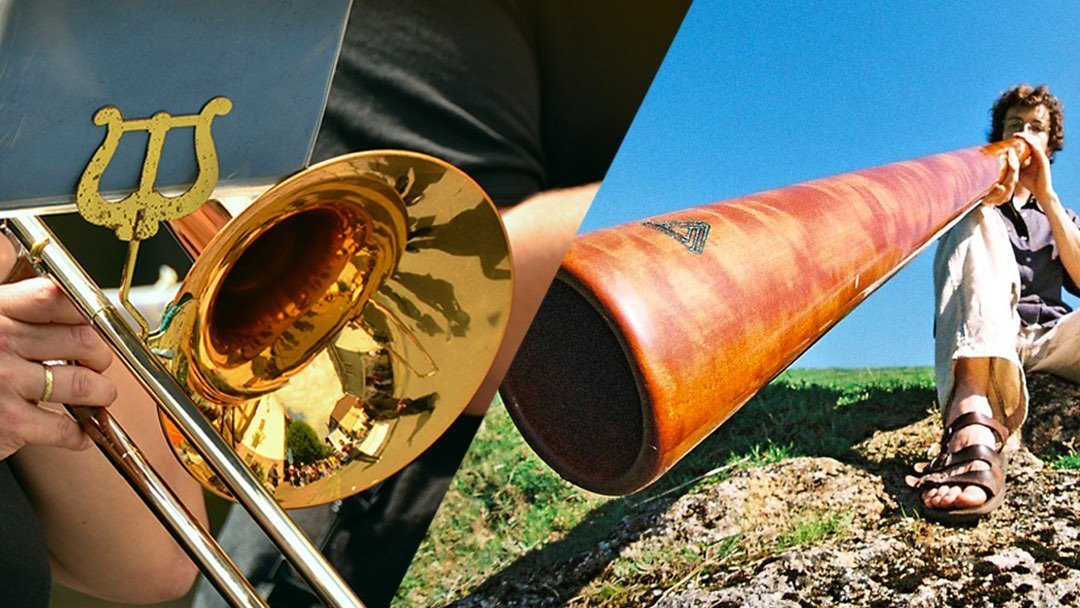
In 2010, I had the chance to play with an orchestra of more than 80 musicians. For the occasion, we created didgeridoo scores and composed a real concerto for our humble pipe! At that time, I was spending a lot of time listening to classical music. And I often imagined my didgeridoo in the middle of an orchestra. I was dreaming away in my corner. I told myself there were things to be done. So, you’ll ask me, how did fate manage to connect these worlds that seem so far apart? Here’s a little story of unlikely encounters and coincidences that, if you still had any doubts, should convince you that life is full of surprises!
Pablo Persico, a composer with a taste for the didgeridoo
It all starts in the spring of 2010. I’m in Barcelona. I’m giving a didgeridoo workshop and concert (thank you Waaza production!) in a beautiful meditation hall, right in the centre of the Catalan capital. The atmosphere is peaceful and joyful. I’m happy to be there, the participants too, everything is going great.

Didgeridoo workshop in Barcelona in 2010
Françoise, who is organising the event, then introduces me to Pablo Persico. Pablo is an Argentinian composer living in Barcelona. He’s passionate about traditional instruments. Over a cup of tea, he tells me how excited he is about the idea of a collaboration with the didgeridoo. He’d like to compose for this instrument. As you can imagine, since I had been nurturing the idea of combining the didgeridoo with a classical ensemble for some time, I was rather happy to hear a composer open to this kind of experience. When we left the café, I was very excited too.
The workshop ends. I come back from Barcelona. I’m happy and full of all these encounters. I don’t get too carried away. Since I started the didgeridoo, I’ve learnt that in music, a lot of things get said and very few get done.
Cautious about whether the project with Pablo would actually happen, I really didn’t want to get fired up only to be left with ashes. And besides, we were missing a key element: the orchestra! That’s not exactly the easiest thing to find! And yet…
A didgeridoo concert: the perfect evening to meet a conductor
… A month later, I went to see my friend Zalem play on the Cancale barge in Dijon. And that’s where the story gets rather funny. I was quietly listening to the concert when I saw my friend Manu coming towards me with a man. He seemed to be talking about me and to have in mind to introduce me:
– “Gauthier, this is Jean-Sébastien, who co-runs the Chenôve wind orchestra.”
– “Oh really?? … But… do you two know each other?”
– “No,” my mate Manu replies, “I’ve just met him. He came to hear some didgeridoo, possibly to set up a collaboration with his orchestra.”
Er… We agree this is a completely unlikely situation, right?
Blimey, what luck! Someone brings me the deputy director of an orchestra on a silver platter…
Without further ado, we get talking. He tells me about his motivation to set up the project.
I tell him about my meeting with Pablo and my interest in classical music.
We hit it off.
That evening, we each went our own way with the crazy idea of setting up a didgeridoo / orchestra project.
Just think about it. Within a month, life had connected an Argentinian composer living in Barcelona and passionate about world music, the deputy director of a wind orchestra wanting to go off the beaten track, and a didgeridoo player interested in classical music. Errr… Not bad, right?!
Well… that’s all very nice, but we had little time and had to get to work. The date was set for 22 November, for the feast of Saint Cecilia, patron saint of musicians. So we met again at Jean-Sébastien’s place, where I met Thierry Weber , who was then the director of the Chenôve wind orchestra (Côte-d’Or, France).

Thierry Weber conducting the Chenôve wind orchestra (Côte-d’Or)
I introduced them to the didgeridoo by letting them hear what I did. Because after all, they had never heard me play! It was time to check whether I was up to the project… I remember Thierry’s reaction after my little introductory piece. Looking surprised, to say the least, he replied: “What? Where did you come from? How come we don’t know you?” That was all I needed to understand he was up for working together.
We could start work.
The first step, to bring imagination into this piece, was to pair it with a tale. It was Bernard Bacherot, a storyteller, who passed on to us the story of “Sabounyouma”, an African tale about spirits and villagers. Emmanuel Collin took charge of narrating the story. The tale of course added extra work and made the challenge even bigger. However, it made this piece, with its sounds that were contemporary to say the least, more accessible…
Once the tale was chosen, we still had many obstacles to overcome. And the biggest by far was creating and writing scores for the didgeridoo.
But wait… does didgeridoo sheet music even exist?
That was the biggest challenge of this project! In the history of the didgeridoo, several collaborations with orchestras had already taken place. We weren’t the first to have this great idea. At the time, William Barton was regularly playing with the Sydney orchestra.
William Barton, his didgeridoo and the Sydney orchestra
However, no truly precise score had been created. The scores of the time gave rather vague and loose directions, such as “play the drone” or “shout now”. I couldn’t tell you how the writing was organised, but it left the didgeridoo player a free hand, placing the instrument in an atmospheric role.
The idea with Pablo was something else entirely. We wanted to give the didgeridoo its true place as a soloist. So we wanted to create a precise, fully written score that could be reproduced by other players around the world.
It was a real challenge for both of us.
On my side, I knew almost nothing about music theory and had never had any written material. As for Pablo, he only had a faint idea of the didgeridoo’s musical possibilities.
You should know that when a composer wants to write for an instrument, they need to understand how it’s played. The aim is to define its range of expression, its technical points and any other musical limits…
In our case, for example, Pablo needed to understand how to manage circular breathing within a rhythm. Or how to use the voice in the instrument and what it brought to the timbre and/or the rhythm…
As you can guess, in all of this the didgeridoo is far from being a classical instrument. So a big part of my work was explaining the didgeridoo in clear terms to a complete beginner.
So I made several trips back and forth to Barcelona.
We spent hours talking on Skype.
I sent Pablo dozens of recordings and explanatory PDFs.
All this so that an Argentinian and a Frenchman could end up speaking didgeridoo!
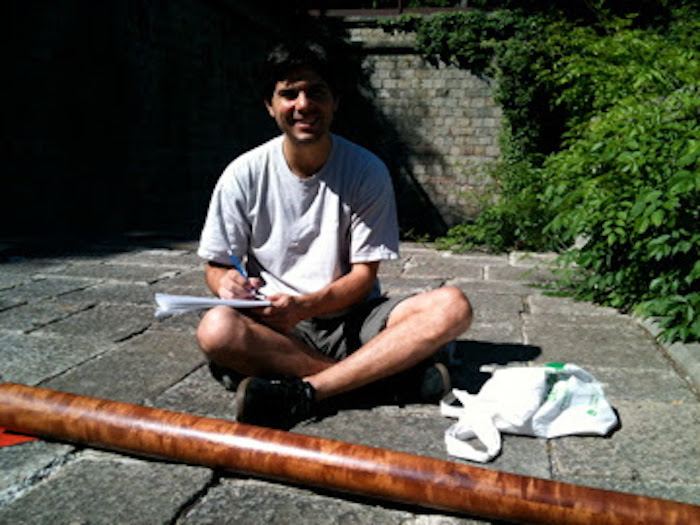
Pablo fine-tuning the didgeridoo writing
Once Pablo started to understand the instrument, he thought about a way of writing it. He then asked me to play simple rhythms so he could start writing them down. He noted the rhythmic structure using music notation, then I told him phonetically what I was saying into the instrument. All he had to do then was place each sound under each note.
During this kind of exercise, he often corrected me in Spanish-accented English: “No Gauthier, that’s not possible, you’re forgetting to tell me a sound, it doesn’t fit the rhythm.” So I’d start again, notice my mistake and correct it. The whole job was discovering how the other person saw music and learning from it.
I learnt so much thanks to this. Pablo pushed me to listen to my instrument a little more every time.
Here’s what the score looked like in the end:
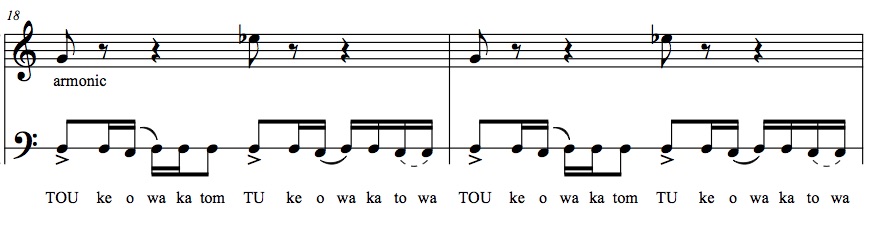
Excerpt from a didgeridoo score created for the concerto
The approach is simple and works rather well. To understand the idea behind the writing, let’s divide it into three parts, which we’ll read from bottom to top:
- The first reproduces the phrase spoken into the didgeridoo. These are classic didgeridoo onomatopoeias. It’s the same approach I used in the Wakatoo card game.
- The second part represents rhythmic notation. It may look a bit barbaric to those who don’t know music theory, but in the end it’s not very complicated (see the article on music theory)
- The third part places the overtones, the voice or the overblows. In this example, the first TOU is an overblow, noted as a G on the upper staff (the E didgeridoo I was playing had its first overblow on G).
This way of writing seemed to us the most consistent and universal for the world of music.
Didgeridoo and orchestra in concert
Months have passed since the Cancale barge. Pablo delivered the piece just in time. The timing is tight. Jean-Sébastien and I work regularly at his place so I can learn to follow his conducting gestures. It’s not easy working with a conductor when you’ve always been used to playing with your eyes closed!
I regularly mess up, I drift on the tempo. In short, it’s not in the bag.
And yet the date is here. There’s a crowd.
More than 2,000 people are there. The orchestra plays its programme and soon the didgeridoo is announced. Here we go. All those months of effort come down to this moment. The piece goes well, the audience applauds. Many seem surprised by this piece of wood with its mysterious sounds. The didgeridoo had made its mark.
We would have one more date in the Jura, then in Paris in spring 2011, and they all went well. The meeting of a didgeridoo and an orchestra never stopped intriguing the audience. Mission accomplished!
Here are two videos of the Sabounyouma concert. Sorry the didgeridoo doesn’t stand out more. Unfortunately, these are the only recordings I have of this concert.
https://www.youtube.com/watch?v=eOFS-NzXfWY&feature=emb_title
Lessons from a fruitful musical collaboration
This collaboration helped me clarify my vision of rhythm on the didgeridoo. During the same period, I was writing my didgeridoo method, and I was able to explain more simply how the various techniques fit together.
Then in 2013, if I created Wakatoo (a card game and web app to create your own didgeridoo rhythms), it was largely thanks to this work with Pablo and the orchestra.
Beyond this “technical” side, it’s also the human encounters that left their mark on me. I’m a solo didgeridoo player. I’m used to giving concerts alone on stage. I like it and it suits me. But here, there were more than 80 of us rehearsing! That’s a lot of people. A few weeks before the concert, we all took part in a residency weekend with the wind orchestra. I discovered group life. The friendly atmosphere of evenings mixing generations and cultures. It was rich, formative, full of laughter and sharing. I discovered how good it was to play in the middle of other sounds, to live among one’s own people.
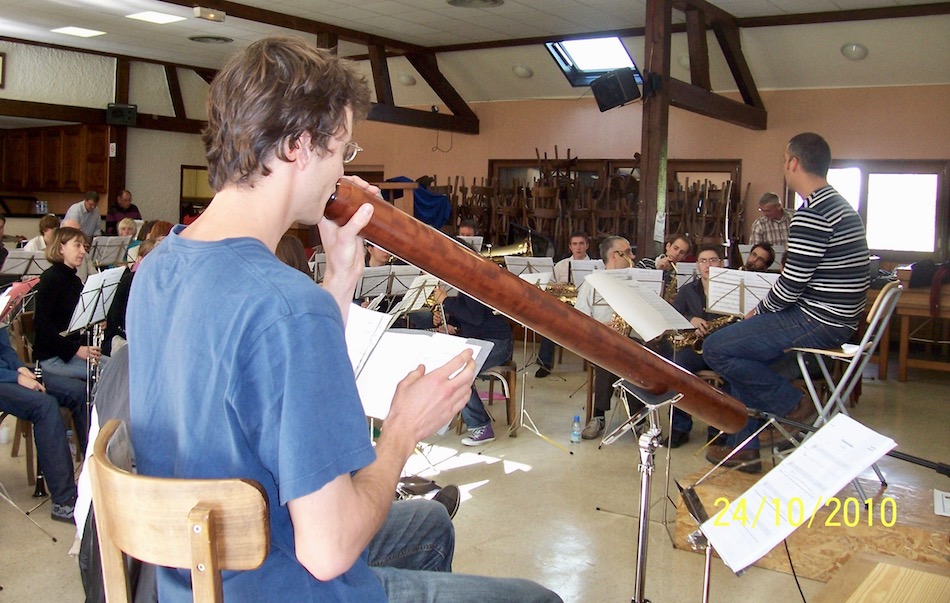
Rehearsals with Jean-Sébastien Lemaire conducting
But it wasn’t always rosy! It took quite a feat for the orchestra’s musicians to agree to play this contemporary piece. It was new to them. They were just coming out of a musical project with a rather modern approach and sometimes seemed tired of this kind of music. You should know that they’re all amateur players. They come for the love of music. They don’t have to be there. They could very well have dropped everything and said they weren’t interested. So I’m taking this article as an opportunity to express my deep gratitude to them for playing along to the very end, despite a few tensions within the group!
Conclusion: blending two approaches
This piece is a first stone, the outline of a drawing, the first notes of a concert… Of course, I hope to continue this kind of collaboration in the future. Blending the didgeridoo with classical music has a lot to offer each of these two worlds. One, intuitive, develops imagination; the other, highly structured, develops rigour. And if you look closely, at the crossroads of these two paths lies one of the secrets that governs the world: encounter. Human encounter. Long live music!
Didgeridoo friends, share, like and comment if you enjoyed the article! It’s great to get your feedback. 🙂



Leave a Reply
You must be logged in to post a comment.