



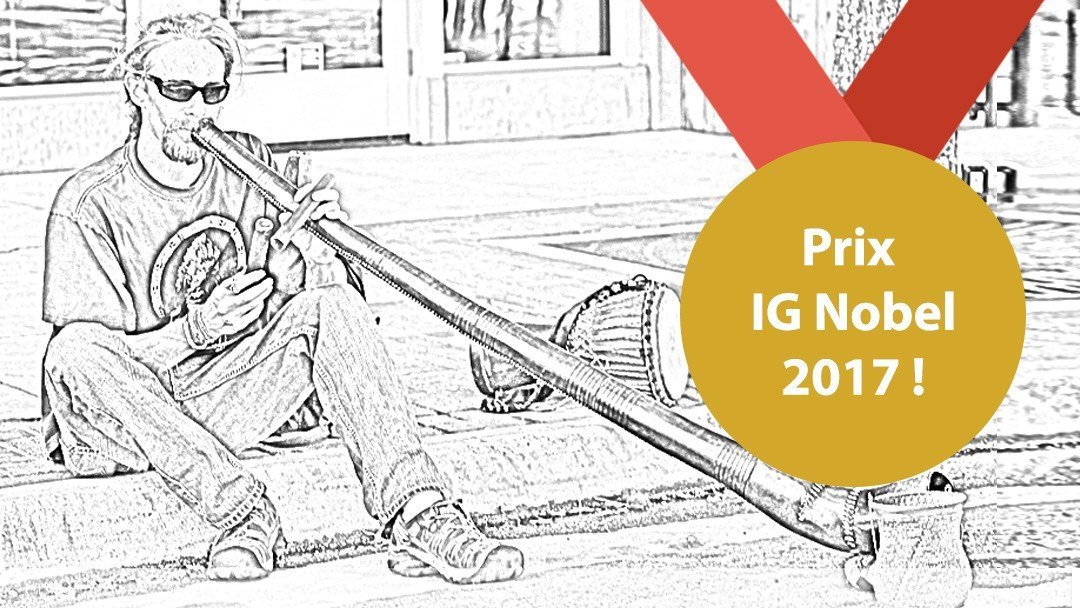
A few days ago, the didgeridoo was in the spotlight at the Ig Nobel Prize ceremony at the prestigious Harvard University. Among the researchers honoured were those from the University of Zurich, rewarded for their study on the didgeridoo and sleep apnoea published in 2006. This event, which puts the didgeridoo centre stage, is a great opportunity to come back to the increasingly popular didgeridoo / sleep apnoea duo! In the space of 10 years, this single study on the subject has travelled around the world. So let’s look back at the reasons for such success… But before that, a quick word on what the Ig Nobel Prize actually is. It looks like the Nobel Prize, but with “Ig” in front… Something to make us wonder!
The Ig Nobel Prizes
A quick look at Wikipedia sheds a bit more light on these mysterious Ig Nobel Prizes. You can pronounce it all in one word: “ignoble”… Ouch, where is this going! But don’t worry, it gets better. The prize is a parody of the official Nobel Prizes. Its aim is to highlight research that may seem absurd or wacky at first glance, but that is of real interest for the common good if you take the time to look into it. Anyone who has seen people’s faces the first time you mention the didgeridoo and sleep apnoea will understand that the didgeridoo and sleep apnoea fully deserve their place among these awards!
The prize, awarded every year, is organised by the humorous science magazine Annals of Improbable Research (AIR), and its jury includes (among others) Nobel Prize winners.
Among the studies rewarded since 1991, there was a group of researchers who apparently showed that yawning isn’t contagious in red-footed tortoises, and another on why discus throwers get dizzy while hammer throwers don’t (sources). And one last one for the road: the University of Bern wondered whether it’s better to be hit with a full bottle or an empty bottle in a fight. For your information, apparently a full bottle is better than an empty one, as it would do less damage. Yes, our dear didgeridoo finds itself among all this research! However, one thing bothers me: they received the Ig Nobel Peace Prize… Peace in the bedroom? Maybe so, after all world peace starts there, doesn’t it? But I digress, let’s get back to our good old piece of wood.
A quick reminder on the didgeridoo and sleep apnoea
I’ve already written an article on the didgeridoo and sleep apnoea (read also: Can the didgeridoo help reduce sleep apnoea?), but this prize is an opportunity to explain once again why the didgeridoo can be an asset in reducing apnoea.
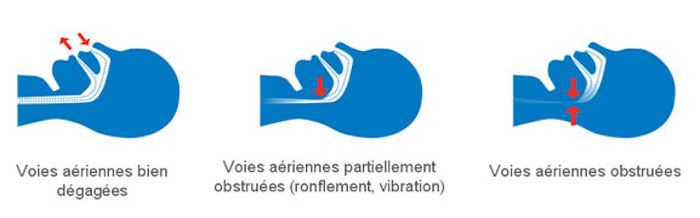
Here’s an image showing the link between the tongue and apnoea (source)
In the illustration above, you can see that the base of the tongue drops back, causing obstructive sleep apnoea. Be careful, though, because apnoea can have several sources of obstruction. For our purposes, it’s in the case illustrated above that the didgeridoo will have its effect. And the reasons are fairly simple to understand!
When playing the didgeridoo, the tongue is always involved. Whether we’re aware of it or not, we’re constantly using this organ when we blow into the tube. It keeps moving back and forth. So there’s no mystery behind the didgeridoo’s success in this area. It’s simply a fun way of retraining the tongue, a kind of musical physiotherapy.
Since 2008, I’ve had many students who came to learn because of sleep apnoea. Unfortunately, few of them were tested before and after. That said, those who were had spectacular results, dividing their number of apnoeas by 3 or 4.
When will there be other studies linking the didgeridoo and sleep apnoea?
What’s surprising in all this is that there has only been one study on the didgeridoo and sleep apnoea… Nothing else since the Zurich one. And yet, on its own, this publication got people talking all over the world. Many websites now pick up this theme and talk about the link between the didgeridoo and sleep apnoea. This enthusiasm is understandable, because the results are encouraging and help many didgeridoo players get good sleep again. But it would be worth clarifying many points. Such as simply carrying out a broader study, with more patients, to have a larger sample (the Zurich study had 25 patients). After that, it would also remain to be determined whether some didgeridoo notes are more effective than others, or whether certain tongue movements would allow faster retraining than others. In short, there’s still plenty to get stuck into for research enthusiasts!
Conclusion: the early days of a great adventure
We’re only at the beginning of this beautiful adventure bringing together the didgeridoo and sleep apnoea. And as the history of humanity shows us, some people are quick to cash in. So beware of didgeridoo teachers who sell you lessons at exorbitant prices (several hundred euros per didgeridoo lesson!) to treat your sleep apnoea. These people ride the wave of people’s ignorance and distress by positioning themselves as experts on the subject. Carefully avoiding, of course, mentioning that a lot is still unknown about it. So keep in mind that nothing replaces regular didgeridoo practice. And if you want to learn to play, the first step is to choose a didgeridoo that isn’t too expensive to start with (read also: Which didgeridoo should you choose to learn to play?). Happy blowing!



Leave a Reply
You must be logged in to post a comment.