

In Europe, and in the world in general, when we talk about the didgeridoo we’re talking about the contemporary didgeridoo (me first). Of course, if I ask you where the didgeridoo comes from, you’ll tell me from the Aboriginal people of Australia, right? And that’s where all our projections onto this little-known people begin.
Whether we admit it or not, we all have our preconceptions about Aboriginal Australians. Some still imagine them as nomads carrying spears… By the way, did you know there are accounts showing that some Aboriginal communities had houses before the English arrived?!
I have my preconceived ideas about Aboriginal Australian culture too. After all, we’re so far from Australia. We know almost nothing about their history apart from its great traumas (listen also: The dark history of Australian colonisation).
Anyway, back to the topic of this article: music and Aboriginal people… sprinkled with all our fantasies. This lovely mix would almost make us forget that Aboriginal Australians have also drawn on Western culture to express themselves.
In this article, I’d like to pay tribute to Aboriginal bands and musicians who left their mark on their time (and still do). And who knows? Maybe it’ll make you want to learn a bit more about this culture, with roots going back tens of thousands of years!
I might as well tell you straight away: I’m far from knowing Aboriginal culture as well as I know the didgeridoo. So far be it from me to pose as an expert in this field! Purists will surely forgive my slips and other inaccuracies, if there are any! Well… a large part of what I’m telling you here comes from Wikipedia, so in principle it’s fairly accurate. 😉
Right, let’s go. For those who didn’t know Aboriginal culture, we’ll start gently with a traditional group. Then will come the time for Aboriginal rock, ska and other reggae influences.
A traditional group founded by Aboriginal Australians
White Cockatoo
I’m starting this tour gently by introducing White Cockatoo, a traditional group. White Cockatoo was co-founded by David Blanasi and his close companion, the singer Djoli Laiwonga. David Blanasi is certainly the most famous Mago player (the Mago is one of the traditional names for the didgeridoo, read also: The origins of the didgeridoo: the Aborigines of Australia). In 1967, he was the first Aboriginal person to visit England since 1792…
Videos of the group are rare on the internet, I found two on YouTube. They’re old and the quality isn’t great, but they’ll give you an idea!
Aboriginal rock
Now that the introductions are done, it’s time to tell you about Aboriginal rock! Get ready to drop a few clichés about Aboriginal culture! The very Western idea that would reduce Aboriginal people to a singer, a dancer and a didgeridoo player is limited… It’s high time we also talked about the Aboriginal artists who have managed to marry their roots with Western music. The next three bands did it with rock!
Yothu Yindi
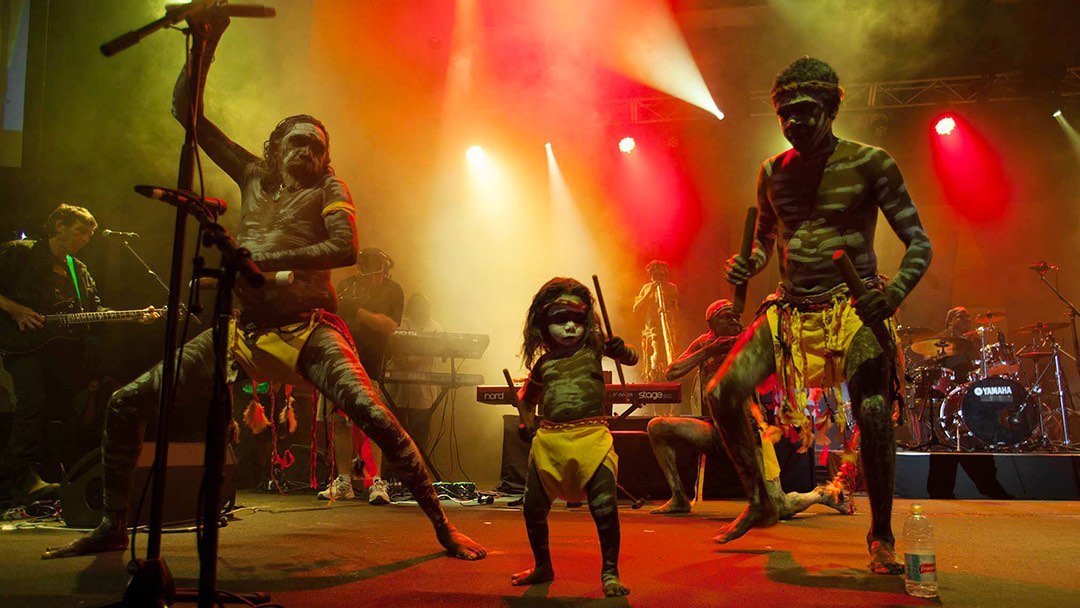
The didgeridoo, or rather the Yidaki, played by Nicky Yunupingu, is there. But what matters most is the message of Yothu Yindi and its singer, Mandawuy Yunupingu, a member of the Yolngu people from Yirrkala (a village in north-east Arnhem Land). Mandawuy Yunupingu is politically committed to the Aboriginal cause and says so loud and clear in his music.
Warumpi Band
Founded in 1980, Warumpi Band was a group influenced by Australian country and Aboriginal rock, formed in the community of Papunya (that’s where the famous Aboriginal dot painting technique was born in 1971). Originally, George Burarrwanga handled vocals and didgeridoo. Gordon Butcher was on drums. His brother, Sammy Butcher, played guitar and bass, and finally Neil Murray took care of rhythm guitar and backing vocals. The band released three albums: Big Name, No Blankets (1985), Go Bush! (1987) and Too Much Humbug (1996).
Lonely Boys
Lonely Boys also come from Arnhem Land, more precisely from the community of Ngukurr, 700 km south-east of Darwin. Their music takes its colours from punk and rock. They’re backed by the Skinnyfish label. Created in 1999 by Mark Grose and Michael Hohnen, Skinnyfish encourages, supports and distributes Aboriginal artists. I came across their website by chance while doing my research. A label worth discovering!
Aboriginal reggae / ska / pop
Us Mob
Us Mob is one of the first Aboriginal reggae rock bands, from the south of Australia. In particular, they co-recorded the music for the film “Wrong Side of the Road”. That makes them one of the first Aboriginal bands to record their music. They were nominated in 1981 at the AFI Awards (Australian Film Institute Awards) for best original film score. You won’t find a didgeridoo in Us Mob, but a bassist (Ronnie Ansell), two guitarists (Pedro Butler and Carroll Karpany, who also sings) and a drummer (Wally McArthur).
Saltwater Band
Saltwater Band comes from Galiwin’ku on Elcho Island, an island about 500 kilometres from Darwin. The band members are Yolngu too. Their music has pop, reggae and ska influences. Their first CD, Gapu Damurrun, sold more than 10,000 copies, which is apparently a record for Australia’s Northern Territory!
Aboriginal solo artists
I’ve introduced you to a few bands among dozens, even hundreds. Now let’s move on to solo artists!
Geoffrey Gurrumul Yunupingu
I have to tell you, he’s my favourite. Geoffrey (1971 – 2017) sings in the Yolngu language. He also played in Yothu Yindi (1986-1995) and in Saltwater Band. His clear voice, accompanied by his guitar, has travelled far beyond Australia’s borders. I remember hearing him on France Inter at the time. His music tells the stories of his land and is steeped in his culture. You’ll quickly realise that his voice is deeply moving, full of great sensitivity.
Archie Roach
Archie Roach was born in 1956 in Mooroopna (Victoria). A singer, songwriter and guitarist, he sings about real life and the Dreamtime of Aboriginal people. Roach first lived at the Framlingham Aboriginal mission near Warrnambool in south-west Victoria. Like many Aboriginal children of his generation, he was taken from his parents and placed with white families. After getting out of several years of living on the streets of Melbourne and Adelaide, he would turn his home into a shelter for Aboriginal children. He played with Paul Kelly, among others, and even sang as an opening act for Bob Dylan.
Kev Carmody
Kev Carmody is an Aboriginal singer born in 1946 in Cairns, Queensland. He recorded his first album, Pillars of Society, in 1987. His music sits between country and folk. From what I’ve been able to listen to online, his lyrics denounce the genocide and atrocities committed against Aboriginal people.
Christine Anu
Here we’re in a completely different style: Australian pop! Christine Anu was born in 1970 in Cairns. She is descended from Torres Strait Islanders. Her album “Come My Way” made her known in Australia. In particular with the song “Sunshine On A Rainy Day” (see the video above), which spent thirteen weeks at the top of the charts in Australia!
Let’s break our preconceptions about Aboriginal Australians!
As you’ll have noticed, we’re a long way from the clichés we might have. When I started writing this article, I was surprised to discover such great diversity. And I kept it short! For the most curious among you who’d like to discover more, I came across this Wikipedia page that lists a large number of Aboriginal artists. When you see the size of the list, you’ll quickly understand that it would be heresy to lock Aboriginal culture into a single, purely traditional musical expression.
Feel free to share the Aboriginal bands or artists you love listening to too! 🙂
Photo credit: TEABBA
Leave a Reply
You must be logged in to post a comment.